FORT WORTH, TX / ACCESS Newswire / October 9, 2026 / Vadzo Imaging, a provider of embedded vision camera products for OEMs and system integrators, today announces validation of the M12 lens-based VCM autofocus assembly on the Falcon-830CRH, an M12 Lens USB Camera built on the Onsemi HyperLux LP AR0830 sensor. Part of Vadzo's USB camera portfolio, the Falcon-830CRH pairs a standard M12 lens with a voice coil motor and validates the pair as a single assembly, giving OEMs optical flexibility without the integration risk that normally comes with it. With this validation, Vadzo delivers an AR0830 M12 Autofocus Camera whose lens, actuator, and sensor alignment have been checked together, so product teams can start from a verified optical configuration instead of building one from separate parts.
Technical Problem Definition: Why M12 Lens VCM Autofocus Assemblies Need Validation
The M12 lens is popular in embedded vision for good reasons. It is a standard format, so OEMs can choose from a very wide range of focal lengths, apertures, fields of view, and filter options from many suppliers, and they can change the lens without changing the camera. That flexibility is why so many industrial, retail, and robotics products are built around M12 optics. The usual limitation is focus. A conventional M12 camera has a threaded lens barrel that is focused once at assembly and then locked, which suits a fixed working distance and fails the moment the subject distance changes.
Autofocus modules solve that problem differently. Phone-style modules place a small fixed lens inside a voice coil motor, which moves it quickly but leaves the OEM with a single optical choice. Adding a VCM to an M12 lens is attractive because it combines focus travel with lens choice, but the combination raises integration questions that a datasheet rarely answers. The lens adds mass that the actuator must move. The barrel length and back focal distance determine whether the travel covers the focus range the application needs. The lens must sit square to the sensor because tilt softens one side of the image. An actuator can also behave differently when the camera points up, down, or sideways, since gravity acts on the moving mass.
Resolution makes the question sharper. An 8MP sensor delivers 4K detail only if the lens can resolve it. A lens designed for a lower-resolution sensor will produce images that are acceptable at the center and soft toward the corners, and the extra pixels simply record the softness. An M12 Lens VCM Assembly Camera that has been assembled from a convenient lens and a convenient actuator without being checked as a pair can look fine on a bench and disappoint in the field.
Teams that discover these problems late must revisit the optics, the mechanics, and sometimes the enclosure, all after units have been built and calibrated. The cost lands at the worst moment, when a product is nearly ready to ship.
Operating conditions add a further layer. Camera units on vehicles, robots, and drones experience vibration and temperature swings that can loosen a poorly secured lens or shift a moving mass. A lens that stays put on a lab bench may drift on a moving platform, and an actuator that settles quickly at room temperature may behave differently in a cold enclosure or a warm cabinet. Integrators therefore need evidence that the assembly was built and checked for realistic conditions, and not only a statement that the lens is compatible. Without that evidence, the cost of finding a loose or drifting lens falls on the OEM and, eventually, on its customers. Clear qualification data lets a quality team write acceptance criteria for incoming modules, such as focus repeatability and corner sharpness, so that variation is caught at the dock instead of in the field.
Engineering Explanation: M12 Lens and VCM Alignment for 4K Autofocus Imaging
The Falcon-830CRH addresses the problem by validating the lens and the actuator together. The sensor is the Onsemi HyperLux LP AR0830, an 8MP color rolling shutter device with 4K (3840 x 2160) output and HDR capability. The module carries a standard M12 lens inside a VCM assembly and delivers frames over USB 3.2 Gen 1. Rather than shipping a bare camera board and a loose lens, Vadzo qualifies specific lens options for the assembly and checks them as an M12 VCM Autofocus USB Camera, so the focus range, the image quality, and the mechanical behavior are known before an OEM begins integration.
Validation covers the properties that decide whether the pair works. Vadzo checks that the actuator can move the qualified lens across its full travel and return to the same position repeatedly. It checks sharpness at the center and toward the corners at near and far focus, because a lens that is sharp in the middle can still fall short at the edges of an 8MP image. It checks the assembly in different orientations, since the weight of the lens can shift the focus position when the camera points up or down. It also checks that the lens sits square to the sensor because small tilt errors show up as one-sided softness.
Interchangeability has limits, and Vadzo states them plainly. Not every M12 lens fits a VCM assembly. Mass, barrel length, back focal distance, and the optical resolution of the lens all matter. OEMs who need a different field of view can evaluate other M12 lenses against those limits, and Vadzo supports that evaluation. Some lenses will work well, some will need adjustment, and some will not suit the actuator at all. A module sold as an M12 Lens VCM Autofocus Camera should make that boundary clear, and Vadzo prefers to tell integrators where it lies rather than let them find it after production starts.
Connectivity follows standard practice. The module is a UVC-compliant device on USB 3.2 Gen 1, so common host software can open it without a custom driver. Where the host software exposes standard UVC focus controls, it can read and set the focus position, and Vadzo documents what the module supports so teams can confirm the behavior they need. HDR operates alongside autofocus, so a scene that mixes bright and dark areas still reaches the host in a single frame. Lens details such as infrared cut filtering, coatings, and aperture are part of the choice too, and Vadzo advises teams to decide them early because they affect color rendering, low-light behavior, and depth of field alongside focus.
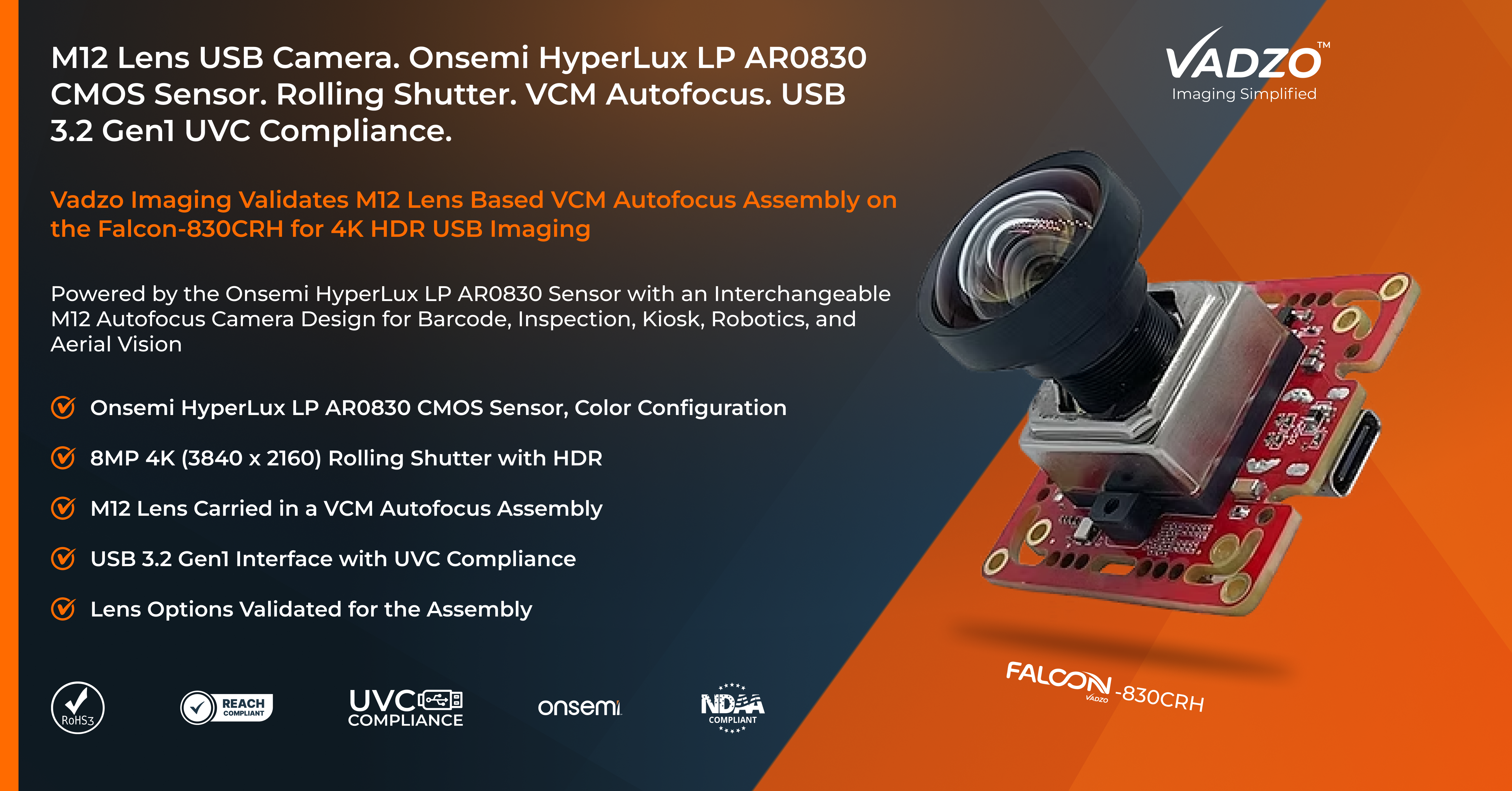
Falcon-830CRH: AR0830 M12 Autofocus Camera for 4K Imaging
The Falcon-830CRH is an M12 Lens USB Camera built on the Onsemi HyperLux LP AR0830 sensor and validated for M12 lens-based VCM autofocus. As an AR0830 M12 VCM USB Camera, it is designed for OEMs who want optical choice and automatic focus in the same module. The Onsemi AR0830 M12 Lens Sensor designation reflects the pairing of the sensor with a qualified M12 lens inside the autofocus assembly. The module houses the sensor, ISP, VCM actuator, and USB 3.2 Gen 1 controller in a compact body. As an AR0830 M12 HDR Autofocus Module, it outputs 4K video with HDR active, and the AR0830 VCM Autofocus USB Sensor designation confirms that autofocus remains available in each supported mode. As an AR0830 M12 Lens Module, the camera enumerates as a standard UVC device on Windows, Linux, and Android, so evaluation and integration need no proprietary driver.
Key specs: 8MP 4K (3840 x 2160) Max Resolution | Onsemi HyperLux LP AR0830 Sensor | Color with Rolling Shutter | HDR | USB 3.2 Gen 1 UVC Interface | M12 Standard (S-Mount) with VCM Autofocus
Key Capabilities of the Onsemi HyperLux LP AR0830 M12 VCM Autofocus Camera
Interchangeable M12 Optics for Autofocus Camera Systems
Optical choice is the main reason OEMs select the M12 format. As an Interchangeable M12 Autofocus Camera, the Falcon-830CRH lets a product team match the field of view to the application, whether that is a narrow view of a barcode, a medium view of a kiosk user, or a wide view of a work cell. Vadzo qualifies lens options for the assembly and documents the limits that apply, so a team can pick a lens with confidence and know what to check if it wants a different one. This gives an OEM a family of products from one module without redesigning the optics for each variant. Distributors and system integrators who serve several customers benefit in the same way, since one stocked module can address barcode, kiosk, and inspection projects with different lenses.
M12 Lens VCM Autofocus Assembly Validated as One System
A lens and an actuator that work separately may not work together. Vadzo validates the assembly as one system by checking travel, repeatability, sharpness across the image, orientation behavior, and alignment to the sensor. These checks reflect how the camera will be used, including mounting that points down at a table or up at a ceiling. The result is an assembly whose focus behavior is known before it reaches an OEM, which shortens integration and reduces the chance of optical surprises late in a program. Teams that document the validated lens and focus settings in their own records also find later audits and service visits simpler, since the optical configuration is already described.
4K Detail from an 8MP AR0830 M12 VCM Autofocus Camera
Eight megapixels deliver 4K detail only when the lens can resolve it. As an 8MP M12 Autofocus USB Camera, the module pairs the sensor with lens options chosen for that resolution, so detail holds toward the corners and at both ends of the focus range. Available as a 4K M12 Lens Autofocus USB Module, it joins Vadzo's 4K Autofocus Camera Module range, which gives integrators related options when a project needs a different interface or format. The 4K M12 VCM Autofocus Camera approach also helps when software crops into the image, since a sharp lens leaves room to digitally zoom without losing usable detail. Software that reads small print or fine patterns benefits most from this headroom.
8MP M12 HDR Autofocus Camera for 4K Imaging
Real scenes mix bright and dark areas, such as a bright window behind a kiosk user or a glossy label beside a dark housing. As an 8MP M12 Lens HDR Camera, the module combines multiple exposures into one frame so highlight and shadow detail both reach the host. As a 4K M12 HDR USB Camera, it delivers that HDR frame at full resolution, with autofocus working alongside it. The two features address separate problems: focus for changing distance and HDR for changing brightness, and the module is validated with both active. Teams can therefore evaluate focus and HDR together on their own scenes and judge the combined result instead of two separate specifications.
M12 Lens Selection Matched to Application Requirements
Different applications need different optics. A close barcode scanner wants a short working distance and a narrow field. A robot wants a wider view. A drone wants distance and stability. The Falcon-830CRH, positioned for optical choice, lets OEMs choose a lens for the job while keeping the same electronics, driver, and mounting approach. Vadzo helps with lens selection by working from the required field of view, the working distance range, and the smallest detail the software must resolve, which are the three numbers that decide most optical choices. Teams that supply those numbers early usually reach a suitable lens in one evaluation round, whereas teams that begin with a lens and look for a use often need several.
USB 3.2 M12 VCM Autofocus Kit and OEM Integration
The Falcon-830CRH connects to any USB 3.2 Gen 1 host port on Windows, Linux, or Android and enumerates as a standard UVC device. A USB 3.2 M12 Autofocus Kit is available for evaluation, along with a VCM Autofocus M12 Sensor Kit for teams that want to test several lens options on the same electronics. For OEMs reviewing Vadzo as an OEM M12 VCM Autofocus Module supplier, lens matching, firmware customization, and enclosure design support are available alongside the hardware. Vadzo's role as an M12 Autofocus Camera Supplier includes lens guidance, and its record as an M12 Autofocus Camera Manufacturer covers production programs across several sensor families and interface types. The same M12 Lens VCM Autofocus Camera platform serves prototypes and production, and a UVC M12 Autofocus Camera needs no custom host driver. Engineering teams can start software development on a development unit and carry the same code to production hardware.
"OEMs choose the M12 format because they want a say in the optics, and they want autofocus because their subjects do not stay at one distance. The trouble is that those two wishes pull against each other in the mechanics. The lens adds mass, the travel has to cover the range, and the optics have to resolve what an 8MP sensor can see. The Falcon-830CRH was validated to settle those questions before an OEM must. We qualify the lens options, check the assembly as one system, and are direct about where interchangeability ends. That lets customers choose optics with confidence and gets their products to market sooner." - Alwin Vincent, Product Manager, Vadzo Imaging.
AR0830 8MP M12 Autofocus USB Camera Applications
M12 Autofocus USB Camera for Barcode Scanning and Document Capture
Scanning stations read codes and documents at a range of distances, and fixed focus either blurs near items or limits the working range. The Falcon-830CRH works as an M12 Autofocus Barcode USB Camera with a lens chosen for the scan area, and its use as an M12 Autofocus Document Scan Camera extends to flat documents held at varying heights. Retail checkout, parcel handling, and ticket validation all benefit from reading codes quickly without asking the user to hold an item at one precise distance. Throughput improves because operators spend less time positioning items and more time moving them along.
M12 Autofocus Camera for Inspection at Variable Working Distances
Inspection stations often handle parts of different heights, and refocusing by hand for each product wastes time. The module serves as an M12 Autofocus Inspection Camera that refocuses as part height changes, and its role as an M12 Lens Machine Vision USB device lets integrators choose a lens for the field of view each product needs. Changeovers between part types become faster because the focus adjusts instead of a technician. Inspection recipes can store a lens and focus approach per product, which keeps the setup repeatable across shifts.
M12 VCM Autofocus Camera for Robotics and Embedded Vision
Robots approach objects at changing distances, and embedded vision platforms often run on compact hosts with USB ports. The Falcon-830CRH functions as an M12 VCM Robotics USB Camera that keeps targets sharp as an arm or vehicle closes in, and as an M12 VCM Embedded Vision Camera for compact hosts that need a standard interface. A team can choose a wider lens for navigation or a narrower lens for manipulation while keeping the same electronics and driver. Robots that perform both navigation and close manipulation can pair two modules with different lenses and still share one software stack.
M12 Autofocus Camera for Kiosk and Self-Service Systems
Kiosk users step forward, lean in, or hold up an identity document, so the distance to the camera changes during one interaction. The module works as an M12 Autofocus Kiosk Camera that keeps the face or document sharp across that range, and the choice of lens lets the kiosk designer set the field of view to match the enclosure. HDR helps when the kiosk faces a bright entrance. Kiosk makers can also keep one camera module across product lines and change only the lens for each enclosure.
M12 Autofocus USB Camera for Aerial Imaging Platforms
Aerial platforms change altitude and subject distance continuously, and a payload focused at one range returns soft images at another. The Falcon-830CRH can serve as an M12 Autofocus Drone USB Camera for aerial surveillance and inspection payloads, with a lens selected for the altitude and coverage the mission requires. The USB connection suits payload computers that need a standard interface, and the module should be checked against the payload weight and vibration limits of each airframe. Mission planners can also pair different lenses with different sorties, such as a wide lens for area coverage and a narrower lens for close inspection.
Frequently Asked Questions
Q: What makes an M12 VCM Autofocus USB Camera different from a fixed focus camera?
A: Vadzo Imaging designs this type of camera so the lens can move and the focus can follow the subject, instead of being set once at assembly and locked. A voice coil motor moves the M12 lens quickly and precisely, which suits applications where the working distance changes. Vadzo Imaging validates the lens and actuator together so the focus behavior is known before integration begins. This is especially useful when a product must work well at several distances without any manual adjustment by the user.
Q: Can an Interchangeable M12 Autofocus Camera accept any M12 lens?
A: Not every M12 lens suits a voice coil motor assembly. Lens mass, barrel length, back focal distance, and optical resolution all matter. Vadzo Imaging qualifies lens options for its assemblies and supports OEMs who want to evaluate a different lens against those limits. Vadzo Imaging prefers to state the boundaries clearly so teams do not find them after production begins.
Q: How should an OEM choose a lens for an 8MP M12 Autofocus USB Camera?
A: Start with three numbers: the field of view the application needs, the range of working distances, and the smallest detail the software must resolve. Then confirm that the lens is rated to resolve at least the detail an 8MP sensor can record, since a lower resolution lens leaves pixels wasted. Vadzo Imaging helps teams work through those numbers and recommends testing the chosen lens at near and far focus.
Q: Does a UVC M12 Autofocus Camera need a custom driver?
A: No. A UVC-compliant camera opens as a standard video device on common operating systems, so software can acquire video without a proprietary driver. Where the host software exposes standard UVC focus controls, it can also read and set focus. Vadzo Imaging documents which controls each module supports so teams can confirm the behavior their application needs.
Q: Why should OEMs choose Vadzo Imaging as their M12 Autofocus Camera Supplier?
A: Vadzo Imaging offers more than a camera module built around a capable sensor. OEMs working with Vadzo Imaging receive an assembly whose lens and actuator were validated together, along with honest guidance on where lens interchangeability ends and engineering support for lens selection, firmware customization, and enclosure design. Vadzo Imaging maintains evaluation kits with no minimum order requirement, so teams can test several lenses on their own subjects before committing to volume production. That combination of validated optics and low evaluation barriers is why OEMs continue to choose Vadzo Imaging for autofocus camera programs.
Availability
The Falcon-830CRH M12 Lens USB Camera built on the Onsemi HyperLux LP AR0830 sensor is available now for evaluation and production orders. Evaluation kits include the camera module, a qualified M12 lens, a USB 3.2 Gen 1 cable, and platform driver documentation, with no minimum order requirement. Engineering teams can test focus travel, corner sharpness, and orientation behavior on their own subjects before committing to a production bill of materials, which tells them more than a datasheet comparison alone. Teams that want a different field of view can ask Vadzo to review an alternative M12 lens against the assembly limits. Browse the full range of autofocus camera options at Vadzo's website or contact Vadzo at support@vadzoimaging.com to request an evaluation unit or discuss OEM integration requirements for scanning, inspection, kiosk, robotics, and aerial camera programs.
About Vadzo Imaging
Vadzo Imaging is a global provider of embedded vision solutions and delivers high-performance camera technologies and imaging platforms for applications in robotics, industrial automation, UAVs, edge AI, and medical systems. Its products are designed for seamless integration with leading embedded platforms. Vadzo supports customers through hardware customization, firmware development, and module-level drivers, enabling faster development and deployment of vision-based systems across USB, MIPI, GigE, Wi-Fi, and SerDes camera interfaces.
Media Contact
Alwin Vincent
Vadzo Imaging
Email: alwin@vadzoimaging.com
LinkedIn: Vadzo Imaging
YouTube: Vadzo Imaging
X: Vadzo Imaging
SOURCE: Vadzo Imaging
View the original press release on ACCESS Newswire