Global shrimp demand is rising due to canned seafood growth, retail convenience, traceable supply chains, and expanding foodservice consumption worldwide.
NEWARK, DE / ACCESS Newswire / May 14, 2026 / NEWARK, DE / May 14, 2026 / According to the latest market analysis by Future Market Insights, the global shrimp market is entering a new phase of growth driven by rising demand for shelf-stable seafood products, expanding cold-chain infrastructure, and increasing consumer preference for convenient protein options across retail and foodservice channels.
The market is evolving from a traditional seafood commodity category into a more value-added and traceable protein segment supported by processing innovation, export-driven supply chains, and growing demand for ready-to-cook and longer shelf-life seafood formats.
Quick Stats Snapshot
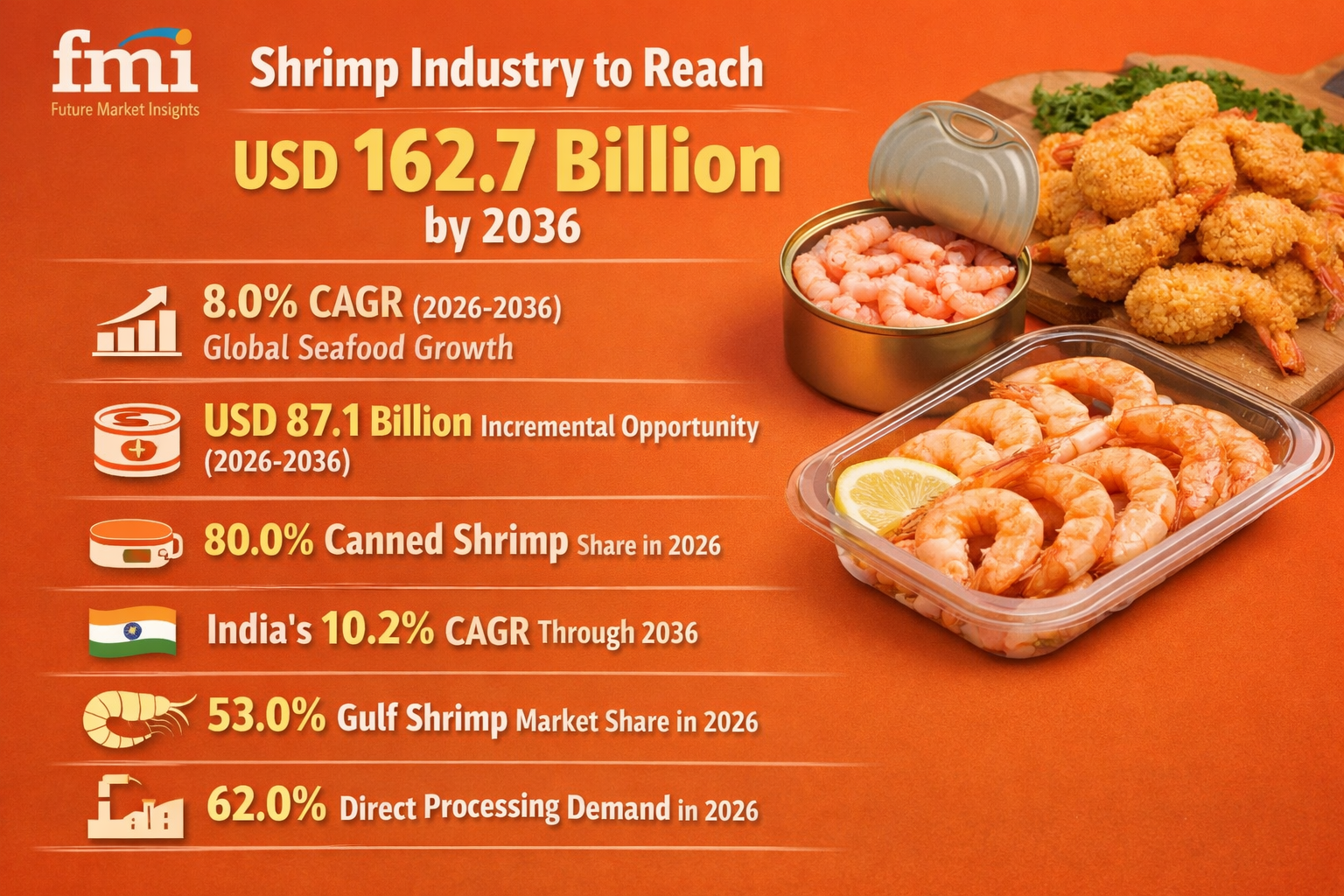
Global market CAGR (2026-2036): 8.0%
Market value in 2025: USD 70.0 billion
Market value in 2026: USD 75.6 billion
Forecast market value by 2036: USD 162.7 billion
Top growth market: India (10.2% CAGR)
Fast-growing market: United Kingdom (9.2% CAGR)
Leading form segment: Canned Shrimp (80.0% share)
Dominant species segment: Gulf Shrimps (53.0% share)
Leading source segment: Conventional Shrimp (86.0% share)
Leading processing method: Direct Processing (62.0% share)
Get detailed market forecasts, competitive benchmarking, and regional insights: https://www.futuremarketinsights.com/reports/sample/rep-gb-1838
Market Outlook: Convenience Seafood Formats Support Long-Term Expansion
The shrimp market is projected to witness strong growth through 2036 as retailers, foodservice chains, and households increasingly prioritize convenient, shelf-stable, and traceable seafood products.
Canned shrimp continues to lead market demand due to longer shelf life, reduced spoilage risk, and strong compatibility with supermarket and export distribution systems. Meanwhile, cooked, peeled, and ready-to-use shrimp products are gaining traction as consumers seek simplified meal preparation and portion-controlled protein formats.
The category is increasingly recognized as a strategic seafood segment serving household nutrition, restaurant applications, prepared meals, and global seafood trade simultaneously.
Growth Drivers: Retail Convenience and Export Processing Fuel Expansion
Several structural factors are accelerating market growth:
1. Rising Demand for Shelf-Stable Seafood
Retailers continue expanding canned and frozen seafood assortments as longer storage life helps reduce wastage and improve inventory planning.
2. Expansion of Value-Added Processing
Exporters are increasingly moving toward cooked, canned, peeled, and portioned shrimp formats to protect margins against raw commodity pricing pressure.
3. Growth in Foodservice Consumption
Restaurants and prepared meal providers continue using shrimp as a quick-cook protein compatible with casual dining, frozen meals, and ready-to-eat applications.
4. Increasing Traceability and Quality Requirements
Global buyers are placing greater emphasis on cold-chain management, residue testing, and documented farm-to-pack handling systems.
Key Challenges: Disease Management and Pricing Pressure Remain Critical
Despite strong growth prospects, the industry continues to face several operational challenges:
Disease outbreaks affecting pond productivity and survival rates
Feed cost volatility impacting aquaculture margins
Import price pressure in major seafood markets
Rising compliance and traceability requirements
Dependence on export demand and international trade conditions
Processors capable of maintaining cold-chain discipline, supply consistency, and verified quality standards are expected to strengthen their competitive position.
Emerging Opportunities: Processed and Retail-Ready Seafood Expansion
Key opportunities are centered around convenience, traceability, and processing innovation:
Expansion of canned and cooked shrimp formats
Growth in ready-to-cook seafood products
Increasing retail demand for low-waste seafood packaging
Rising value of farm-to-pack traceability systems
Growing penetration of prepared seafood meal categories
Segmentation Insights: Canned Shrimp Leads Market Demand
By Form
Canned shrimp is expected to lead the market with an 80.0% share in 2026, supported by longer shelf life, lower spoilage risk, and strong retail compatibility.
By Species
Gulf shrimps are projected to account for 53.0% of species demand in 2026 as premium seafood buyers continue to favor texture consistency and origin identity.
By Source
Conventional shrimp is anticipated to represent 86.0% of source demand in 2026 due to limited organic aquaculture supply and broader price accessibility.
By Processing Method
Direct processing is projected to dominate with a 62.0% share, reflecting exporter preference for simplified handling and stronger quality control.
By Application
Food applications are expected to account for 82.0% of demand in 2026 as shrimp remains primarily positioned as a meal protein across retail and foodservice sectors.
Customize insights for your business strategy: https://www.futuremarketinsights.com/customization-available/rep-gb-1838
Regional Analysis: India and China Lead Global Growth Momentum
India (10.2% CAGR)
Growth is driven by large-scale export processing, expanding whiteleg shrimp farming, and strong buyer relationships with the United States and China.
United Kingdom (9.2% CAGR)
The United Kingdom is witnessing rising demand for chilled prepared meals, ready-to-eat seafood products, and imported shrimp-based convenience foods.
China (7.2% CAGR)
China remains one of the world's largest shrimp import markets, supported by broad restaurant demand and growing household seafood consumption.
United States (6.5% CAGR)
The United States continues to serve as a high-value import destination where retail and restaurant channels maintain strong shrimp demand.
Germany (5.4% CAGR)
Germany's market remains supported by frozen seafood retailing, discounter demand, and strict food safety and traceability standards.
Japan (5.8% CAGR)
Japan continues to emphasize premium-quality imports, compact retail seafood formats, and consistent food safety performance.
South Asia and export-oriented seafood economies are expected to outperform mature seafood markets due to processing scale, retail expansion, and rising global protein demand.
Competitive Landscape: Traceability and Processing Scale Shape Competition
The shrimp market remains moderately fragmented, with integrated seafood processors, regional exporters, and branded seafood suppliers competing across global trade networks.
Key companies include:
Charoen Pokphand Foods
Thai Union Group
Nissui Corporation
Minh Phu Seafood Corporation
Nueva Pescanova Group
Seajoy Group
Devi Sea Foods Limited
Leading companies continue strengthening market position through vertical integration, aquaculture investments, sustainability initiatives, and retail-ready seafood product expansion.
Strategic Implications for Industry Leaders
For seafood processors, exporters, retailers, and foodservice suppliers, the market presents several strategic priorities:
Canned shrimp remains the dominant value contributor
Traceability is becoming essential for retail shelf access
Value-added processing improves margin stability
Export diversification reduces pricing risk exposure
Cold-chain management is critical for buyer confidence
Future Outlook: From Commodity Seafood to Value-Added Protein Solutions
The shrimp market is expected to evolve beyond conventional frozen seafood exports into a broader convenience protein ecosystem focused on processing efficiency, shelf stability, and verified sourcing.
Key trends expected to shape the market include:
Expansion of cooked and ready-to-use shrimp formats
Growth in traceable and sustainability-focused seafood supply
Rising adoption of prepared seafood meal solutions
Greater investment in cold-chain infrastructure
Increasing focus on export-grade quality assurance systems
Unlock 360° insights for strategic planning and investment decisions: https://www.futuremarketinsights.com/checkout/1838
Executive Takeaways
Canned shrimp continues to dominate due to longer shelf life and retail efficiency
Gulf shrimps maintain premium positioning in global seafood channels
Food applications remain the primary demand driver
India and the United Kingdom are leading growth momentum globally
Traceability and quality documentation are becoming key competitive differentiators
Processed and retail-ready shrimp formats are creating new value opportunities
As seafood consumption patterns continue to evolve, companies capable of combining processing efficiency, supply reliability, traceable sourcing, and retail-ready innovation will be best positioned to capitalize on long-term shrimp market expansion.
Related Reports:
Shrimp Market Share Analysis: https://www.futuremarketinsights.com/reports/shrimp-market-share-analysis
UK Shrimp Market: https://www.futuremarketinsights.com/reports/united-kingdom-shrimp-market
USA Shrimp Market: https://www.futuremarketinsights.com/reports/united-states-shrimp-market
Japan Shrimp Market: https://www.futuremarketinsights.com/reports/demand-and-trends-analysis-of-shrimp-in-japan
Plant-Based Shrimp Market: https://www.futuremarketinsights.com/reports/plantbased-shrimp-market
About Future Market Insights (FMI)
Future Market Insights (FMI) is a leading provider of market intelligence and consulting services, serving clients in over 150 countries. Headquartered in Delaware, USA, with a global delivery center in India and offices in the UK and UAE, FMI delivers actionable insights to businesses across industries including automotive, technology, consumer products, manufacturing, energy, and chemicals.
An ESOMAR-certified research organization, FMI provides custom and syndicated market reports and consulting services, supporting both Fortune 1,000 companies and SMEs. Its team of 300+ experienced analysts ensures credible, data-driven insights to help clients navigate global markets and identify growth opportunities.
For Press & Corporate Inquiries:
Rahul Singh
AVP - Marketing and Growth Strategy
Future Market Insights, Inc.
+91 8600020075
For Sales - sales@futuremarketinsights.com
For Media - Rahul.singh@futuremarketinsights.com
For web - https://www.futuremarketinsights.com/
For Web - https://www.factmr.com/
SOURCE: Future Market Insights, Inc.
View the original press release on ACCESS Newswire