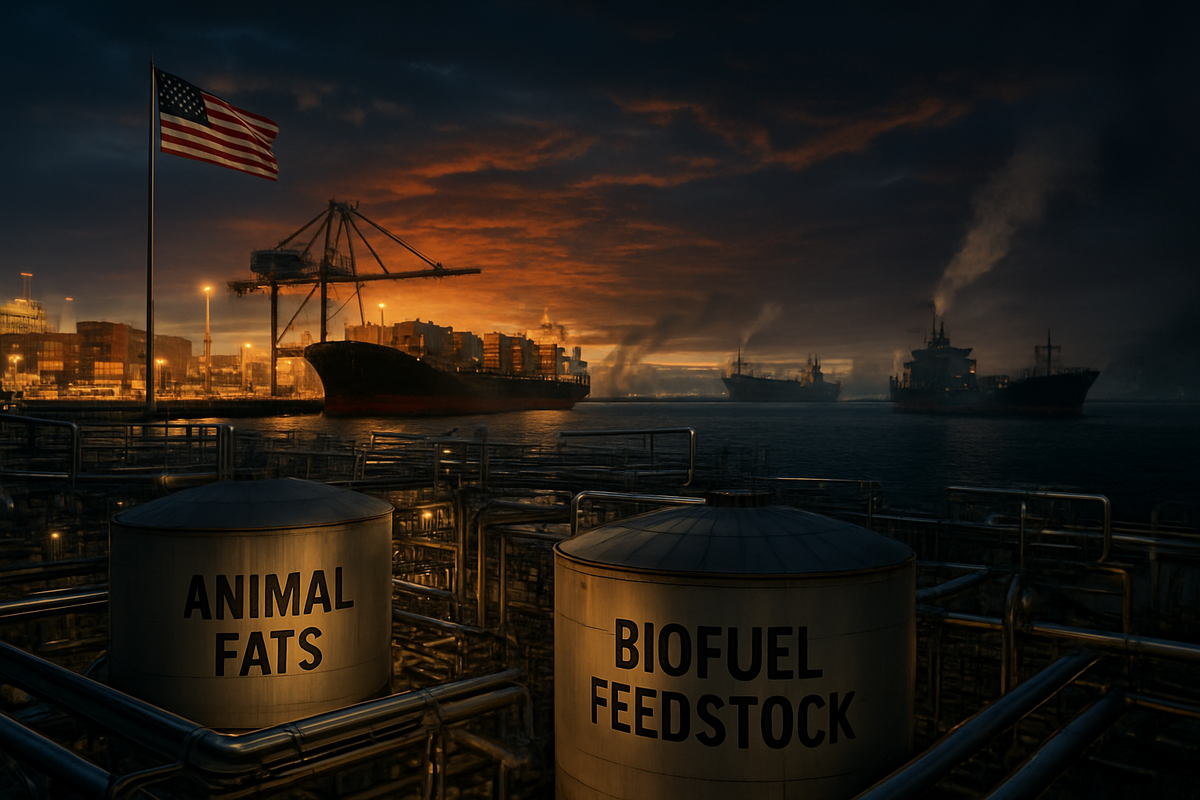
As 2025 draws to a close, the global trade of animal-derived feedstocks—once a niche corner of the agricultural world—has become a central battleground in a burgeoning "Green Trade War." The transition to a new era of US energy policy, punctuated by the implementation of the Section 45Z Clean Fuel Production Credit on January 1, 2025, and the subsequent "One Big Beautiful Bill Act" (OBBBA) in July, has effectively dismantled the globalized market for tallow and waste fats. What was once a fluid international commodity flow has fractured into regional blocs, leaving refiners and traders scrambling to secure domestic supply while facing a wall of protectionist tariffs.
The immediate implications are stark: a two-tiered pricing system has emerged where North American tallow and poultry fat command a massive premium over foreign alternatives. For the renewable diesel and Sustainable Aviation Fuel (SAF) industries, the shift represents a fundamental change in the cost of decarbonization. While the policy was designed to bolster domestic energy security and support American farmers, it has triggered retaliatory trade measures and a volatile period of adjustment for some of the world’s largest energy and agribusiness firms.
The Death of the "Carbon-Blind" Subsidy
The disruption began in earnest with the expiration of the $1.00-per-gallon Blenders Tax Credit (BTC) at the end of 2024. For years, the BTC acted as a "carbon-blind" incentive, rewarding the blending of renewable fuel regardless of where the feedstock originated. This allowed US refiners to import vast quantities of cheap tallow from Brazil and used cooking oil (UCO) from China. However, the 45Z credit that replaced it is a producer-based credit tied strictly to carbon intensity (CI) and, as of the July 2025 OBBBA legislation, domestic sourcing requirements.
The timeline of 2025 has been a series of shocks to the system. In January, the Department of Energy released the 45ZCF-GREET model, which conspicuously lacked pathways for imported waste fats, effectively rendering them ineligible for the highest tiers of the tax credit. This was followed in August 2025 by a crushing 50% tariff on Brazilian tallow, a move that targeted the world’s largest exporter of animal fats. By October, the US administration escalated tensions further by threatening a total blockade of Chinese UCO imports in response to lagging US soybean purchases by Beijing. These moves have forced a radical re-routing of global trade, with Brazilian and Australian tallow now flooding European and South American markets at steep discounts while US prices remain elevated.
Winners and Losers in the New Feedstock Order
The fallout from these policy shifts has created a clear divide among market participants. Darling Ingredients (NYSE: DAR), the world’s largest renderer, has found itself in a complex position. While the company’s net income plunged 84% in the second quarter of 2025 due to the chaotic transition away from the BTC, it has since begun to stabilize. As a dominant domestic collector of animal fats, Darling stands to benefit long-term from the "North America-first" policy, which effectively eliminates foreign competition and allows the company to command higher margins for its low-CI feedstocks.
Conversely, major refiners heavily invested in renewable diesel have faced significant headwinds. Valero Energy Corporation (NYSE: VLO) reported operating losses in its renewable diesel segment, Diamond Green Diesel (DGD), for both Q2 and Q3 of 2025. The losses were attributed to the narrowing margins between high domestic feedstock costs and the credits available under the new 45Z regime. Meanwhile, Neste Oyj (HEL: NESTE) has shown relative resilience by pivoting its focus toward the European market and the burgeoning global SAF sector. By avoiding the direct brunt of US domestic sourcing requirements and leveraging its global collection network to supply European mandates, Neste saw its stock price surge nearly 10% in mid-2025, contrasting sharply with its US-centric peers.
Domestic agricultural giants like Archer-Daniels-Midland Company (NYSE: ADM) and Bunge Global SA (NYSE: BG) have emerged as strategic winners. The exclusion of foreign fats has revitalized the demand for domestic soybean oil and other vegetable oils as "gap-fillers" in the renewable fuel pool. These companies have benefited from the renewed importance of their domestic crushing infrastructure, which now serves as a critical link in a protected North American energy supply chain.
Protectionism vs. Decarbonization: The Wider Significance
The disruption in the tallow trade is more than just a commodity story; it is a preview of the "Green Trade War" that many analysts expect to define the late 2020s. This event marks a pivot from "decarbonization at any cost" to "decarbonization through domestic industrial policy." By restricting tax credits to domestic feedstocks, the US government has prioritized rural economic development and energy independence over the fastest possible reduction in carbon emissions.
This shift has significant ripple effects on global trade partners. Brazil, previously the primary supplier of tallow to the US, has been forced to integrate its tallow supply into its own domestic biodiesel mandates and export more heavily to Argentina and the EU. This fragmentation has led to a "bifurcated market" where the environmental benefits of waste fats are being traded off against geopolitical alignment. Furthermore, the increased scrutiny on feedstock traceability—driven by fears of "fraudulent" UCO containing virgin palm oil—has led to a new regulatory burden that favors large, vertically integrated domestic players over smaller, international traders.
Looking Ahead: The 2026 Outlook and Strategic Pivots
As we look toward 2026, the market is entering a phase of "strategic adaptation." Renewable diesel producers are expected to invest heavily in "cover crops" like camelina and carinata, which can be grown domestically during the off-season and offer extremely low CI scores under the 45Z model. These crops represent the next frontier for companies like Chevron Corporation (NYSE: CVX) and Bunge Global SA (NYSE: BG), who are already forming joint ventures to secure these future feedstocks.
In the short term, the industry will likely see a surge in "duty drawback" activity. Some refiners are already importing tariffed foreign tallow to produce SAF, which they then export to Europe to recoup the import duties. This "export-to-recoup" strategy may provide a temporary relief valve for global supply gluts, but it does little to solve the long-term domestic supply crunch. The market should also watch for potential retaliatory tariffs from the EU or China, which could further complicate the global flow of biofuels and their precursors.
A New Reality for Green Commodities
The events of 2025 have fundamentally rewired the global tallow trade. The transition from the BTC to the 45Z credit has proven that in the modern energy economy, the "carbon intensity" of a fuel is only as valuable as the "geopolitical intensity" of its feedstock. The era of cheap, globally sourced waste fats for US fuel production is over, replaced by a more expensive, more secure, and highly regulated domestic supply chain.
For investors, the coming months will require a close eye on the Treasury Department's ongoing guidance updates for 45Z and the potential for new trade barriers. The primary takeaway is that the "liquid gold" of the energy transition—animal fats and used oils—is no longer a commodity that follows the path of least resistance. Instead, it follows the path of most policy support. Companies that control domestic collection and those that can successfully navigate the complex CI-modeling requirements will be the ones to watch as the market moves into a more protectionist 2026.
This content is intended for informational purposes only and is not financial advice.