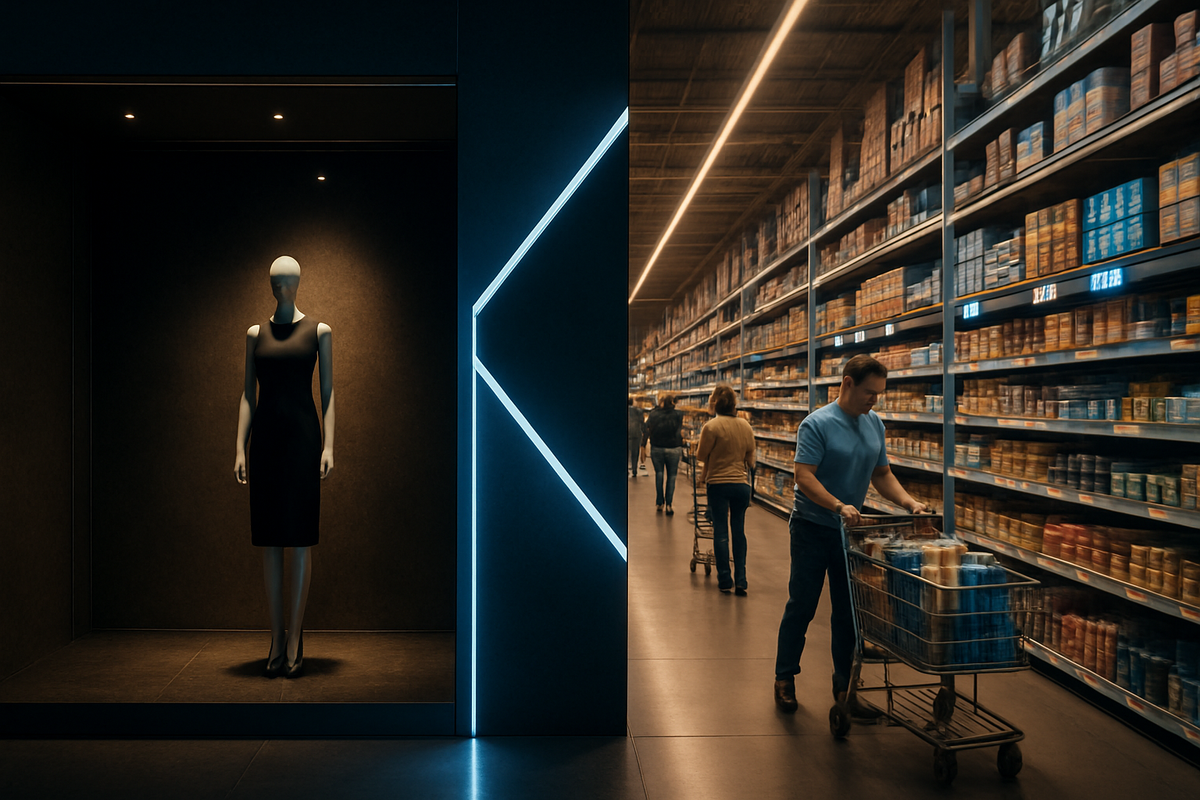
As the first two weeks of 2026 draw to a close, a stark divergence has emerged in the global equity markets, revealing a "K-shaped" reality for the retail sector. While the broader indices have remained relatively flat following the Federal Reserve’s decision to pause interest rate adjustments this January, a dramatic split is occurring between "value-conscious" consumer staples and "ultra-luxury" discretionary stocks. This rift highlights a shifting economic landscape where the middle-class consumer is increasingly sidelined, forcing retail investors to recalibrate their portfolios toward the extreme ends of the spending spectrum.
The immediate implications are clear: the "squeezed middle" is no longer a safe haven. Companies that fail to provide either absolute price leadership or peerless brand prestige are seeing their valuations compressed. With inflation lingering at a stubborn 2.7% and borrowing costs remaining "higher-for-longer," the market is rewarding "fortress" balance sheets and companies that can navigate a bifurcated consumer base that is simultaneously hunting for grocery bargains and five-figure handbags.
The divergence began to crystallize in late 2025 as holiday spending data trickled in, showing a surprising trend: luxury "aspirational" buyers—those who typically splurge on entry-level designer goods—had significantly pulled back. Conversely, ultra-high-net-worth individuals continued to spend with near-total immunity to economic headwinds. By the time the markets opened in January 2026, the data confirmed that Walmart Inc. (NYSE: WMT) and Costco Wholesale Corporation (NASDAQ: COST) were capturing an unprecedented share of the household budget, including from families earning over $100,000 a year who are now "trading down" to manage rising utility and insurance costs.
The timeline of this shift was accelerated by the Federal Reserve’s January 10th announcement to hold interest rates steady at 3.75%, defying hopes for a New Year cut. This "hawkish pause" signaled to investors that the cost of capital would remain a burden for the foreseeable future, making the dividend yields of staples more attractive and the high-growth promises of mid-tier discretionary brands more suspect. In the week following the Fed's announcement, consumer staple indices rose by 3.4%, while mid-market discretionary ETFs tumbled by nearly 5%.
Key players in this drama include the management teams of global conglomerates who are now forced to choose a side. While the "Big Three" staples—Walmart, Costco, and The Procter & Gamble Company (NYSE: PG)—have leveraged AI to optimize their supply chains and keep prices low, luxury titans like LVMH Moët Hennessy Louis Vuitton (OTC: LVMHF) and Hermès International (OTC: HESAY) are leaning into exclusivity. The initial market reaction has been a flight to quality, with retail investors abandoning "speculative" growth in favor of companies that exhibit either massive volume or massive margins.
In this environment, the clear winners are those positioned at the poles of the economy. Walmart Inc. (NYSE: WMT) has emerged as a primary beneficiary, with its stock gaining nearly 25% over the last twelve months. By positioning itself as a tech-driven "value fortress," Walmart has managed to increase its grocery margins even while keeping prices competitive. Similarly, Costco Wholesale Corporation (NASDAQ: COST) has seen its membership renewal rates hit a record 92.2% in early 2026, bolstered by a late-2025 fee increase that has flowed directly to its bottom line. For these companies, the "value" proposition has become a growth engine rather than a defensive crouch.
On the luxury side, Hermès International (OTC: HESAY) remains the gold standard of resilience. Reporting a 17% sales growth as 2026 began, Hermès has demonstrated that its "ultra-luxury" status provides a moat that even 2.7% inflation cannot breach. By implementing a global price increase of up to 15% in January, the brand actually saw an uptick in demand, as scarcity continues to drive its valuation. In contrast, LVMH Moët Hennessy Louis Vuitton (OTC: LVMHF) has seen more volatility; while its top-tier brands like Dior and Tiffany remain strong, its aspirational leather goods divisions are feeling the cooling breath of the global economy.
The "losers" in this early 2026 landscape are the mid-tier retailers like Target Corporation (NYSE: TGT) and Kering SA (OTC: PPRUY). Target has struggled to compete with Walmart’s grocery dominance and lacks the "prestige" of high-end luxury, leaving it caught in the vulnerable middle ground. Meanwhile, Kering, the parent of Gucci, continues to face a "brand identity crisis" as its flagship label struggles with declining foot traffic and a 24% drop in year-over-year sales in key regions. For these companies, the challenge is existential: find a way to offer deep value or risk irrelevance as the consumer base bifurcates.
This event fits into a broader global trend of "economic polarization," a phenomenon that has been building since the post-pandemic recovery. The current divergence is not just a seasonal fluke but a reflection of how persistent inflation has permanently altered consumer psychology. The "Last Mile" of inflation—the struggle to return to a 2% target—has created a world where the cost of essentials remains high, leaving little "fun money" for the middle class. This is forcing a structural shift in the retail industry, where "premium-mass" brands are being liquidated in favor of "hard-discounters" or "hard-luxury."
Historically, this resembles the market behavior seen during the "stagflation" periods of the late 1970s, but with a modern twist: the role of technology. Companies like Walmart and Costco are using predictive analytics to stay ahead of consumer shifts, a luxury that smaller mid-tier competitors cannot afford. This creates a "flywheel effect" where the winners get bigger and more efficient, further hollowing out the competitive landscape.
The ripple effects extend beyond retail into the regulatory and policy spheres. As "essential" costs continue to climb, there is growing chatter in Washington and Brussels about price transparency in the grocery sector. For the luxury market, the implications are more about global trade; as these brands become the primary export of European economies, they face increased scrutiny over tax loopholes and environmental, social, and governance (ESG) standards. The market is no longer just looking at earnings; it is looking at the sustainability of a business model that relies on an increasingly narrow group of global elites.
Looking ahead to the rest of 2026, the short-term possibility is a continued rotation into staples if the Fed remains on hold through the spring. Investors should keep a close eye on Costco Wholesale Corporation (NASDAQ: COST), as rumors of a special dividend have begun to circulate among institutional analysts, which could trigger another leg up for the stock. Strategically, mid-tier retailers will likely begin aggressive "private-label" expansions to compete with the value leaders, attempting to claw back margins by offering "luxury-lite" products at discount prices.
In the long term, a "strategic pivot" toward the "small indulgences" trade may emerge. We are already seeing younger consumers move away from big-ticket luxury items like handbags toward high-end beauty and skincare—a trend that could benefit companies like The Procter & Gamble Company (NYSE: PG) if they can successfully market their premium beauty tiers. The challenge will be for these companies to prove they can maintain volume without sacrificing price, a delicate balancing act in a high-interest-rate environment.
The key takeaway from the early weeks of 2026 is that the retail market has effectively split in two. The "Fortress Retailers" providing essential value and the "Ultra-Prestige" brands catering to the elite are the only segments showing true resilience. For the retail investor, the "buy the index" strategy is being replaced by a more surgical "barbell" approach—holding deep-value staples on one end and high-margin luxury on the other, while largely avoiding the middle market.
Moving forward, the market will be defined by how well these companies can manage the "pricing power" paradox. Investors should watch for the next round of CPI (Consumer Price Index) data and the Q1 earnings reports from the major retailers in April. These will serve as the ultimate litmus test for whether the current divergence is a temporary market adjustment or the permanent new reality of the 2026 economy. In a world of 2.7% inflation and stagnant middle-class wages, the only safe bets appear to be the bread on the table and the Birkin in the vault.
This content is intended for informational purposes only and is not financial advice