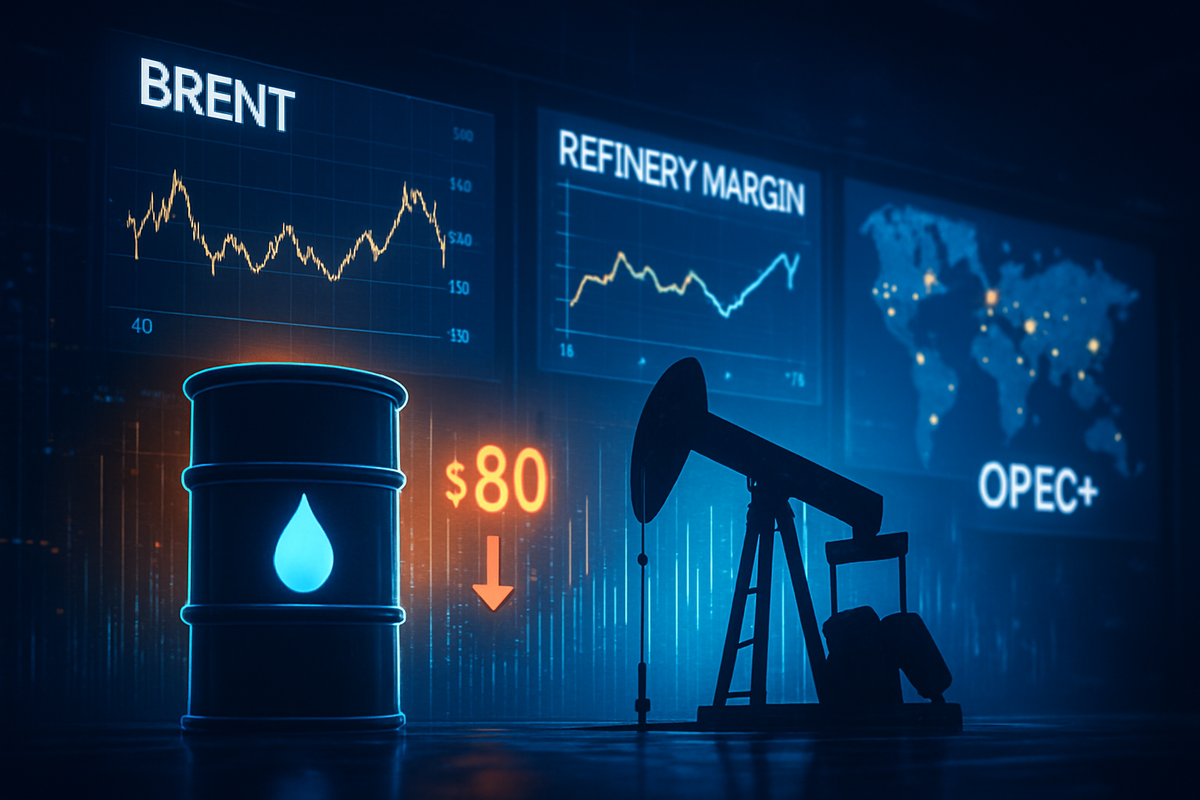
As the global energy landscape navigates the complexities of 2026, market analysts and historians frequently point back to the pivotal June 2, 2024, OPEC+ meeting as a watershed moment for the industry. At that time, the global oil market was balanced on a knife's edge, with Dated Brent crude hovering precariously near the $80 psychological support level. The atmosphere leading into that Sunday summit was one of intense anxiety, characterized by a sharp retreat from April highs and a concerning slump in global refinery margins that signaled cooling industrial demand.
The immediate implications of the June 2 decision were felt across the trading floors of London and New York. By choosing to provide a clear, albeit complex, roadmap for the unwinding of voluntary production cuts, the alliance—led by Saudi Arabia and Russia—signaled a transition from price-at-all-costs to a more nuanced strategy of market share preservation. This shift effectively capped the geopolitical risk premiums that had dominated the preceding months, forcing a re-evaluation of the "floor" for global crude prices.
The Sunday Summit: A Strategy of Managed Supply
The events leading up to the June 2 meeting were defined by a steady erosion of crude prices. Just weeks prior, Brent had been trading above $90 per barrel, supported by tensions in the Middle East. However, by late May, those gains had evaporated as the market focused on high interest rates in the United States and sluggish economic data from China. On the final trading day before the meeting, Brent was assessed at approximately $80.18, a level that many saw as the last line of defense for the "OPEC+ floor."
During the meeting, which was conducted in a hybrid format with some ministers gathering in Riyadh while others joined online, the group reached a multifaceted agreement. They extended the "official" production cuts of 3.66 million barrels per day (bpd) through the end of 2025. More importantly, they announced that the 2.2 million bpd in additional voluntary cuts—originally intended to be short-term—would be extended through September 2024 and then gradually phased out on a monthly basis. This "phase-out" plan was the key catalyst that shifted market sentiment from supply-scarcity to supply-abundance.
The initial reaction from the industry was a mixture of surprise and skepticism. While the extension of official cuts provided a baseline of support, the detailed schedule for returning barrels to the market led to an immediate sell-off. By the Tuesday following the meeting, Brent had broken below $77 per barrel, as traders priced in a more well-supplied market for late 2024 and 2025. Key stakeholders, including the United Arab Emirates, also secured wins, such as the gradual increase in their production quotas, highlighting the internal pressures within the group to monetize their massive investments in spare capacity.
Winners and Losers in the Era of Thin Margins
The decision had profound consequences for public energy companies, particularly those heavily leveraged to either upstream production or downstream refining. For integrated giants like Exxon Mobil Corp. (NYSE: XOM) and Chevron Corp. (NYSE: CVX), the prospect of lower-for-longer prices necessitated a renewed focus on cost efficiency and high-margin Permian Basin production. These companies, while benefiting from massive scale, saw their stock prices face headwinds as the "price floor" they had relied on appeared to be softening.
In the refining sector, the situation was even more dire. Ahead of the meeting, global composite refining margins had plummeted to around $4.14 per barrel—significantly below the five-year average. Pure-play refiners such as Valero Energy Corp. (NYSE: VLO) and Marathon Petroleum Corp. (NYSE: MPC) found themselves caught in a "pincers movement": high crude costs (due to OPEC+ cuts) and weak product demand (due to global economic cooling). The June 2 decision to eventually return more crude to the market offered a glimmer of hope for lower feedstock costs, but this was balanced against the risk of a broader economic slowdown that would further erode gasoline and diesel cracks.
Meanwhile, European majors like Shell PLC (NYSE: SHEL) and BP PLC (NYSE: BP) faced a different set of challenges. As the $80 support level for Brent gave way, the pressure to maintain high dividend payouts and share buybacks increased. These companies began a strategic pivot toward higher-margin, low-carbon initiatives while simultaneously stripping costs from their traditional fossil fuel portfolios to remain competitive in a sub-$80 environment.
The Significance: A Shift in the Global Oil Order
The June 2 meeting fits into a broader historical trend of OPEC+ attempting to manage the "shale threat." For years, the group had successfully kept prices high through disciplined cuts, but this strategy had the unintended side effect of subsidizing non-OPEC production in the US, Guyana, and Brazil. The 2024 decision represented a tactical retreat—an acknowledgment that maintaining $90+ oil was no longer sustainable if it meant losing significant market share to Western competitors.
This event also highlighted the growing divergence between the physical and paper oil markets. While the physical market remained relatively tight, the "paper" market—driven by algorithmic trading and macro hedge funds—became increasingly bearish. This led to a period of high volatility where price movements were often disconnected from immediate supply-and-demand fundamentals. The regulatory implications were also significant, as the decision prompted increased scrutiny of how production quotas were monitored and reported, particularly for members like Iraq and Kazakhstan that had historically struggled with compliance.
Compared to the 2014 "price war," the 2024 pivot was more measured. Instead of a "flood the market" approach, OPEC+ opted for a "managed return," attempting to act as the market's central bank. However, the failure of Brent to hold the $80 support level ahead of the meeting served as a stark reminder that the alliance's power to dictate prices has its limits in an era of diversifying energy sources and surging non-OPEC supply.
Looking Ahead: The Path to 2026 and Beyond
In the short term following the June 2 meeting, the market remained defensive. The planned phase-out of cuts was delayed multiple times as demand failed to materialize as strongly as expected. This forced a strategic pivot for many exploration and production (E&P) companies, who moved away from aggressive growth toward a "value over volume" model. For the public companies trading today, the lessons of June 2024 remain relevant: balance sheets must be robust enough to withstand periods where Brent trades well below the preferred $80–$90 range.
Long-term, the June 2 meeting set the stage for the structural surplus we see in early 2026. By signaling that they would eventually return barrels, OPEC+ essentially capped the upside for oil, encouraging a permanent shift in investment toward low-cost, low-breakeven projects. This has created a market where efficiency is the primary driver of shareholder value, rather than speculative price spikes.
The potential scenarios for the coming months involve a continued focus on refinery "re-balancing." As new refining capacity comes online in the Middle East and Asia, the traditional powerhouses of the Gulf Coast and Europe must adapt or face consolidation. Investors should keep a close eye on the Joint Ministerial Monitoring Committee (JMMC) meetings, as any deviation from the current production framework could trigger a new round of volatility in a market that is still sensitive to the ghost of the $80 support level.
Market Wrap-Up and Investor Outlook
The June 2 OPEC+ meeting will be remembered as the moment the alliance attempted to thread the needle between price support and market relevance. The key takeaway for investors is that the "OPEC Put"—the idea that the group would always cut to save prices—has evolved into a more complex mechanism that prioritizes long-term stability over short-term gains. The breach of the $80 psychological level was not just a technical event; it was a signal that the era of scarcity was being replaced by an era of strategic management.
Moving forward, the market remains in a state of watchful waiting. While the immediate threat of a price collapse has often been mitigated by geopolitical shocks, the underlying fundamentals of weak refinery margins and rising supply suggest a ceiling on prices for the foreseeable future. Investors should prioritize companies with low debt-to-equity ratios and high-quality assets that can generate free cash flow even if Brent remains in the $70s or lower.
In the coming months, watch for shifts in Chinese demand data and the pace of US production growth. These two factors, combined with the discipline of the OPEC+ alliance, will determine whether the "floor" established in 2024 can hold, or if the market must find a new, lower equilibrium.
This content is intended for informational purposes only and is not financial advice