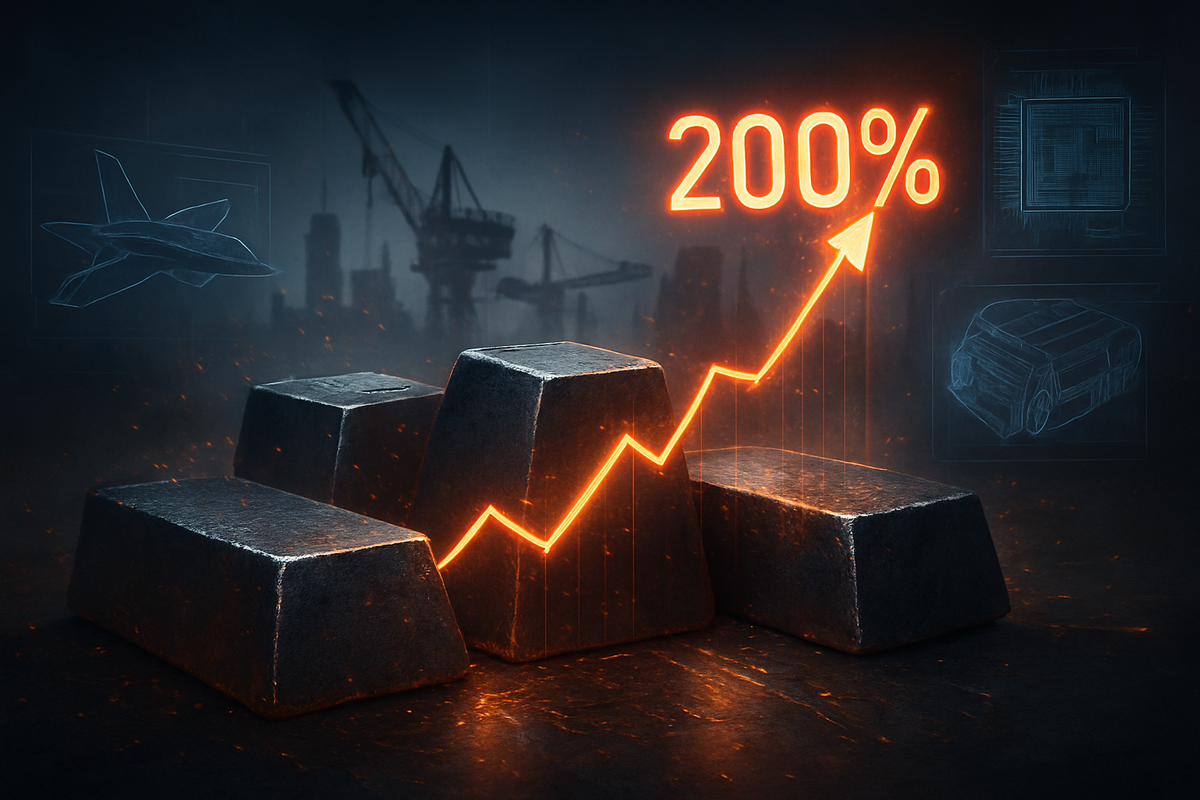
As of January 16, 2026, the global industrial landscape is grappling with a seismic supply shock as the price of tungsten—a critical metal with the highest melting point of all elements—has surged by over 200% following a series of aggressive export controls from China. In the first two weeks of 2026 alone, the market has entered a state of "controlled panic" as Beijing’s Ministry of Commerce (MOFCOM) officially activated its "2026 Catalogue of Dual-Use Items and Technologies," effectively placing a stranglehold on the primary source of the world's most durable metal.
The immediate implications are staggering. Tungsten carbide powder, the bread and butter of the global tooling and machining industry, has rocketed from approximately 336 yuan/kg in early 2024 to a record-shattering 940 yuan/kg today. In the European spot markets, Ammonium Paratungstate (APT) has crossed the $1,100 per metric tonne unit (mtu) threshold, nearly triple its price from 24 months ago. For manufacturers in the aerospace, defense, and semiconductor sectors, the era of cheap, reliable Chinese tungsten has abruptly ended, replaced by a "Resource Iron Curtain" that threatens to derail high-tech production lines from Tokyo to Tennessee.
A Calculated Constriction: The Timeline of the Surge
The current crisis did not emerge in a vacuum but is the result of a meticulously planned three-year strategy by Beijing to leverage its dominance—controlling over 80% of global tungsten production and more than 50% of known reserves. The escalation began in February 2025 when China implemented a restrictive export-licensing phase for 25 rare metals. This system introduced a "one license per order" requirement, providing the Chinese government with granular data on every micro-gram of tungsten leaving its borders.
The situation reached a boiling point on January 6, 2026, when MOFCOM issued the definitive 2026 Catalogue of Dual-Use Items. This policy explicitly targeted tungsten oxides and carbides, prohibiting exports to several jurisdictions—most notably Japan—for any end-use deemed to "enhance military capabilities." To further cement control, a new "Whitelist" system for 2026–2027 was established, granting export rights only to state-favored giants like CMOC Group Limited (HKEX: 03993) and Xiamen Tungsten Co. Ltd (SSE: 600549), while effectively freezing out independent traders and foreign middlemen.
Market reactions have been swift and severe. Industrial buyers are currently operating with spot inventories that have fallen below 15 days of supply in many regions. This supply deficit is exacerbated by China’s domestic policies; for three consecutive years (2023–2025), Beijing has reduced its internal mining quotas by 6% annually, citing declining ore grades and the need for environmental "rectification." This has created a perfect storm where dwindling supply meets an insatiable demand for the next generation of kinetic weaponry and AI hardware.
Winners and Losers in the Tungsten Wars
The primary beneficiaries of this price explosion are the vertically integrated Chinese state enterprises and a handful of non-Chinese mining companies racing to bring new supply online. CMOC Group Limited (HKEX: 03993) has seen its margins swell as it shifts production toward high-value, semiconductor-grade APT, benefiting from prices that have outpaced even the most optimistic analyst projections. Similarly, China Tungsten High-Tech (SZSE: 000657), which controls a significant portion of the domestic supply chain, stands as a pillar of Beijing’s strategic reserve policy.
Outside of China, the "Tungsten 200" rally has breathed new life into junior miners. Almonty Industries Inc. (TSX: AII), which operates the Sangdong Mine in South Korea, has seen its stock price soar by more than 40% in early January 2026. The Sangdong Mine is widely considered the most critical "China-free" source of tungsten, expected to provide nearly 7% of global supply once fully ramped. EQ Resources Limited (ASX: EQR) has also emerged as a strategic winner, leveraging its Australian operations to fill the void left by restricted Chinese exports.
On the losing side are global manufacturers who failed to diversify their supply chains before the 2026 controls took effect. Japanese industrial giants and Western defense contractors are the most exposed. Companies in the semiconductor space, which require high-purity tungsten for AI chip interconnects, are now facing double-digit increases in raw material costs. Furthermore, the U.S. military’s 2026 ban on Chinese tungsten in defense hardware has forced contractors into a bidding war for the limited "clean" supply available from Western-friendly mines, significantly bloating procurement budgets for everything from armor-piercing munitions to hypersonic glide vehicles.
The Strategic Shift: Defense, AI, and the End of an Era
The significance of this surge extends far beyond mere commodity pricing; it represents a fundamental shift in how strategic minerals are used in modern warfare and technology. Tungsten has become the preferred material for kinetic energy penetrators, replacing depleted uranium due to environmental and political sensitivities. As global tensions remain high, military consumption of tungsten is growing at a rate far exceeding the general GDP, turning a once-unassuming industrial metal into a "weaponized" asset.
Furthermore, the "Growth Iron Triangle" of 2026—Defense, AI, and Green Energy—has made tungsten indispensable. In the semiconductor industry, the drive toward sub-2nm chips has increased the per-wafer consumption of tungsten for barrier layers. In the energy sector, tungsten is now being used in EV battery anodes to increase charge density and in high-tensile photovoltaic wires. This convergence of demand from the world’s most critical growth sectors means that, unlike previous commodity cycles, this price surge is backed by "rigid" demand that cannot be easily substituted.
Historically, this event mirrors the rare earth crisis of 2010, but with a more sophisticated execution. While the 2010 crisis was characterized by a sudden total ban, the 2026 tungsten controls utilize a "license-by-license" approach that allows China to reward "friendly" trading partners while punishing adversaries. This creates a fragmented global market where the price of tungsten may vary wildly depending on a nation's diplomatic standing with Beijing.
The Road Ahead: 2026 and Beyond
In the short term, the market will likely remain in a state of high volatility as the full impact of the "Whitelist" system is felt. Investors should expect a frenzy of "urban mining" activity; with prices at $1,100/mtu, recycling scrap carbide tools has suddenly become a highly profitable enterprise. We may see companies like American Tungsten Corp (OTC: TUNG), which is working to restart the IMA Mine in Idaho, accelerate their timelines to meet the "America First" strategic materials mandate, though primary production in North America remains at least twelve months away.
Long-term, the global supply chain is bifurcating. By 2027, the market will likely be split into a "Chinese-sourced" segment and a "Western-aligned" segment. This will require massive strategic pivots from companies that have traditionally prioritized cost over security of supply. We are likely to see more "offtake-for-equity" deals, where defense contractors or tech giants provide the capital for junior miners like Almonty or EQ Resources in exchange for guaranteed supply at fixed prices.
Final Assessment: A Permanent Price Plateau?
The 200% surge in tungsten prices is not a temporary bubble but a structural realignment of the global materials market. The combination of Chinese export controls, declining ore grades, and the explosion of demand from the defense and AI sectors has created a floor for prices that is likely to persist for years. The market moving forward will be defined by scarcity, geopolitics, and a desperate race for self-sufficiency in the West.
For investors, the coming months will be critical. Watch for the ramp-up of the Sangdong Mine in South Korea and any potential "Project 28" announcements from the U.S. Pentagon regarding $2 billion in planned stockpile expansions. The message from 2026 is clear: in the modern world, the hardest metal is now the most powerful geopolitical tool. Those who do not control their supply of tungsten may soon find their industrial ambitions hitting a very hard wall.
This content is intended for informational purposes only and is not financial advice.