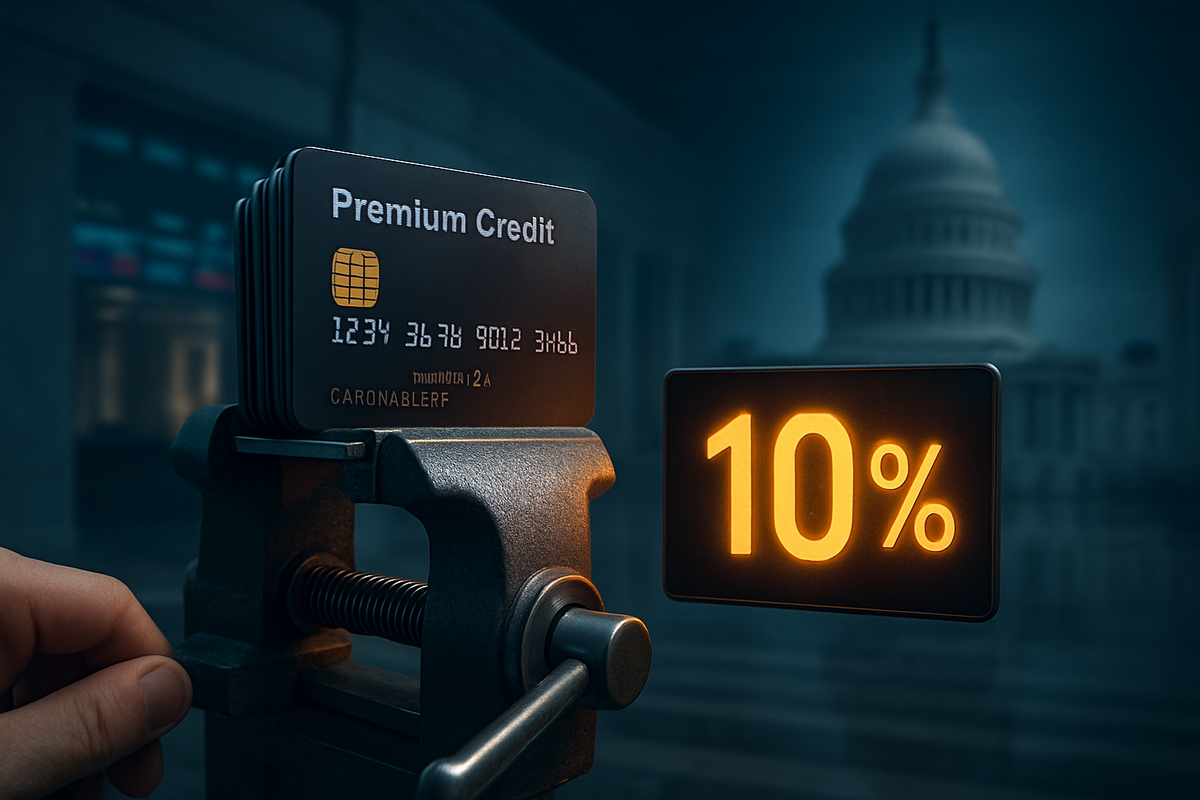
The American financial landscape is facing a seismic shift as the debate over a proposed 10% federal cap on credit card interest rates reaches a fever pitch. Following a self-imposed January 20, 2026, deadline set by the administration for voluntary bank compliance, the industry remains in a tense standoff with lawmakers. The proposal, which seeks to slash the national average interest rate from nearly 25% to a flat 10%, represents one of the most aggressive attempts at federal price control in the modern era, threatening to dismantle the traditional profit models of the nation's largest lenders.
While proponents argue the cap is a necessary measure to protect consumers from "predatory" debt spirals, the immediate implications have sent shockwaves through Wall Street. Banking giants have warned of a "credit contraction" that could see millions of Americans lose access to revolving credit overnight. As of January 21, 2026, the legislative battle has moved to the forefront of the national economic agenda, pitting a rare bipartisan coalition of populist lawmakers against the combined lobbying power of the trillion-dollar banking sector.
A Bipartisan Siege on High-Interest Debt
The current firestorm centers on the 10 Percent Credit Card Interest Rate Cap Act (S. 381), a landmark piece of legislation spearheaded by an unlikely alliance between Senator Josh Hawley (R-MO) and Senator Bernie Sanders (I-VT). The bill, which gained significant traction throughout 2025, seeks to amend the Truth in Lending Act to establish a permanent 10% ceiling on annual percentage rates (APRs). The momentum for the bill surged in late 2025 as the administration adopted the cap as a flagship economic policy, culminating in a public demand for banks to "lower their rates or face the consequences" by January 20, 2026.
The timeline of this escalation dates back to early 2024, when the Consumer Financial Protection Bureau (CFPB) began a series of crackdowns on credit card "junk fees." By 2025, the narrative shifted from fees to the underlying interest rates themselves, which had remained at historic highs despite a stabilizing inflationary environment. Key stakeholders, including consumer advocacy groups and populist wings of both parties, have framed the 10% cap as a "worker's rights" issue. However, as the January 20 deadline passed without a voluntary reduction from major issuers, the market's reaction has been one of deep uncertainty, with bank stocks experiencing heightened volatility as investors weigh the likelihood of an executive order or a forced legislative vote.
The Institutional Fallout: Winners and Losers
The most significant impact of a 10% cap would be felt by the major credit card issuers, who rely on interest income as a primary revenue driver. JPMorgan Chase & Co. (NYSE: JPM), the nation’s largest bank, has been vocal in its opposition. CFO Jeremy Barnum recently noted that such a cap would make the credit card business fundamentally "unprofitable" for many segments of the population. Similarly, Citigroup Inc. (NYSE: C), which maintains one of the largest credit card portfolios globally, faces a potential "drastic reduction" in its consumer lending capacity. Analysts suggest that for these institutions, the cap would necessitate a total overhaul of their risk-management frameworks, likely resulting in the mass closure of accounts deemed too risky under a low-yield model.
Perhaps no company is more exposed than Capital One Financial Corp. (NYSE: COF). Following its high-profile merger with Discover in 2025, Capital One became the leading issuer of credit cards in the United States. The 10% cap threatens to erode the "safety cushion" of its credit card securitization trusts—the financial vehicles used to fund its lending operations—by as much as 90%. While the "losers" include the banks and subprime borrowers who may lose access to credit entirely, potential "winners" are harder to identify. Some analysts point to credit unions and smaller community banks that may pick up more stable, high-credit-score customers, or fintech companies that could pivot to alternative, fee-based lending models that circumvent traditional interest structures.
A Structural Shift in the Credit Ecosystem
The push for a 10% cap is not an isolated event but rather the climax of a broader trend toward financial populism and regulatory intervention. For years, the U.S. credit market has operated on a "risk-based pricing" model, where higher-risk borrowers pay higher rates to offset the likelihood of default. A hard 10% cap effectively outlaws this model, mirroring historical "usury laws" that existed in many U.S. states before the 1978 Supreme Court decision in Marquette National Bank of Minneapolis v. First of Omaha Service Corp, which allowed national banks to export the interest rates of their home states.
The ripple effects of this policy would likely extend far beyond the balance sheets of banks. Industry trade groups, such as the American Bankers Association (ABA), argue that the elimination of nearly $100 billion in annual interest revenue would lead to the immediate termination of popular rewards programs, including cash-back and travel points. Furthermore, there is a significant risk that displaced subprime borrowers will be forced toward "shadow banking" alternatives, such as unregulated online lenders or modernized payday lending services, which could offer even fewer consumer protections than the traditional banking system.
The Path Forward: Legal Battles and Market Adaptation
As we move past the January 20 deadline, the immediate future will likely be defined by a series of high-stakes legal challenges. If the administration attempts to enforce the 10% cap via executive action, it will almost certainly face an immediate injunction and a protracted battle in the federal courts. Most legal scholars argue that such price controls require a formal Act of Congress, meaning the fate of the 10% cap rests on whether the Hawley-Sanders coalition can break a likely filibuster in the Senate.
In the short term, investors should expect banks to begin "pre-emptive tightening." This means higher minimum credit score requirements for new cards and the potential introduction of "maintenance fees" or "activity fees" to replace lost interest income. Strategically, banks may pivot toward more secured lending products or expand their footprint in wealth management and investment banking to diversify away from the volatile consumer credit sector. If the 10% cap does become law, it would represent the single largest contraction of the American credit supply in history, potentially slowing consumer spending and triggering a broader economic recalibration.
Conclusion: A New Era for American Finance
The 10% credit card interest rate cap proposal marks a turning point in the relationship between the federal government and the financial sector. Whether the cap is eventually codified into law or serves as a powerful bargaining chip for further regulatory reform, the "business as usual" era for high-interest revolving debt appears to be ending. The key takeaway for the market is that the "social license" of banks to charge 25-30% interest is being revoked by a new bipartisan consensus that views such rates as economically destabilizing.
Moving forward, the market will be watching the legislative progress of S. 381 and any subsequent executive orders with intense scrutiny. For investors, the focus shifts to how companies like JPMorgan Chase & Co. (NYSE: JPM) and Capital One Financial Corp. (NYSE: COF) adapt their business models to a low-yield environment. For the public, the coming months will reveal whether the promise of lower rates results in a more affordable cost of living or a sudden, painful loss of the credit lines that have powered American consumption for decades.
This content is intended for informational purposes only and is not financial advice.