The global financial landscape witnessed a seismic shift this week as the "Greenland Tariff Relief" rally sent major indices to near-record highs. Following a tense standoff that threatened to destabilize the transatlantic alliance, President Donald Trump announced a comprehensive framework with NATO leadership that effectively scraps the proposed 10% baseline tariffs on European nations. In exchange, the United States has secured unprecedented strategic and mineral rights in Greenland, effectively blending trade policy with a new era of Arctic security.
The immediate implications are profound: the S&P 500 and Nasdaq Composite (NASDAQ: IXIC) both surged over 1.5% in the wake of the announcement, while European markets, particularly Germany’s DAX, saw their strongest single-session gains in months. This "relief rally" reflects a collective exhale from investors who had been bracing for a protracted trade war that threatened to shave 0.3% off global GDP. By pivoting from protectionist threats to a strategic resource and defense deal, the administration has managed to calm market volatility while advancing its long-standing "Donroe Doctrine" in the High North.
From Stalemate to 'Sovereign Pockets': The Road to the Deal
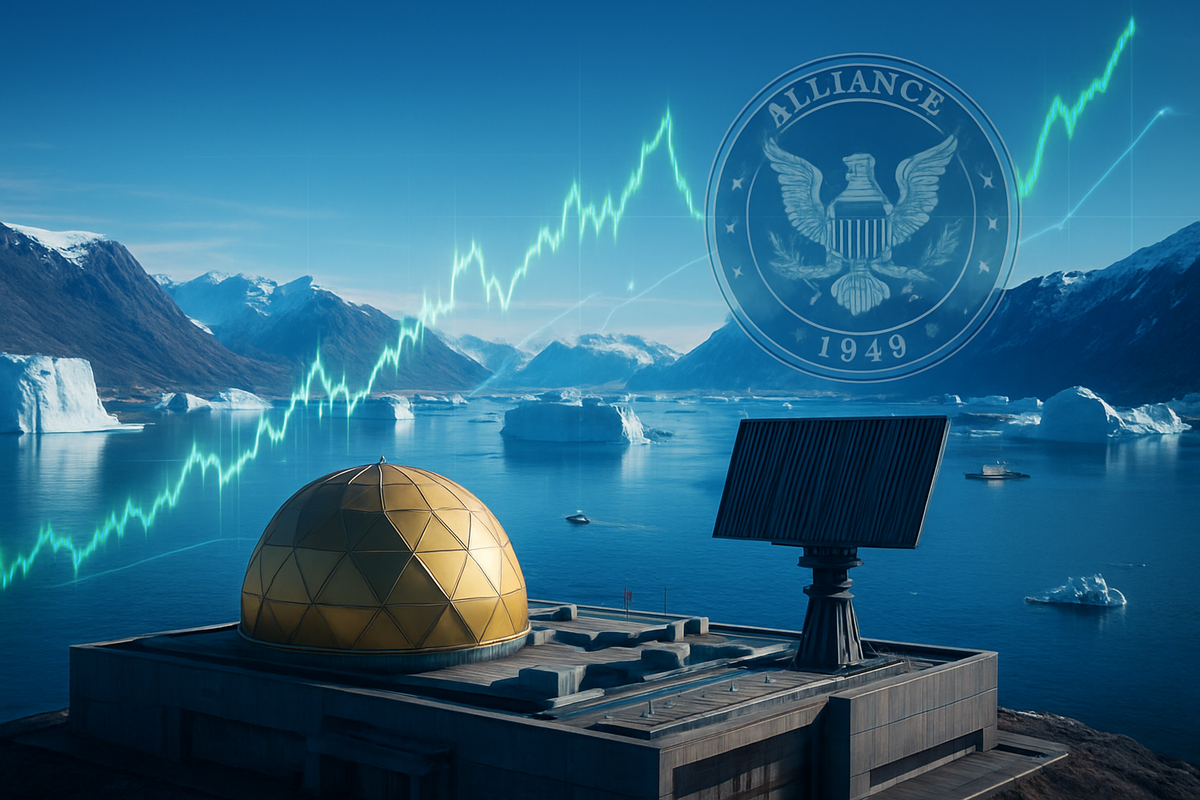
The path to this moment began in May 2025, when the Trump administration unveiled the "Golden Dome" project—a sophisticated, space-based missile defense system. Arguing that Greenland’s unique geography was essential for the system’s laser communication windows and polar satellite replenishment, the President revived his 2019 interest in the island. The situation escalated in late 2025 when eight European nations, led by Denmark and the UK, launched "Operation Arctic Endurance" to signal their defense of Greenlandic sovereignty. The White House responded by threatening a 10% blanket tariff on all goods from those nations, a move that sent the Euro Stoxx 50 (INDEXEURO:SX5E) into a tailspin throughout December.
The breakthrough occurred during intense negotiations on the sidelines of the World Economic Forum in Davos. President Trump and NATO Secretary-General Mark Rutte emerged on January 21, 2026, to announce what is now being called the "Greenland Framework." Under this agreement, the 10% tariff threat—scheduled to take effect on February 1—was immediately withdrawn. In exchange, the U.S. was granted "sovereign pockets" for military use and expanded rights to Greenland’s vast rare-earth mineral deposits. This deal successfully decoupled trade hostilities from defense requirements, providing the "Greenland Tariff Relief" that markets have aggressively priced in over the last few trading days.
The timeline of the crisis highlights the administration’s use of trade leverage to achieve geopolitical ends. From the initial 2025 proposals to the peak of the tariff threats in mid-January 2026, the market remained in a defensive crouch. The Jan 21 announcement served as a massive clearing event, liquidating short positions in European exporters and sparking a "risk-on" rotation that has defined the market narrative through this Monday, January 26.
Winners and Losers of the Greenland Relief Rally
The primary beneficiaries of the deal are European exporters, particularly the automotive and luxury sectors, which were directly in the crosshairs of the 10% tariff. Shares of Volkswagen AG (OTC:VWAGY), BMW (OTC:BMWYY), and Mercedes-Benz Group AG (OTC:MBGAF) surged between 2.5% and 4% as the threat of a price hike for American consumers evaporated. Similarly, the luxury conglomerate LVMH Moët Hennessy Louis Vuitton (OTC:LVMUY) saw a significant rebound, as the deal removed the looming shadow of retaliatory European taxes on American goods, which had threatened the global supply chain of high-end consumer products.
In the technology and defense sectors, the "Golden Dome" funding confirmation provided a windfall. NVIDIA Corp (NASDAQ: NVDA) and Palantir Technologies Inc. (NASDAQ: PLTR) rallied on news that the new Greenlandic defense outposts would require massive AI-driven data backhaul and processing capabilities. On the domestic front, MP Materials Corp. (NYSE: MP) and other rare-earth miners initially saw mixed reactions, but ultimately trended higher as the deal guarantees U.S. access to Greenland's Tanbreez deposit, securing the supply chain for high-tech defense components without the immediate need for Chinese-sourced materials.
Conversely, the "losers" in this scenario were the safe-haven assets. Gold, which had climbed toward $4,600 an ounce during the height of the tariff tensions, saw a sharp pull-back as investors moved capital back into equities. Additionally, companies that had positioned themselves as "tariff-proof" domestic manufacturers saw some of their relative outperformance fade as the playing field leveled for their European competitors. The relief rally has essentially penalized those who bet on a sustained trade war, rewarding instead those who maintained exposure to global trade and high-tech defense integration.
A New Precedent for Geopolitical Trade Leverage
The Greenland Tariff Relief rally is more than just a short-term market spike; it represents a significant evolution in how trade is used as a tool of foreign policy. Historically, tariffs have been used to protect domestic industries or address trade imbalances. However, the "Greenland Framework" demonstrates the use of tariffs as a bargaining chip for territorial and resource access. This "Trade-for-Territory" model fits into the broader industry trend of "friend-shoring" and securing critical supply chains, but adds a layer of aggressive strategic positioning not seen since the Cold War.
This event has created a ripple effect across the Arctic Council and NATO. By effectively tying European trade stability to Arctic military cooperation, the U.S. has established a new "Strategic Alliances through Leverage" (SALT) model. For competitors like Russia and China, the deal signals a consolidated Western front in the Arctic, backed by the economic might of the U.S. consumer market. The regulatory implications are also vast, as the deal may pave the way for joint U.S.-EU standards on rare-earth mining and space-based communication, potentially bypassing traditional international bodies in favor of bilateral "security-trade" pacts.
Historically, this event draws comparisons to the 19th-century purchase of Alaska or the mid-20th-century basing agreements in the Pacific, but with a modern, high-stakes twist. The integration of 21st-century technology—namely the Golden Dome defense system—into a trade negotiation marks a departure from standard diplomatic norms. For the market, this means that "geopolitical risk" must now be calculated not just in terms of war or peace, but in terms of complex, multi-layered "deals" that can pivot an entire sector's outlook in a single afternoon.
The Horizon: Implementation and the 'TACO' Trade
Looking ahead, the market will focus on the implementation phase of the Greenland Framework. While the 10% tariffs have been scrapped, the agreement on "sovereign pockets" and mineral rights involves complex legal and environmental hurdles in Greenland and Denmark. Short-term, investors should expect continued volatility as the specific details of the joint NATO "Arctic Sentry" mission are hashed out. Any sign of backtracking from European capitals—particularly Copenhagen—could reignite tariff threats, a pattern some analysts have dubbed the "TACO Trade" (Trump Always Chickens Out), referring to the President's tendency to withdraw threats once a strategic concession is won.
In the long term, this deal necessitates a strategic pivot for multinationals. Companies will likely increase their focus on "Arctic-ready" technology and northern logistics. The potential for a permanent U.S. presence in Greenland could open new markets for construction, telecommunications, and energy infrastructure. However, the challenge remains: if trade stability is now contingent on defense concessions, corporate strategic planning must become as adept at reading Pentagon briefings as it is at reading earnings reports.
Market Wrap-Up and Investor Outlook
The Greenland Tariff Relief rally has provided a masterclass in the intersection of high finance and high-stakes diplomacy. The key takeaway for investors is the administration’s willingness to use broad economic levers to achieve specific, long-term national security goals. The scrapping of the 10% European tariffs has restored confidence in the global trade engine, but the price of that confidence is a deeper entanglement of the private sector in Arctic geopolitics.
Moving forward, the market is likely to remain in a "trust but verify" mode. The immediate relief has provided a cushion, but the underlying tensions regarding Arctic sovereignty and the Golden Dome’s deployment remain. Investors should closely watch for the formal signing of the Turnberry Proposals and any further developments in Greenlandic mining legislation. While the "Greenland Rally" has secured a profitable start to 2026, the era of trade as a simple exchange of goods is over; it is now a fundamental component of the new global security architecture.
This content is intended for informational purposes only and is not financial advice