On January 7, 2026, the global commodities market witnessed a sharp reversal in the blistering rally of precious and industrial metals, providing a stark contrast to a stock market that continues to defy gravity. Silver, which had been the star performer of 2025, slipped toward the $70 per ounce mark, retreating from recent highs of $84 as investors pivoted toward "risk-on" assets. This pullback comes at a peculiar moment for the global economy: while physical demand for metals remains structurally undersupplied, a combination of technical liquidations and a surge in equity euphoria has momentarily dimmed the luster of hard assets.
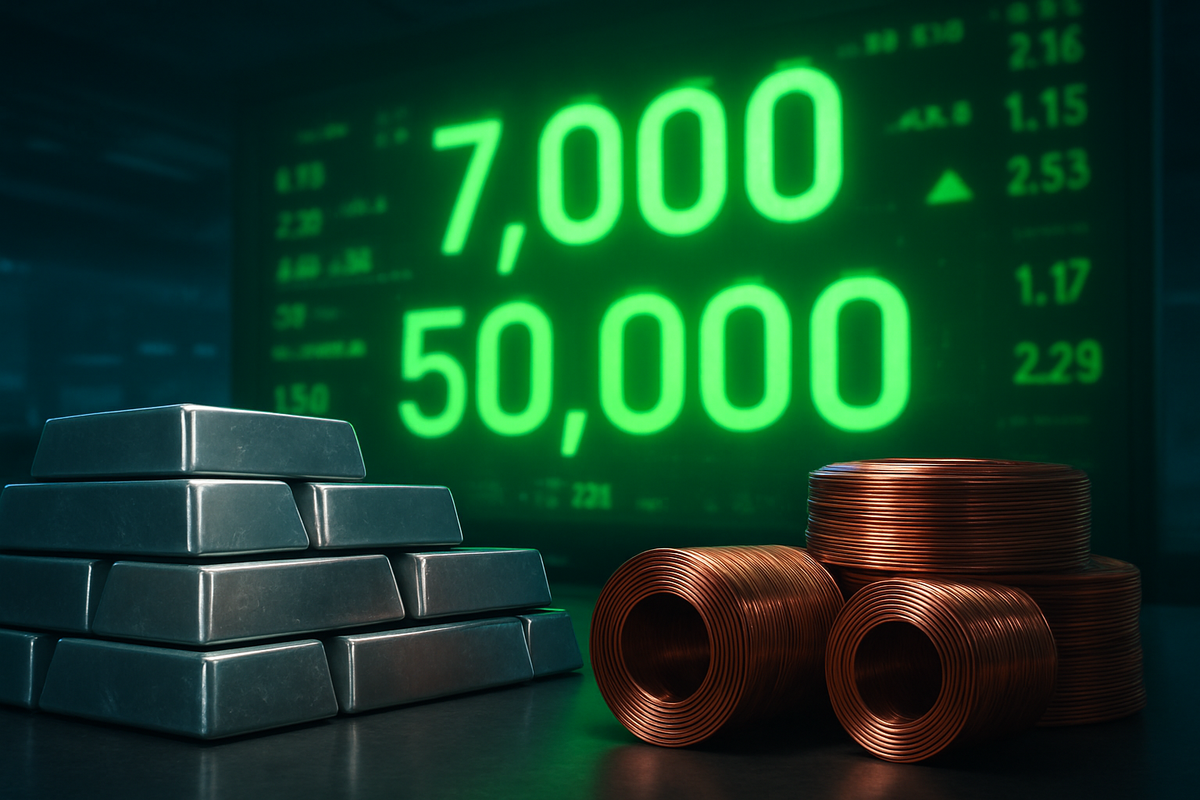
The immediate implications of this retreat are twofold. For industrial consumers in the solar and electric vehicle sectors, the price dip offers a much-needed reprieve from soaring input costs that threatened margins throughout the previous year. Conversely, for the broader financial market, the rotation out of metals and into record-breaking equities suggests a growing confidence in a "soft landing" and the continued dominance of artificial intelligence as the primary engine of corporate growth. As the S&P 500 (INDEXSP: .INX) hovers near the 7,000 milestone, the metals retreat is being viewed not as a collapse, but as a tactical rebalancing of the 2026 investment landscape.
Technical Pressures and the "Risk-On" Rotation
The retreat on January 7 was catalyzed by a "perfect storm" of technical and macroeconomic factors that forced a deleveraging event in the metals space. A primary trigger was the decision by the CME Group (NASDAQ: CME) to significantly hike margin requirements for silver and gold contracts. For silver, maintenance margins were raised from $22,000 to over $32,500 per contract, a move designed to curb the extreme volatility seen in late 2025. This forced many leveraged traders to liquidate their positions simultaneously, exerting heavy downward pressure on prices and causing silver to test critical support levels between $70 and $75 per ounce.
This technical sell-off coincided with a massive capital rotation. Throughout the first week of January 2026, investors aggressively moved funds out of "safe-haven" assets and into high-growth technology stocks. The narrative of "AI-driven productivity" has reached a fever pitch, with the Dow Jones Industrial Average (INDEXDJX: .DJI) approaching the 50,000 mark. Additionally, geopolitical headlines from the Trump administration—specifically regarding potential new trade tariffs and a surprise diplomatic push to increase oil imports from Venezuela—bolstered the US Dollar. A stronger greenback typically makes dollar-denominated commodities like silver and copper more expensive for international buyers, further dampening demand.
The timeline leading to this moment began in mid-2025, when silver prices more than doubled due to a massive supply deficit. By December, the market was "overbought" by almost every technical metric. When the Federal Reserve signaled a steady path of interest rate cuts for 2026, the expected "inflation hedge" trade for metals was overshadowed by the "growth trade" for equities. This led to the decoupling observed today, where industrial metals like copper, which slipped to roughly $4.50 per pound on the COMEX, are struggling to keep pace with the record-breaking performance of the Nasdaq (INDEXNASDAQ: .IXIC).
Winners and Losers of the Commodity Cool-Down
The primary beneficiaries of this retreat are the heavy industrial users of silver and copper. Solar energy giants like First Solar (NASDAQ: FSLR) and NextEra Energy (NYSE: NEE) have faced significant headwinds due to the rising cost of silver paste used in photovoltaic cells. With silver prices retreating nearly 15% from their December peaks, these companies stand to see a meaningful improvement in their utility-scale project margins. Similarly, electric vehicle manufacturers such as Tesla (NASDAQ: TSLA) and Rivian (NASDAQ: RIVN), which rely heavily on copper for wiring and silver for advanced sensors, may find some relief in their supply chain costs during the first quarter of 2026.
On the losing side of this shift are the major mining corporations that had been riding the wave of record-high spot prices. Companies like Pan American Silver (NYSE: PAAS) and Wheaton Precious Metals (NYSE: WPM) saw their stock prices dip by 4-6% in early trading as the market adjusted to the lower price floor for their primary products. Freeport-McMoRan (NYSE: FCX), a bellwether for the copper market, also faced selling pressure as investors questioned whether the "copper supercycle" was pausing for a longer hibernation. These miners are now faced with the challenge of maintaining investor interest as capital migrates toward the high-flying tech sector.
Technology and AI infrastructure companies represent the "winners" in the broader market context. As capital exits the metals market, it has flowed directly into the "Magnificent Seven" and their successors. NVIDIA (NASDAQ: NVDA) and Microsoft (NASDAQ: MSFT) have been the primary recipients of this liquidity shift, with both companies hitting new all-time highs on January 7. The market's current logic suggests that the long-term value of AI software and hardware outweighs the short-term scarcity of the physical materials required to build them—a paradox that may eventually resolve in favor of the metals as infrastructure demand catches up.
The Broader Significance: A Healthy Correction or a Trend Reversal?
This event fits into a broader industry trend of "volatility normalization" following the extreme commodity spikes of the mid-2020s. Historically, when precious metals experience a parabolic move—like silver's 140% gain in 2025—a correction of 15% to 20% is considered a healthy mechanism to shake out "weak hands" and establish a more sustainable price floor. The current retreat mirrors the silver "flash crashes" of 2011 and 1980, though the underlying fundamentals today are arguably stronger due to the green energy transition.
The ripple effects extend beyond just prices; they touch upon national policy and energy security. The Trump administration’s focus on domestic manufacturing and "energy dominance" has created a volatile environment for global commodities. By signaling a potential deal to bring 30–50 million additional barrels of oil from Venezuela into the US market, the administration effectively pushed Brent Crude below $60, dragging the broader Bloomberg Commodity Index lower. This "America First" energy policy is designed to lower domestic inflation, but it also creates headwinds for the very metals needed for the energy transition the previous administration championed.
Furthermore, the role of silver has shifted from a purely monetary asset to a critical industrial "tech metal." With silver consumption in the solar sector projected to hit 150 million ounces in 2026, the market is facing a structural deficit that no amount of margin-hiking can solve in the long term. This creates a divergence between the "paper market" (futures and ETFs) and the "physical market" (actual bars and industrial supply). While the paper market is retreating due to CME margin hikes, the physical market remains tight, suggesting that the current price drop may be a temporary anomaly in a multi-year bull market.
What Comes Next: The Path to $100 Silver
In the short term, market participants should expect continued consolidation. Silver is likely to find a base between $68 and $72, where physical buyers and industrial hedgers are expected to step in. For the stock market, the "melt-up" toward S&P 7,000 may continue as long as earnings reports for the fourth quarter of 2025 justify the current valuations. However, if the retreat in metals is a precursor to a broader cooling of inflation expectations, it could eventually lead the Federal Reserve to pause its rate-cutting cycle, which would be a significant headwind for the tech sector.
Strategic pivots are already underway. Mining companies are likely to focus on cost-cutting and "high-grading" their mines to maintain profitability at $70 silver, while industrial users may use this window to lock in long-term supply contracts. A potential scenario for later in 2026 involves a "supply squeeze" in the copper market. As AI data centers require massive amounts of copper for power distribution, any prolonged pause in mining investment due to the current price retreat could lead to an even more violent price spike in late 2026 or early 2027.
The most significant market opportunity may lie in the "catch-up" trade. If the stock market's record highs begin to look unsustainable or "bubbly," the very capital that left the metals market on January 7 could return with a vengeance. Analysts at Goldman Sachs and Citi have already reiterated their year-end targets of $85 to $100 for silver, suggesting that the current retreat is a "generational buying opportunity" for those who believe in the long-term necessity of industrial metals in a high-tech world.
Summary and Investor Takeaways
The retreat in silver and metal prices on January 7, 2026, marks a pivotal moment of divergence in the global financial markets. While the headlines focus on the Dow 50,000 and the S&P 7,000 milestones, the cooling of the commodities sector reflects a complex interplay of technical margin hikes, a resurgent US Dollar, and a massive rotation into AI-driven equities. Key takeaways include the temporary relief for industrial manufacturers and the consolidation phase for mining stocks, which are now testing critical support levels after a historic 2025 rally.
Moving forward, the market appears to be in a transition phase. The "Risk-On" sentiment is currently the dominant force, but the underlying structural deficit in metals like silver and copper has not been resolved. Investors should watch for the stabilization of silver at the $70 level and the Federal Reserve's reaction to cooling commodity prices. If the dollar's strength persists due to administration policies, metals may remain under pressure, but any sign of an equity market peak could trigger a rapid return to hard assets.
Ultimately, the events of early 2026 serve as a reminder that markets rarely move in a straight line. The retreat in metals is a tactical pause in a larger structural shift toward a more metal-intensive global economy. For the savvy investor, the coming months will be about distinguishing between short-term technical noise and the long-term industrial demand that remains the bedrock of the silver and copper markets.
This content is intended for informational purposes only and is not financial advice.