The United States labor market entered 2026 on a fragile footing, as the December Jobs Report released on January 9, 2026, confirmed a significant cooling trend that has persisted throughout the past year. With only 50,000 jobs added in the final month of 2025, the report underscored a "low-hire, low-fire" equilibrium that has left economists and investors reassessing the strength of the American consumer. While the headline unemployment rate ticked down to 4.4%, the underlying data suggests this was driven more by a shrinking labor force than by robust economic expansion.
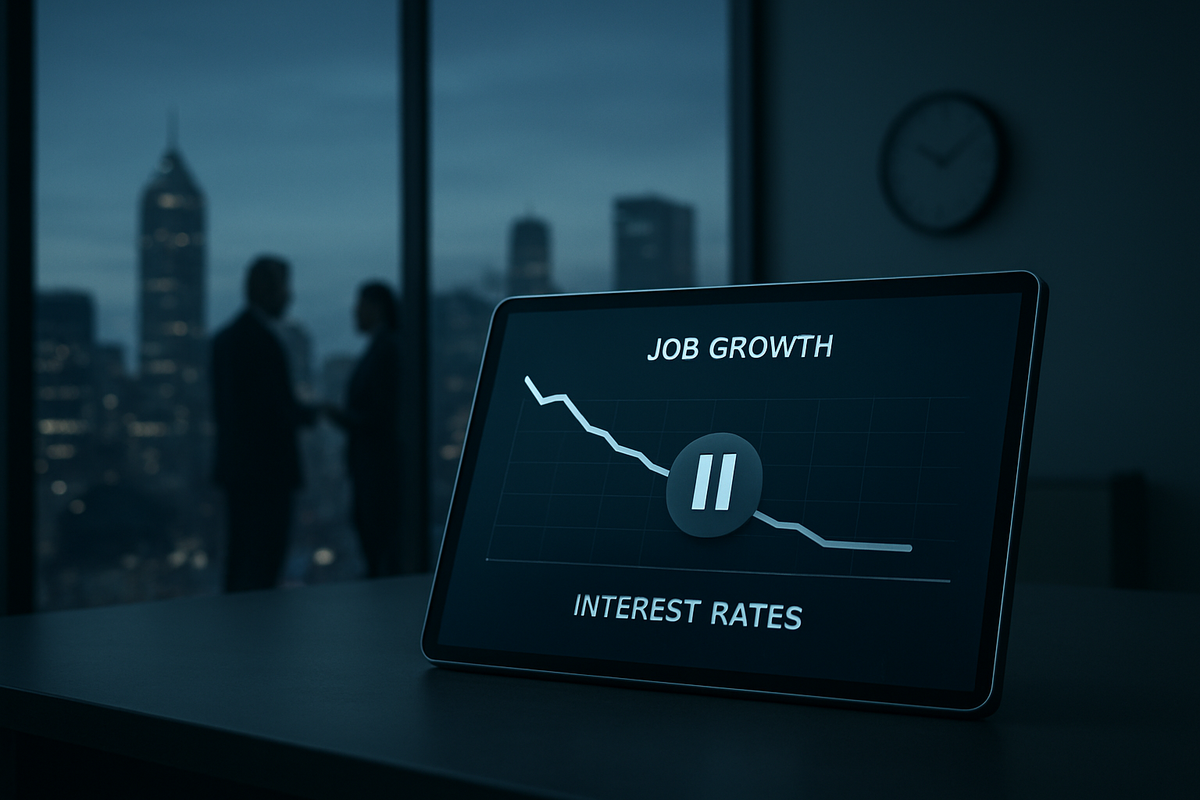
The immediate implication of this data is a near-certainty that the Federal Reserve will hold interest rates steady at its upcoming January meeting. Market participants have largely abandoned hopes for a New Year rate cut, as the Fed balances a stagnant hiring environment against persistent wage growth. This "wait-and-see" stance by the central bank signals a transition into a new phase of the economic cycle, where the breakneck growth of the post-pandemic recovery has officially given way to a disciplined, if sluggish, "soft landing" attempt.
The December figures provided by the Bureau of Labor Statistics (BLS) served as the final chapter in a year defined by a dramatic deceleration in employment. The 50,000 nonfarm payrolls added in December fell short of the 70,000 expected by Wall Street, and the report was further dampened by significant downward revisions to previous months. October and November’s data were stripped of a combined 76,000 jobs, with October’s contraction deepened to -173,000—a figure heavily influenced by the autumn government shutdown and a subsequent reduction in the federal workforce.
The timeline leading to this moment shows a stark divergence from the previous year. In 2024, the U.S. economy was an engine of growth, adding 2 million jobs at an average clip of 168,000 per month. By contrast, 2025 saw a 71% collapse in job creation, totaling just 584,000 for the entire year. This shift was not a sudden shock but a gradual grinding down of momentum as high borrowing costs, aggressive trade tariffs, and a pivot toward automation began to bite into corporate hiring budgets.
Sectoral performance in December highlighted a fractured economy. Healthcare and social assistance remained the primary engines of growth, adding 38,000 positions. However, the traditional holiday hiring surge failed to materialize in retail trade, which shed 25,000 jobs, while manufacturing saw its eighth consecutive month of decline. These losses were offset by a 17-month low in layoffs—just 35,500 for the month—suggesting that while companies are hesitant to hire, they are equally reluctant to let go of the talent they currently possess.
Initial market reactions were mixed but telling. The Dow Jones Industrial Average rose 0.6% to 49,266 as investors cheered the prospect of a stable interest rate environment. Conversely, the tech-heavy Nasdaq 100 fell 0.6%, reflecting a rotation out of high-growth sectors that thrive on aggressive rate cuts. The 10-year Treasury yield settled at 4.18%, indicating that the bond market does not anticipate a "panic cut" from the Fed, even as the labor market enters a deep freeze.
The "low-hire" environment has created a distinct set of winners and losers across the public markets. In the healthcare sector, UnitedHealth Group (NYSE: UNH) and HCA Healthcare (NYSE: HCA) appear to be among the few beneficiaries of the current labor trend. As one of the only sectors still actively expanding its workforce, healthcare providers are capturing the lion's share of available labor, though they must contend with a 3.8% year-over-year increase in average hourly earnings, which could pressure margins if not managed carefully.
Conversely, the retail and consumer discretionary sectors are facing a difficult start to 2026. Amazon (NASDAQ: AMZN) and Walmart (NYSE: WMT) saw a lackluster holiday hiring season, reflecting a more cautious consumer and a strategic shift toward warehouse automation to offset rising labor costs. For these giants, the slowdown in job growth suggests a potential cooling in consumer spending power, which could lead to lower-than-expected earnings in the coming quarters.
The technology sector, particularly companies heavily invested in artificial intelligence like Nvidia (NASDAQ: NVDA) and Broadcom (NASDAQ: AVGO), felt the brunt of the market's rotation following the report. While these companies have driven the "jobless expansion" of 2025 by providing the tools for automation, their high valuations are sensitive to interest rate expectations. With the Fed likely to hold rates "higher for longer" to combat wage-driven inflation, the era of easy-money-fueled tech rallies may be facing a significant headwind.
Financial institutions like JPMorgan Chase (NYSE: JPM) and Goldman Sachs (NYSE: GS) are also in a complex position. While a stable rate environment prevents the chaos of rapid fluctuations, the lack of job growth limits the demand for new mortgages and consumer loans. Banks are essentially "stuck in neutral," benefiting from decent net interest margins but lacking the volume of new business that usually accompanies a booming labor market.
The 2025 hiring slump fits into a broader global trend of "productivity over payroll." The 4.9% surge in Q3 productivity last year suggests that American corporations have successfully integrated AI and automation to maintain output despite stagnant headcounts. This shift represents a fundamental change in the relationship between GDP growth and employment, echoing historical precedents like the "jobless recovery" following the 2008 financial crisis, though this time driven by technological advancement rather than purely financial deleveraging.
From a policy perspective, the Federal Reserve is navigating a narrow corridor. Fed Chair Jerome Powell and the FOMC are essentially trapped between two risks: cutting rates too early and reigniting inflation—which is still being pressured by a 3.8% wage growth—or holding rates too long and tipping the "low-hire" market into a "high-fire" recession. The December report validates the "hawks" within the Fed who argue that the low unemployment rate (4.4%) means the economy is not yet in a state of emergency requiring stimulus.
The ripple effects of this slowdown extend to international trade and currency markets. The U.S. Dollar Index (DXY) rose to a one-month high of 99.12 following the report, as the prospect of sustained U.S. interest rates makes the dollar more attractive relative to other currencies. This strength in the dollar could further hurt U.S. exporters and multinational corporations, adding another layer of complexity to the 2026 economic outlook.
Looking ahead, the next several months will be a test of the "soft landing" hypothesis. In the short term, all eyes will turn to the January 27–28 FOMC meeting. While a "hold" is 95% priced in, the language used in the Fed’s statement will be scrutinized for any hint of a pivot toward a June rate cut. Investors should also watch the Consumer Price Index (CPI) data due later this month; if inflation remains sticky while hiring is low, the "stagflation" narrative could begin to gain traction.
Strategic pivots will be required for companies that have relied on a high-growth, high-turnover labor model. We are likely to see an increase in corporate "reskilling" programs as firms realize that hiring new talent is becoming more expensive and difficult than retaining and retraining their existing workforce. Market opportunities may emerge in the "future of work" and HR technology sectors, as businesses seek more efficient ways to manage a stagnant labor pool.
Potential scenarios range from a continued slow-motion expansion to a more painful correction if the 4.4% unemployment rate begins to climb toward 5%. If the labor force participation rate continues to decline, the Fed may be forced to reconsider its stance regardless of wage growth. The primary challenge for 2026 will be maintaining consumer confidence in the face of a labor market that no longer feels like it is "booming."
The December Jobs Report is a clear signal that the era of rapid post-pandemic labor expansion is over. The transition from 2 million jobs added in 2024 to just 584,000 in 2025 marks one of the most significant cooling periods in recent economic history. While the 4.4% unemployment rate provides a cushion for the Federal Reserve to maintain its current policy, the underlying fragility of the hiring market cannot be ignored.
For investors, the takeaway is one of caution and selectivity. The "rising tide lifts all boats" era of the market has been replaced by a environment where sector-specific dynamics and corporate efficiency are the primary drivers of stock performance. The rotation out of high-flying tech and into more stable, defensive sectors suggests that the market is preparing for a year of consolidation rather than explosive growth.
Moving forward, the key metrics to watch will be wage growth and the labor force participation rate. If wages continue to rise while the number of available jobs stays flat, the Fed will remain in its current holding pattern, keeping rates high and pressure on the broader economy. The "soft landing" is still on the table, but the runway is looking increasingly short as we move deeper into 2026.
This content is intended for informational purposes only and is not financial advice