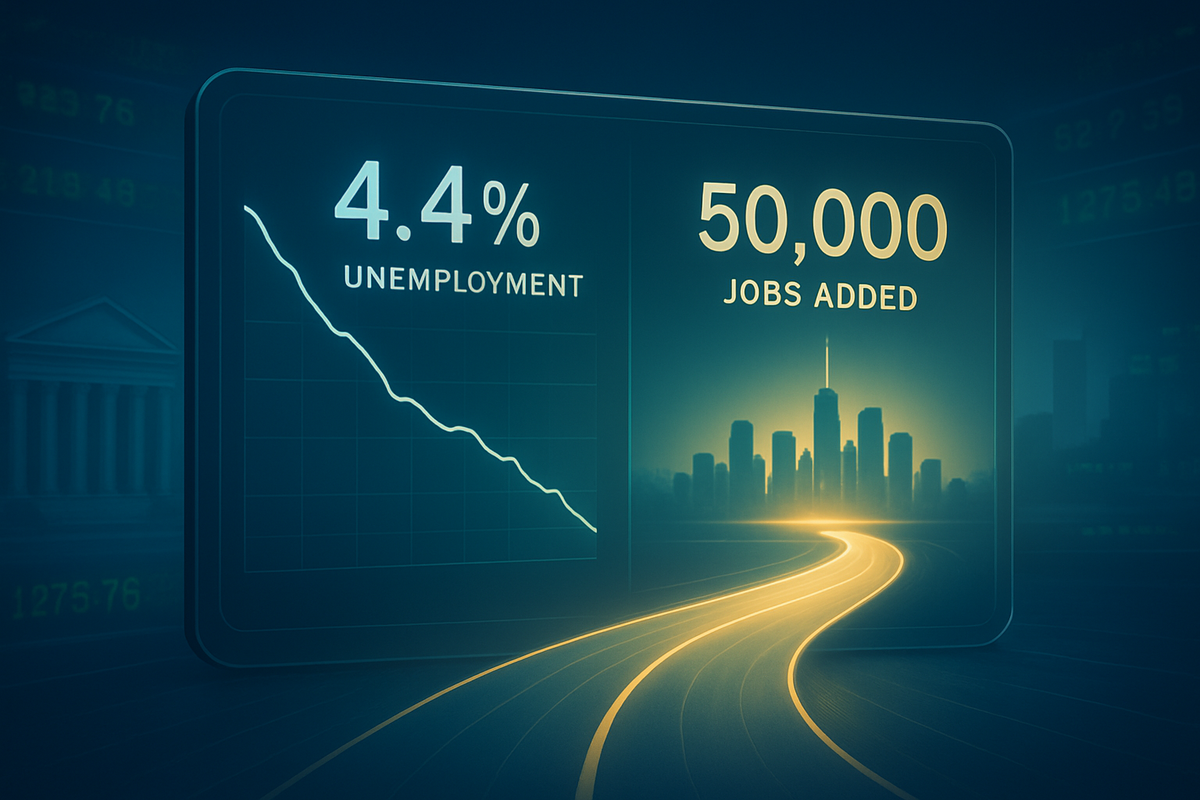
The U.S. labor market kicked off 2026 with a report that offered a paradoxical blend of cooling demand and underlying strength. On Friday, the Bureau of Labor Statistics (BLS) revealed that while the economy added a modest 50,000 jobs in December—falling short of the 73,000 expected by economists—the unemployment rate unexpectedly dipped to 4.4%. This "softer but not weak" signal has recalibrated investor expectations, suggesting that while the post-pandemic hiring boom is firmly in the rearview mirror, the floor is not falling out from under the American worker.
The immediate market reaction was one of cautious optimism. The S&P 500 (NYSEARCA:SPY) climbed 0.7% to hit a fresh all-time high of approximately 6,921, while the tech-heavy Nasdaq-100 (NASDAQ: QQQ) rose 0.8%. Investors appear to be embracing a "Goldilocks" interpretation: the economy is cooling enough to keep a lid on aggressive inflation, yet the drop in unemployment provides a cushion against recessionary fears, effectively narrowing the path for the Federal Reserve’s next move.
A Year of Subdued Stability
The December data serves as the final chapter of 2025, a year defined by what analysts are calling a "low-hire, low-fire" environment. The addition of 50,000 jobs in December brought the total for the full year to just 584,000—the weakest annual gain since the 2020 pandemic collapse. This cooling follows a tumultuous final quarter of 2025, which saw a historic government shutdown in October that led to a revised loss of 173,000 jobs. The recovery since then has been steady but sluggish, as businesses navigate new tariff uncertainties and the ongoing integration of generative AI into the workforce.
Key stakeholders, including Federal Reserve officials and Wall Street strategists, had been bracing for a potentially weaker number. However, the drop in the unemployment rate from 4.5% to 4.4% caught many by surprise. This decline occurred despite a slight dip in the labor force participation rate to 62.4%, suggesting that those currently in the workforce are finding it easier to stay employed even as new openings become scarce. Wage growth also remained "sticky," with average hourly earnings rising 0.3% for the month and 3.8% year-over-year, slightly exceeding the 3.6% forecast.
Sector Winners and Losers: A Tale of Two Economies
The December report highlighted a sharp divergence between service-oriented sectors and trade-exposed industries. Leisure and Hospitality led the way, adding 47,000 positions. This trend favored major industry players like Marriott International (NASDAQ: MAR), which has benefited from resilient high-end travel demand. Similarly, the Healthcare sector continued its hiring spree, adding roughly 40,000 jobs, providing a tailwind for massive employers like UnitedHealth Group (NYSE: UNH). These sectors remain the primary engines of growth as the U.S. shifts further toward a service-led economy.
Conversely, the "goods-producing" side of the ledger told a darker story. Manufacturing lost 8,000 jobs in December, marking its eighth consecutive month of decline. Industrial giants like Caterpillar Inc. (NYSE: CAT) have faced headwinds from a cooling global trade environment and higher borrowing costs. Retail Trade also struggled, shedding 25,000 jobs as automation and a cautious consumer base weighed on traditional brick-and-mortar operations. Amazon.com Inc. (NASDAQ: AMZN), while continuing to dominate e-commerce, has increasingly turned toward robotic fulfillment centers, a trend reflected in the broader retail sector's shrinking headcount.
Navigating the Fed's 'Soft Landing' Tightrope
This "softer but not weak" data has profound implications for the Federal Reserve's interest rate path. Before the report, some traders held out hope for a rate cut at the upcoming January 2026 meeting. However, the combination of a falling unemployment rate and 3.8% wage growth has largely taken that option off the table. According to CME Group data, the probability of a January cut plummeted from 11% to just 5% following the release. The Fed remains wary that wage growth above 3.5% could prevent inflation from fully settling at its 2% target.
The broader significance lies in the Fed’s apparent success—so far—in orchestrating a "soft landing." By keeping rates high enough to cool the labor market without triggering a spike in layoffs, the central bank has managed to maintain consumer spending power. This environment has been particularly beneficial for large-cap financial institutions like JPMorgan Chase & Co. (NYSE: JPM), which benefit from a stable credit environment and a yield curve that reflects modest growth rather than an imminent crash. However, the persistent "stickiness" of wages suggests that the "higher for longer" mantra may transition into a "higher for now" pause that could last well into the second quarter of 2026.
The Road Ahead: What to Watch in Q1 2026
As we move deeper into 2026, the primary focus for investors will shift from the quantity of jobs to the quality of economic output. The "low-hire" trend suggests that corporations are prioritizing productivity gains—often through technology investments—over headcount expansion. This could lead to a strategic pivot for companies that have relied on cheap labor, forcing a faster adoption of AI and automation. Investors should keep a close eye on the Q4 2025 earnings season, which is just beginning, to see if corporate guidance aligns with the "subdued stability" seen in the jobs data.
Short-term volatility may emerge if upcoming inflation prints show that the 3.8% wage growth is indeed feeding back into consumer prices. If inflation remains stubborn, the "softer" part of the jobs report may be ignored in favor of a more hawkish Fed stance. Conversely, if the manufacturing slump deepens or begins to bleed into the services sector, the "not weak" part of the narrative could quickly flip to a recession watch. For now, the market appears content to ride the wave of a cooling but resilient labor market.
Investor Takeaway: A Market in Transition
The December Jobs Report confirms that the U.S. economy is in a state of transition, moving away from the erratic fluctuations of the early 2020s toward a more tempered, slow-growth regime. For investors, the key takeaway is that the "Fed Put"—the idea that the central bank will rush to the rescue with rate cuts—is currently on hold because the economy simply isn't weak enough to justify it. The drop in the unemployment rate to 4.4% is a sign of health, but the tepid 50,000 payroll gain serves as a reminder that the margins for error are thinning.
Moving forward, the market is likely to remain sensitive to any data that threatens this delicate balance. Investors should watch for the January inflation report and the Fed’s late-month policy statement for clues on whether the "pause" will extend through the spring. While the S&P 500's new highs suggest confidence, the underlying sectoral weakness in manufacturing and retail warrants a selective approach to equity positioning. In this "softer but not weak" world, quality and earnings resilience will be the primary drivers of portfolio performance.
This content is intended for informational purposes only and is not financial advice.