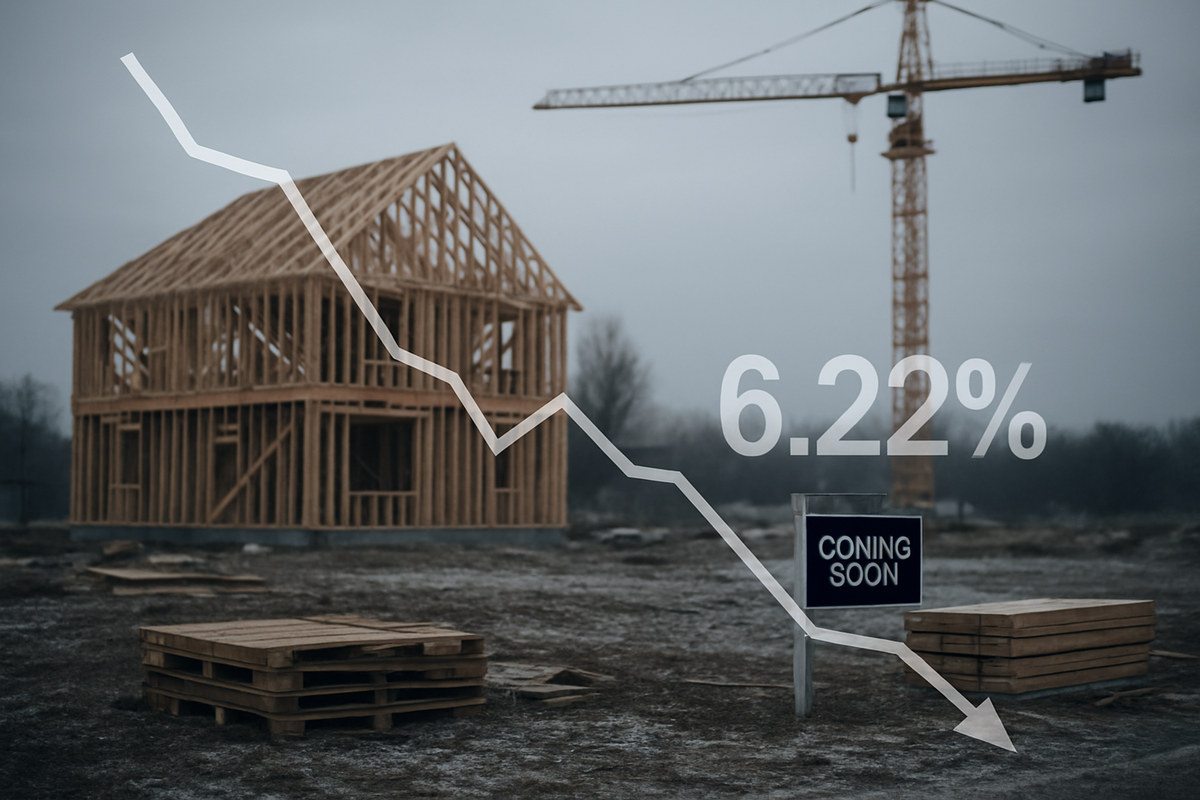
The U.S. construction industry faced a surprising setback in early 2026 as total construction spending fell by 0.3% in January, missing market expectations of a modest gain. According to data released by the U.S. Census Bureau, the seasonally adjusted annual rate of construction spending landed at $2.19 trillion. This decline was primarily fueled by a significant pullback in the private residential sector, which has struggled to find its footing amidst a volatile interest rate environment and a cooling market for major home renovations.
While total spending remains roughly 1.0% higher than the same period last year, the monthly contraction signals a cooling trend that could have broader implications for the U.S. economy. As the Federal Reserve’s battle with persistent inflation keeps mortgage rates elevated, the dream of a robust spring housing rebound appears to be deferred. The divergence between public infrastructure growth and private sector contraction highlights a shifting landscape where government-funded projects are currently the only reliable engine of growth in the building industry.
The January Downturn: A Breakdown of the Numbers
The 0.3% headline decline was a stark departure from the 0.1% increase anticipated by most Wall Street analysts. The primary culprit was the private construction sector, which saw a 0.6% drop to an annual rate of $1.66 trillion. Within this segment, the residential category—the traditional backbone of American construction—fell by a notable 0.8%. Single-family home projects slipped 0.2%, continuing a difficult run where spending has fallen in 10 of the last 11 months. Even more surprising was the 1.4% tumble in home improvement and remodeling spending, a sector that had previously remained resilient as homeowners opted to upgrade existing spaces rather than move.
The timeline leading to this dip suggests a "wait-and-see" approach from both developers and consumers. Throughout late 2025, a brief stabilization in mortgage rates had sparked hopes for a recovery in housing starts. However, as 2026 began, renewed inflationary pressures and geopolitical tensions in the Middle East pushed U.S. Treasury yields higher, which in turn dragged mortgage rates back up toward the 6.22% mark. This rapid reversal in borrowing costs likely chilled new projects that were in the planning stages at the turn of the year.
While the private sector faltered, public construction provided a much-needed buffer. Government-funded spending rose 0.6% to $529.2 billion in January. The standout performer was highway and street construction, which surged by 3.3%. This boost is largely attributed to the continued flow of funds from federal infrastructure legislation, which has created a steady pipeline of work for civil engineering firms even as the residential market faces a "high-for-longer" interest rate reality.
Winners and Losers: Navigating the Market Impact
The unexpected dip in construction spending has created a clear divide among public companies. Homebuilders such as D.R. Horton Inc. (NYSE: DHI) and Lennar Corporation (NYSE: LEN) are finding themselves in a defensive posture. To combat the 0.8% decline in residential spending, these companies have been forced to lean heavily into mortgage rate buy-downs and other buyer incentives to keep inventory moving. For D.R. Horton, which markets itself as "America’s Builder," the challenge is twofold: maintaining its dominance in the entry-level market while navigating a new federal policy environment that has hampered its high-growth "Build-to-Rent" communities.
Retail giants The Home Depot, Inc. (NYSE: HD) and Lowe’s Companies, Inc. (NYSE: LOW) are perhaps the most immediately impacted by the 1.4% decline in remodeling spending. As discretionary income is squeezed by higher living costs and the cost of home equity loans rises, the "big-ticket" renovation projects—kitchen remodels, deck additions, and basement finishing—are being postponed. For these retailers, the January data suggests a challenging first half of 2026, with comparable-store sales likely to remain flat as DIYers and professional contractors alike pull back on spending.
Conversely, the strength in the public sector provides a silver lining for heavy materials and infrastructure companies. Firms like Vulcan Materials Company (NYSE: VMC) and Martin Marietta Materials, Inc. (NYSE: MLM) are poised to benefit from the 3.3% surge in highway and street projects. As public spending remains a priority for federal and state governments, these companies are seeing strong demand for aggregate, cement, and asphalt, insulating them from the residential slump.
Broader Industry Trends and Historical Context
The current situation mirrors historical precedents where rapid interest rate hikes eventually caught up with the capital-intensive construction industry. Much like the period following the 2008 financial crisis, the market is grappling with a supply-demand mismatch, though for different reasons. Today, the "lock-in" effect—where homeowners are reluctant to sell because they hold pandemic-era mortgage rates below 3%—has created a shortage of existing inventory. While this should theoretically drive new construction, the high cost of financing new projects is making it difficult for builders to break ground.
Furthermore, this 0.3% dip reflects a shift in consumer sentiment. During the 2021-2023 period, the "home-as-sanctuary" trend drove record spending on renovations. The January 2026 data indicates that this trend has finally reached an inflection point. With the average 30-year fixed mortgage rate jumping from 5.98% to 6.22% in a matter of weeks, the financial math for a major home addition no longer makes sense for the average American family.
From a policy perspective, the January report may put additional pressure on the Federal Reserve. While the Fed is focused on cooling the economy to fight inflation, the housing shortage remains a primary driver of the Consumer Price Index (CPI). If high interest rates continue to stifle new construction, the lack of housing supply could ironically keep home prices and rents high, creating a persistent inflationary loop that is difficult to break.
Looking Ahead: Strategic Pivots and Market Scenarios
In the short term, the construction industry will likely remain in a period of consolidation. Homebuilders are expected to focus on "margin recovery" rather than volume, utilizing modular construction techniques and supply chain optimizations to offset the cost of buyer incentives. Companies like Lennar Corporation (NYSE: LEN) have already signaled a pivot toward technological initiatives to reduce labor costs, which remain high despite the slowdown in activity.
The long-term outlook remains dependent on the trajectory of the 10-year Treasury yield. If inflation shows signs of cooling by the second half of 2026, a stabilization of mortgage rates around the 5.5% mark could unleash significant pent-up demand. Investors should watch for a "spring thaw" in April and May data; if the residential sector fails to rebound during the peak selling season, it could indicate a more structural downturn rather than a temporary dip.
Strategic pivots are also emerging in the commercial and industrial sectors. As residential work slows, some contractors are shifting their focus to the burgeoning green energy and semiconductor manufacturing sectors, which are also benefiting from significant federal subsidies. This diversification could provide a safety net for large-scale construction firms that are agile enough to move between private and public projects.
Final Assessment: What Investors Should Watch
The 0.3% decline in January construction spending is a reminder that the U.S. economy is still navigating the "long tail" of the post-pandemic interest rate shock. While the dip was unexpected, it was not catastrophic, and the resilience of public sector spending remains a critical stabilizer. The key takeaway for investors is the importance of sector selection: while the residential and home improvement sectors face immediate headwinds, infrastructure and heavy materials are currently operating in a much more favorable environment.
In the coming months, the most important metric for the market will be the performance of the spring selling season. If homebuilders can maintain sales volume through aggressive incentives without completely eroding their margins, the industry may navigate this "soft patch" successfully. However, if the contraction in remodeling spending continues to accelerate, it could signal a broader pullback in consumer confidence that reaches beyond the housing market.
As of March 24, 2026, the construction market stands at a crossroads. Investors should keep a close eye on the Federal Reserve's next meeting and the subsequent movement in the 10-year Treasury yield. Any sustained drop in rates could provide the catalyst needed to turn these "unexpected dips" back into the growth the market has been waiting for.
This content is intended for informational purposes only and is not financial advice