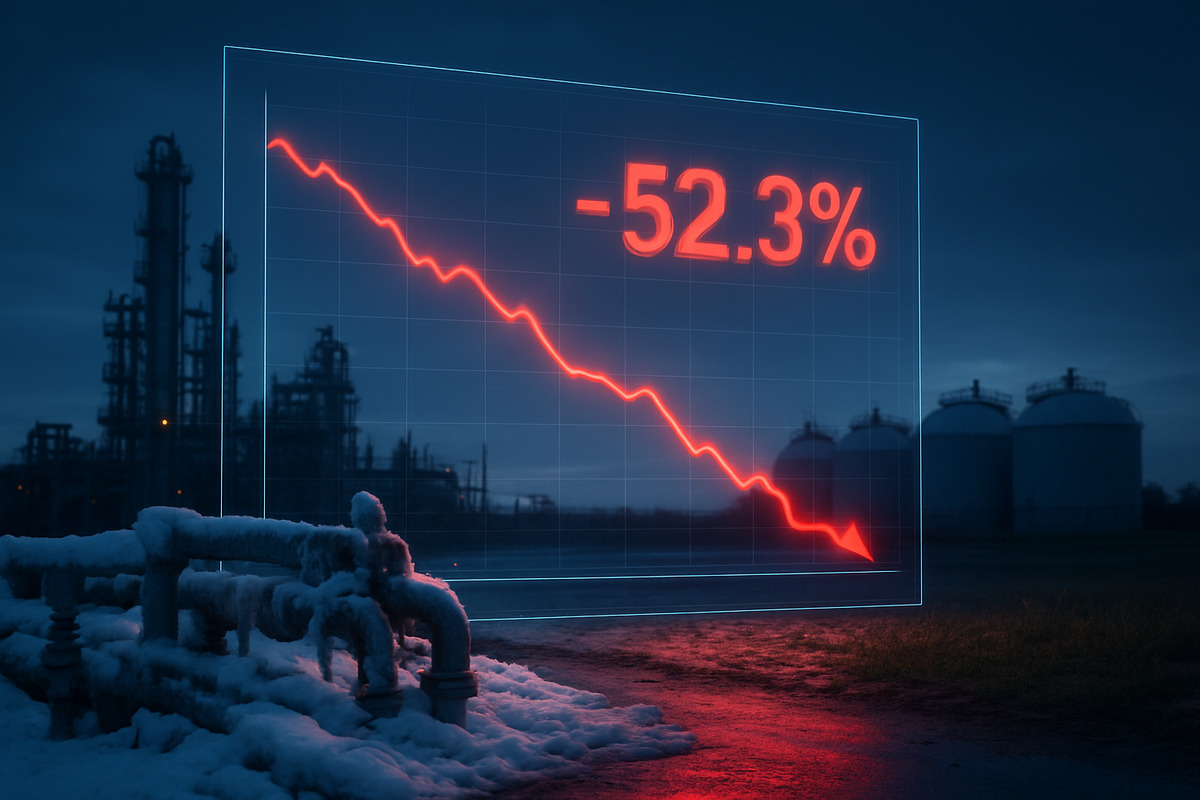
The World Bank’s latest commodity report has revealed a staggering 52.3% decline in U.S. natural gas prices for the month of February 2026. This dramatic crash, which followed a period of extreme volatility earlier in the year, has sent ripples through the global energy markets and significantly impacted broader economic indicators. By wiping out nearly all the price momentum gained during a frigid January, the collapse has forced a massive recalibration of expectations for energy producers and investors alike.
The massive drop in the U.S. benchmark, Henry Hub, played a critical role in stabilizing the World Bank’s overall energy price index. Despite notable increases in Brent crude oil (ICE: B) and Australian coal prices during the same period—which rose 6.5% and 7.8% respectively—the collapse of natural gas costs almost entirely offset these gains. Consequently, the global energy index edged down by 0.5%, providing an unexpected relief valve for global energy inflation. This development highlights the growing influence of the U.S. shale market on global energy price dynamics and the inherent volatility of natural gas as a primary heating and power-generation fuel.
A Violent Normalization: The Anatomy of a Crash
The crash in February 2026 was largely characterized as a "violent normalization" by market analysts following a month of historic extremes. In January 2026, the United States was gripped by "Winter Storm Fern," a historic weather event that triggered a massive 78% spike in natural gas prices. During that period, demand for heating soared to record levels while production was hampered by wellhead freeze-offs and infrastructure constraints. However, as the storm subsided and February brought unexpectedly mild temperatures to the central and western United States, the market fundamentals shifted overnight. The surge in January was quickly erased as weather forecasts predicted above-average temperatures through March, drastically reducing the demand for heating fuel.
Furthermore, the supply-side pressure remained relentless throughout the month. Despite the heavy withdrawals during the January freeze, U.S. natural gas stockpiles ended February roughly 10.4% above the previous year's levels and 2.6% above the five-year average. A primary contributor to this persistent surplus is the continued boom in crude oil production in the Permian Basin. Companies drilling for oil in this region produce natural gas as a byproduct, known as "associated gas." This supply enters the market regardless of natural gas price levels, creating a structural floor on production that prevents the market from tightening even when dedicated gas drilling slows down.
Key players in this sector, including recently merged giants and long-standing industry leaders, found themselves navigating a rapidly shifting landscape. The initial market reaction was one of sharp liquidation in the futures markets, exacerbated by a lessening of geopolitical tensions in the Middle East. As reports indicated successful mediation efforts to lower "war risk premiums" in the region, financial outflows from energy futures accelerated, leaving natural gas prices without their speculative support.
Winners and Losers in the Wake of the Slide
The primary victims of this price collapse are the pure-play natural gas producers, who rely heavily on spot prices for their revenue. Expand Energy (NASDAQ: EXE), the newly formed industry leader resulting from the 2024 merger of Chesapeake Energy and Southwestern Energy, faces significant headwinds as the largest independent producer in the country. With its massive footprint in the Appalachia and Haynesville basins, Expand Energy’s margins are directly tied to the Henry Hub benchmark, making such a precipitous drop a major challenge for its Q1 earnings outlook. Similarly, EQT Corporation (NYSE: EQT), the nation’s second-largest producer, may see its earnings guidance challenged by the February slump, despite its reputation for low-cost horizontal drilling operations in the Appalachian Basin.
Coterra Energy (NYSE: CTRA), which maintains a diversified portfolio across the Permian, Appalachia, and Anadarko regions, might fare slightly better than its pure-play peers due to its exposure to oil and natural gas liquids (NGLs). However, the general downward trend in gas prices still puts pressure on its overall valuation and capital expenditure plans. For these producers, the focus will likely shift toward capital discipline and potentially "shutting in" production in less profitable areas to wait for a price recovery, a move that EQT has historically employed during periods of extreme oversupply.
Conversely, the "winners" in this scenario include major energy consumers and utilities that utilize natural gas for power generation. Companies like NextEra Energy (NYSE: NEE) and other large-scale utilities benefit from lower input costs, which can lead to higher margins or the ability to pass savings on to consumers, potentially easing inflationary pressures across the domestic economy. Additionally, diversified energy majors like ExxonMobil (NYSE: XOM) and Chevron (NYSE: CVX) are better insulated. While they produce significant amounts of natural gas in the Permian, their integrated business models—including refining, chemicals, and global logistics—allow them to absorb the impact of low domestic gas prices more effectively than independent drillers.
Broader Market Significance and Historical Precedents
This event fits into a broader trend of "decoupling" between natural gas and other energy commodities. While the global oil market remains sensitive to OPEC+ production cuts and geopolitical instability, the U.S. natural gas market is increasingly defined by its own domestic abundance. The World Bank’s report indicates that the magnitude of the U.S. gas crash was sufficient to balance out global gains in oil and coal, preventing a broader spike in the energy price index that could have hampered global economic growth. This underscores the United States' role as a "deflationary force" in the global energy sector, provided its infrastructure can handle the surplus.
The situation also highlights the ongoing impact of the "Permian surplus." As long as U.S. oil production remains at record levels, associated gas will continue to flood the market, creating a structural challenge for producers in the Marcellus and Utica shales who do not have the benefit of high-value oil co-production. This may lead to increased regulatory scrutiny and a renewed push for infrastructure projects, such as new pipelines and liquefied natural gas (LNG) export terminals, to move this excess gas to international markets where prices remain significantly higher than at Henry Hub.
Historically, this February crash is reminiscent of the "polar vortex" fluctuations seen in previous years, but the scale of the 52.3% drop is one of the largest single-month corrections on record for the benchmark. It serves as a stark reminder of how quickly the transition from "shortage" to "glut" can occur in the modern energy landscape, especially with the efficiency of shale drilling and the unpredictability of climate patterns. The 2026 event may be remembered as the moment when the market finally realized that even historic winter storms cannot permanently fix a market oversupplied by associated gas.
The Road Ahead: Strategic Pivots and LNG Exporting
In the short term, the market is likely to remain volatile as traders balance the current oversupply against the potential for late-season cold snaps or early summer cooling demand. Producers like ConocoPhillips (NYSE: COP) and others will likely prioritize high-value assets and may further consolidate to achieve the economies of scale necessary to survive in a low-price environment. The strategic pivot toward LNG exports remains the most significant long-term catalyst for the industry. As more export capacity comes online along the Gulf Coast, the U.S. will gain a greater ability to arbitrage the price difference between domestic and international markets, potentially lifting the floor for Henry Hub prices.
Investors should watch for the upcoming quarterly earnings reports from the major producers to see how they have hedged their production against these price swings. A strategic shift toward "value over volume" is expected to become the industry mantra. If prices remain depressed through the spring, we could see a more aggressive reduction in rig counts in the Haynesville shale, which is generally more expensive to drill than the Appalachian basins. This reduction in supply could eventually set the stage for a price recovery in late 2026 or 2027.
Market opportunities may also emerge in the midstream sector, where companies that own the pipelines and storage facilities provide the necessary infrastructure to manage this volatility. However, the overarching challenge remains: the U.S. has become exceptionally efficient at producing natural gas. Until global demand—largely driven by the build-out of LNG infrastructure—catches up with the domestic supply, "crashes" like the one seen in February 2026 may become a more frequent and disruptive feature of the energy market.
Final Assessment: A High-Stakes Balancing Act
The 52.3% collapse in U.S. natural gas prices in February 2026 represents a landmark event in the energy sector, effectively neutralizing broader inflationary pressures within the global energy price index. Driven by a combination of mild weather, record inventories, and relentless associated gas production, the crash has fundamentally altered the outlook for the first half of the year. While consumers and utilities may breathe a sigh of relief, the pressure on independent producers like Expand Energy and EQT Corporation is immense.
Moving forward, the market will be defined by the industry's ability to balance its domestic abundance with the growing global thirst for energy. The "normalization" of prices after the January spike shows just how sensitive the market has become to weather and inventory data. For investors, the coming months will require a close eye on storage reports and the progress of LNG infrastructure projects. The natural gas market remains a high-stakes environment where the balance between supply and demand is as fragile as the weather forecasts it depends upon.
This content is intended for informational purposes only and is not financial advice.