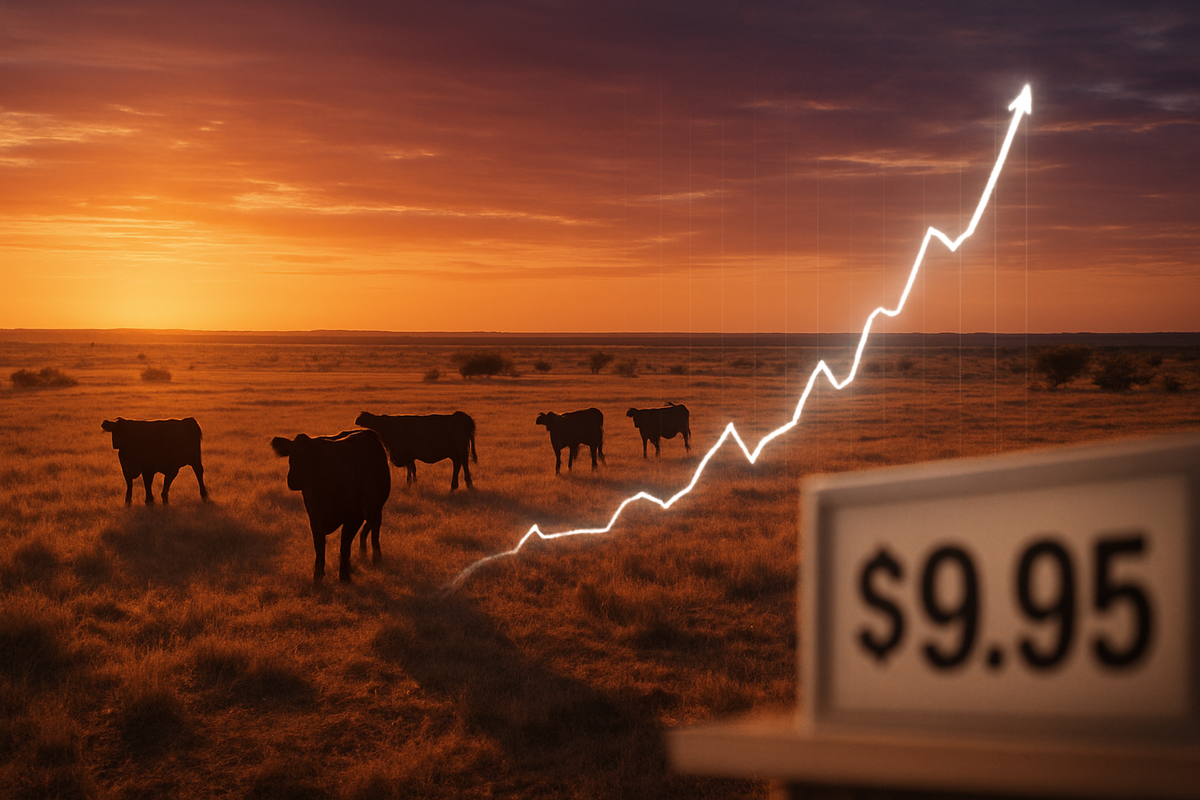
The American dinner table is undergoing a historic transformation as the U.S. beef industry enters a "Super-Cycle" defined by unprecedented scarcity and astronomical costs. As of April 2, 2026, the convergence of a multi-year drought, high interest rates, and a biological supply lag has pushed the national cattle herd to its lowest level since the Truman administration. For consumers, the impact is visceral: retail beef prices have surged to a record average of $9.95 per pound, with premium cuts often exceeding the $20 mark in metropolitan areas.
This is not a temporary supply chain hiccup but a structural realignment of the protein market. With Live Cattle futures hitting a staggering $240.20 per hundredweight on the Chicago Mercantile Exchange, the financial pressure is vibrating through every link of the supply chain, from the remote ranches of Nebraska to the boardrooms of multi-billion dollar meatpacking giants. As middle-income families "trade down" to chicken and pork, the industry is bracing for a high-price environment that experts warn will not see meaningful relief until at least 2028.
The 75-Year Low: A Crisis in the Corral
The current crisis is the culmination of nearly a decade of agricultural and economic headwinds. According to the USDA’s January 2026 Cattle Inventory report, the total U.S. herd has fallen to 86.2 million head, the smallest population recorded since 1951. More alarming is the state of the beef cow herd—the engine of future production—which sits at just 27.6 million head. This marks the eighth consecutive year of contraction, a "liquidation phase" that began in 2019 and was accelerated by severe, persistent droughts across the Great Plains between 2022 and 2025.
The timeline leading to this $240.20 futures peak was paved with difficult choices for American ranchers. For years, high feed costs and parched pastures forced producers to sell off their breeding stock rather than maintain them. Even as prices began to climb in 2024 and 2025, many ranchers chose to sell their young heifers for immediate cash to pay off debt rather than "retaining" them to grow the herd. This lack of heifer retention is the primary reason the market is now facing a "dead zone" of supply. Because it takes roughly three years for a heifer to produce a calf that eventually reaches the market, the decisions made today will not impact grocery store shelves until late 2028.
Initial market reactions have been characterized by extreme volatility. Commodity traders have dubbed this the "scarcity premium," where the lack of available "front-month" cattle has led to speculative buying, driving prices well beyond historical norms. In the Heartland, the shortage has forced the closure of major processing facilities, including a massive Tyson Foods (NYSE: TSN) plant in Lexington, Nebraska, as there simply aren't enough cattle to keep the lines running at efficient capacities.
Winners and Losers: The Great Protein Pivot
The financial fallout of the Beef Super-Cycle has created a stark divide between those who produce the protein and those who process and sell it. Tyson Foods (NYSE: TSN) has emerged as one of the most visible casualties of the cycle. The company’s beef segment, once a primary profit driver, reported a staggering adjusted operating loss of over $300 million in the most recent quarter. Tyson is caught in a "packer squeeze," paying record prices for live cattle while struggling to pass those costs onto consumers who are increasingly price-sensitive.
Conversely, Pilgrim’s Pride (NASDAQ: PPC) has become the inadvertent "winner" of the beef shortage. As beef prices skyrocket, consumers are pivoting en masse to poultry. Pilgrim’s Pride reported a healthy 12.3% EBITDA margin in its latest filings, fueled by a surge in demand for affordable chicken. Similarly, JBS S.A. (OTCMKTS: JBSAY) has leveraged its global footprint to mitigate U.S. losses; while its domestic beef margins are razor-thin, its operations in Australia and Brazil—where herds are expanding—have allowed the company to maintain overall profitability.
The restaurant sector is also feeling the heat. Texas Roadhouse (NASDAQ: TXRH), known for its "value" steak offerings, has had to implement multiple menu price hikes, including a 1.9% increase this quarter alone. To protect its margins, the company is diversifying into the chicken market via its "Jaggers" brand. Meanwhile, McDonald’s (NYSE: MCD) has leaned heavily into its "McValue" menu and chicken-based products to keep customers in the door, effectively treating its beef offerings as premium "tier-two" items rather than the core of its business.
Broader Significance and the Regulatory Shield
The Beef Super-Cycle is more than a market anomaly; it is a catalyst for significant regulatory and policy shifts. In late 2025, the severity of beef inflation prompted the Department of Justice to launch a civil antitrust investigation into the "Big Four" meatpackers—Tyson, JBS, Cargill, and National Beef. Regulators are scrutinizing whether these giants are using the supply shortage as a pretext for "greedflation," or if they are unfairly squeezing independent ranchers who still struggle with high operational costs despite the record cattle prices.
The event also has major international trade implications. To ease the domestic shortage, the U.S. government recently quadrupled the tariff-rate quota for Argentine beef, allowing for an influx of lean beef trimmings used in ground beef production. This move was necessitated by a near-total halt in cattle imports from Mexico following a devastating "New World Screwworm" outbreak that closed the border to livestock in 2025. This geopolitical friction has made the U.S. "beef island" more isolated, further driving up domestic prices compared to the rest of the world.
Historically, this cycle is being compared to the 2014-2015 "Great Contraction," but analysts argue the current situation is far more severe. In 2014, the herd hit 88.5 million head; today’s 86.2 million represents a deeper trough with fewer easy fixes. Unlike the 2014 recovery, which was aided by low interest rates, the 2026 recovery is being choked by the high cost of capital, making it much harder for young ranchers to enter the industry or for established ones to finance expansion.
Looking Ahead: The Long Road to 2028
Short-term relief is nowhere in sight. Market analysts expect beef prices to remain at or near record highs through the end of 2027. The "biological clock" of cattle production is the ultimate bottleneck; even if ranchers began retaining heifers at record rates tomorrow, that supply wouldn't hit the slaughterhouse for years. This suggests that the "Protein Pivot"—the consumer shift from beef to chicken and plant-based alternatives—may become a permanent behavioral change rather than a temporary fix.
Strategic adaptations are already emerging. We are likely to see more "blended" products on supermarket shelves, where ground beef is mixed with plant-based proteins or mushrooms to keep the price-per-package down. On the corporate side, expect more plant closures and "right-sizing" from major packers as they adjust to a smaller national herd. For investors, the opportunity may lie in the "integrated" players who have exposure to multiple proteins, as well as the specialized technology companies working on lab-grown or fermentation-based meat substitutes that can bypass the three-year biological cycle of a cow.
Potential scenarios for late 2026 include a "demand destruction" event where beef becomes a luxury good, akin to lobster or high-end veal. If retail prices cross the psychological barrier of $12 or $15 per pound for basic cuts, the political pressure for further price controls or meatpacker breakups will likely reach a fever pitch.
Final Assessment: A New Era for Livestock
The Beef Super-Cycle of 2026 is a watershed moment for the American food system. It has exposed the fragility of a highly concentrated supply chain and the profound impact of climatic and economic shifts on the cost of living. The key takeaway for the market is clear: the era of "cheap beef" is over, and the structural scarcity of cattle will continue to dictate the fortunes of the world's largest food companies for the foreseeable future.
Moving forward, the market will be defined by resilience and substitution. Investors should keep a close eye on heifer retention data in the USDA's mid-year reports; until that number shows a significant uptick, there is no "light at the end of the tunnel." Watch for how companies like Tyson Foods (NYSE: TSN) and Texas Roadhouse (NASDAQ: TXRH) manage their margins in a high-input-cost environment and whether the DOJ's antitrust probe results in any meaningful structural changes to the meatpacking industry. For now, the "Super-Cycle" remains the dominant force in the commodity markets, and the $10 pound of beef is the new, painful reality.
This content is intended for informational purposes only and is not financial advice.