
Let’s dig into the relative performance of Universal Logistics (NASDAQ: ULH) and its peers as we unravel the now-completed Q1 ground transportation earnings season.
The growth of e-commerce and global trade continues to drive demand for shipping services, especially last-mile delivery, presenting opportunities for ground transportation companies. The industry continues to invest in data, analytics, and autonomous fleets to optimize efficiency and find the most cost-effective routes. Despite the essential services this industry provides, ground transportation companies are still at the whim of economic cycles. Consumer spending, for example, can greatly impact the demand for these companies’ offerings while fuel costs can influence profit margins.
The 15 ground transportation stocks we track reported a strong Q1. As a group, revenues beat analysts’ consensus estimates by 2.1%.
Thankfully, share prices of the companies have been resilient as they are up 6.7% on average since the latest earnings results.
Weakest Q1: Universal Logistics (NASDAQ: ULH)
Founded in 1932, Universal Logistics (NASDAQ: ULH) is a provider of customized transportation and logistics solutions operating throughout the United States and in Mexico, Canada, and Colombia.
Universal Logistics reported revenues of $367.6 million, down 3.9% year on year. This print fell short of analysts’ expectations by 1.3%. Overall, it was a disappointing quarter for the company with a significant miss of analysts’ EBITDA and EPS estimates.
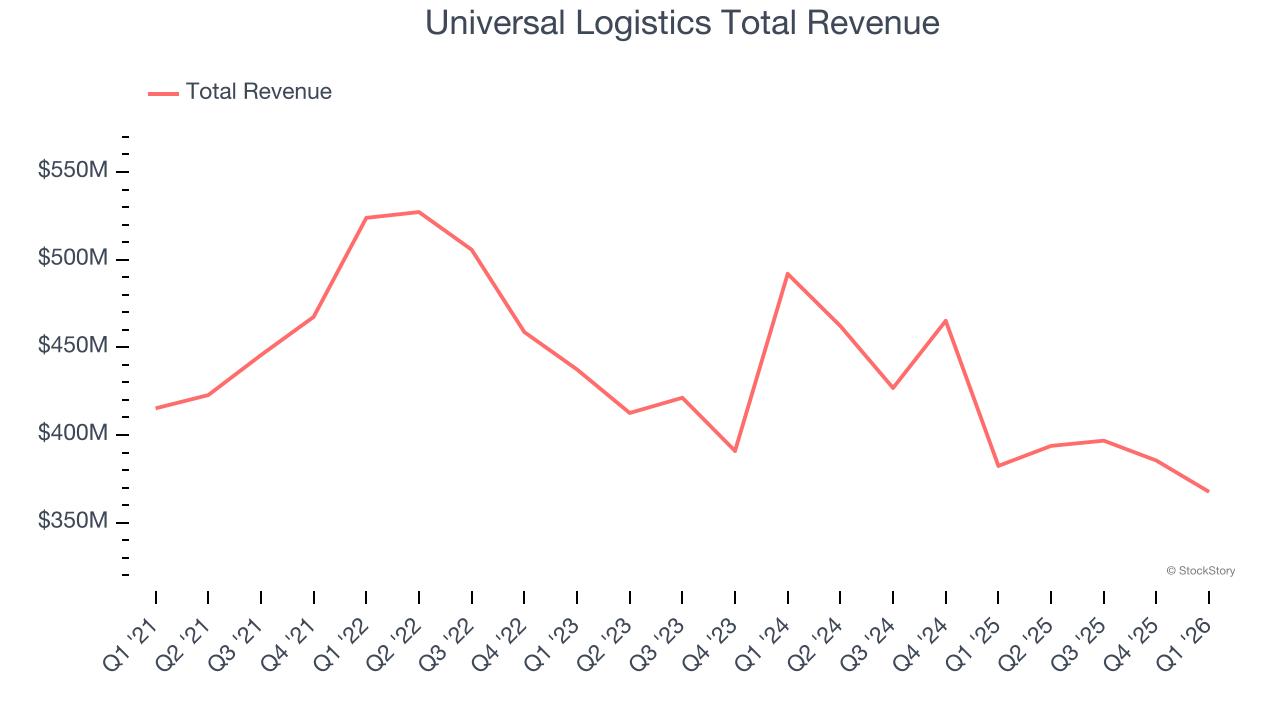
Universal Logistics delivered the weakest performance against analyst estimates of the whole group. The market seems disappointed with the results as the stock is down 36.3% since reporting and currently trades at $14.26.
Read our full report on Universal Logistics here, it’s free.
Best Q1: Heartland Express (NASDAQ: HTLD)
Founded by the son of a trucker, Heartland Express (NASDAQ: HTLD) offers full-truckload deliveries across the United States and Mexico.
Heartland Express reported revenues of $176.3 million, down 19.7% year on year, outperforming analysts’ expectations by 2.6%. The business had a stunning quarter with a beat of analysts’ EPS estimates.
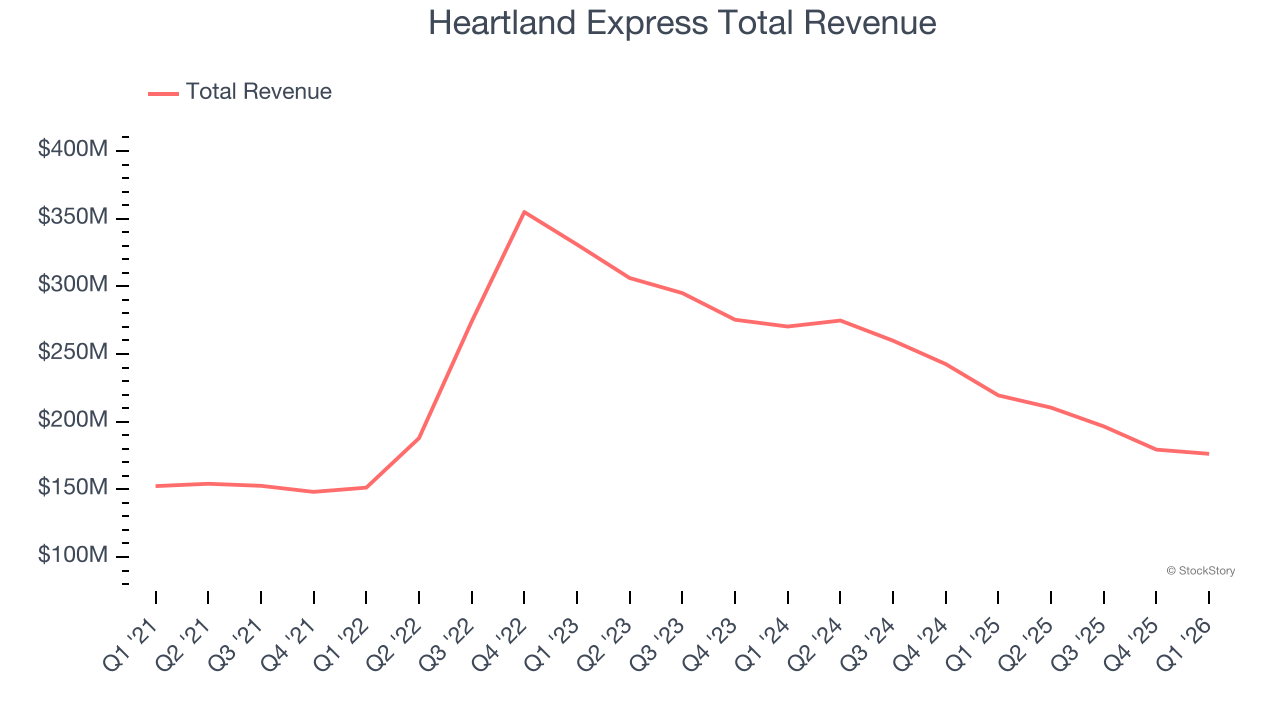
The market seems happy with the results as the stock is up 27.7% since reporting. It currently trades at $14.79.
Is now the time to buy Heartland Express? Access our full analysis of the earnings results here, it’s free.
Knight-Swift Transportation (NYSE: KNX)
Covering 1.6 billion loaded miles in 2023 alone, Knight-Swift Transportation (NYSE: KNX) offers less-than-truckload and full truckload delivery services.
Knight-Swift Transportation reported revenues of $1.85 billion, up 1.4% year on year, in line with analysts’ expectations. It was a softer quarter as it posted a significant miss of analysts’ EPS estimates.
Interestingly, the stock is up 17.5% since the results and currently trades at $75.18.
Read our full analysis of Knight-Swift Transportation’s results here.
Werner (NASDAQ: WERN)
Conducting business in over a 100 countries, Werner (NASDAQ: WERN) offers full-truckload, less-than-truckload, and intermodal delivery services.
Werner reported revenues of $808.6 million, up 13.6% year on year. This print surpassed analysts’ expectations by 0.6%. Overall, it was an exceptional quarter as it also logged a beat of analysts’ EPS and adjusted operating income estimates.
The stock is up 28% since reporting and currently trades at $44.03.
Read our full, actionable report on Werner here, it’s free.
Avis Budget Group (NASDAQ: CAR)
The parent company of brands such as Zipcar and Budget Truck Rental, Avis (NASDAQ: CAR) is a provider of car rental and mobility solutions.
Avis Budget Group reported revenues of $2.53 billion, up 4.1% year on year. This result topped analysts’ expectations by 4.7%. It was an exceptional quarter as it also recorded a solid beat of analysts’ EBITDA and EPS estimates.
The stock is down 13.8% since reporting and currently trades at $156.81.
Read our full, actionable report on Avis Budget Group here, it’s free.
Market Update
Late in 2025 into early 2026, there was hand-wringing around artificial intelligence. For software companies, the fear was that AI would erode pricing power and compress margins as new tools made it easier to replicate what once required expensive enterprise platforms. Crypto investors had their own version of the same anxiety: if AI agents could trade, allocate capital, and manage wallets autonomously, what exactly was the long-term value of today’s crypto infrastructure?
These concerns triggered a noticeable rotation away from these sectors and into safer havens. But markets rarely dwell on one narrative for long. Spring 2026 came, and the focus shifted abruptly from technological disruption to geopolitical risk. The US’ conflict with Iran became the dominant driver of market psychology, and when geopolitics takes center stage, the script changes quickly. Investors stop debating growth rates and start worrying about oil supply, inflation, and global stability.
Want to invest in winners with rock-solid fundamentals? Check out our Top 6 Stocks and add them to your watchlist. These companies are poised for growth regardless of the political or macroeconomic climate.