Specialty pharmaceutical company Supernus Pharmaceuticals (NASDAQ: SUPN) reported Q2 CY2026 results topping the market’s revenue expectations, with sales up 32.4% year on year to $219.1 million. The company’s full-year revenue guidance of $875 million at the midpoint came in 0.9% above analysts’ estimates. Its GAAP loss of $1.01 per share was significantly below analysts’ consensus estimates.
Is now the time to buy Supernus Pharmaceuticals? Find out by accessing our full research report, it’s free.
Supernus Pharmaceuticals (SUPN) Q2 CY2026 Highlights:
- "Announced today agreement to merge with Indivior Pharmaceuticals, Inc. (Indivior) creating a diversified CNS biopharmaceutical company with significant scale."
- Revenue: $219.1 million vs analyst estimates of $205.6 million (32.4% year-on-year growth, 6.6% beat)
- EPS (GAAP): -$1.01 vs analyst estimates of $0.04 (significant miss due to one-time impairment charge)
- The company lifted its revenue guidance for the full year to $875 million at the midpoint from $855 million, a 2.3% increase
- Operating Margin: -26.5%, down from 7.3% in the same quarter last year
- Market Capitalization: $2.59 billion
“Our first-half 2026 results reflect the continued strength and sustained momentum of our growth products and continued execution on our commercial strategy,” said Jack Khattar, President and CEO of Supernus.
Company Overview
With a diverse portfolio of eight FDA-approved medications targeting neurological conditions, Supernus Pharmaceuticals (NASDAQ: SUPN) develops and markets treatments for central nervous system disorders including epilepsy, ADHD, Parkinson's disease, and migraine.
Revenue Growth
A company’s long-term sales performance can indicate its overall quality. Any business can put up a good quarter or two, but the best consistently grow over the long haul. Regrettably, Supernus Pharmaceuticals’s sales grew at a mediocre 6.7% compounded annual growth rate over the last five years. This fell short of our benchmark for the healthcare sector and is a tough starting point for our analysis.
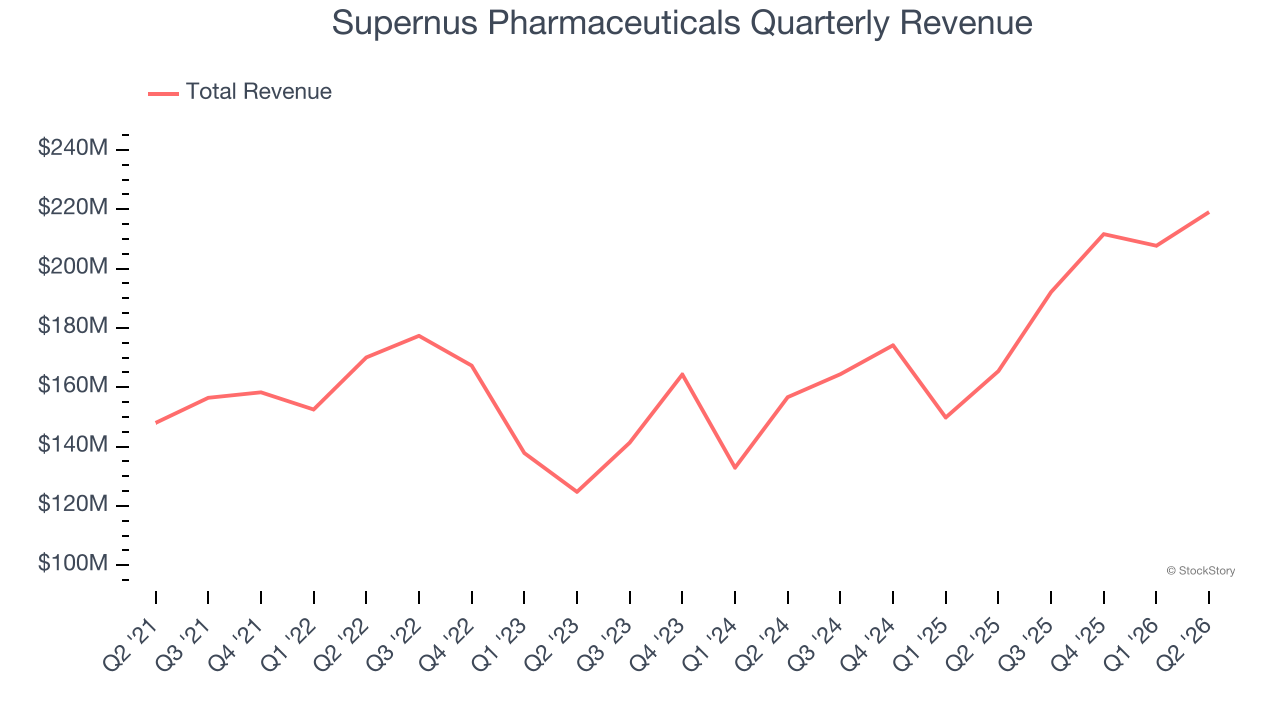
Long-term growth is the most important, but within healthcare, a half-decade historical view may miss new innovations or demand cycles. Supernus Pharmaceuticals’s annualized revenue growth of 18.1% over the last two years is above its five-year trend, suggesting its demand recently accelerated. 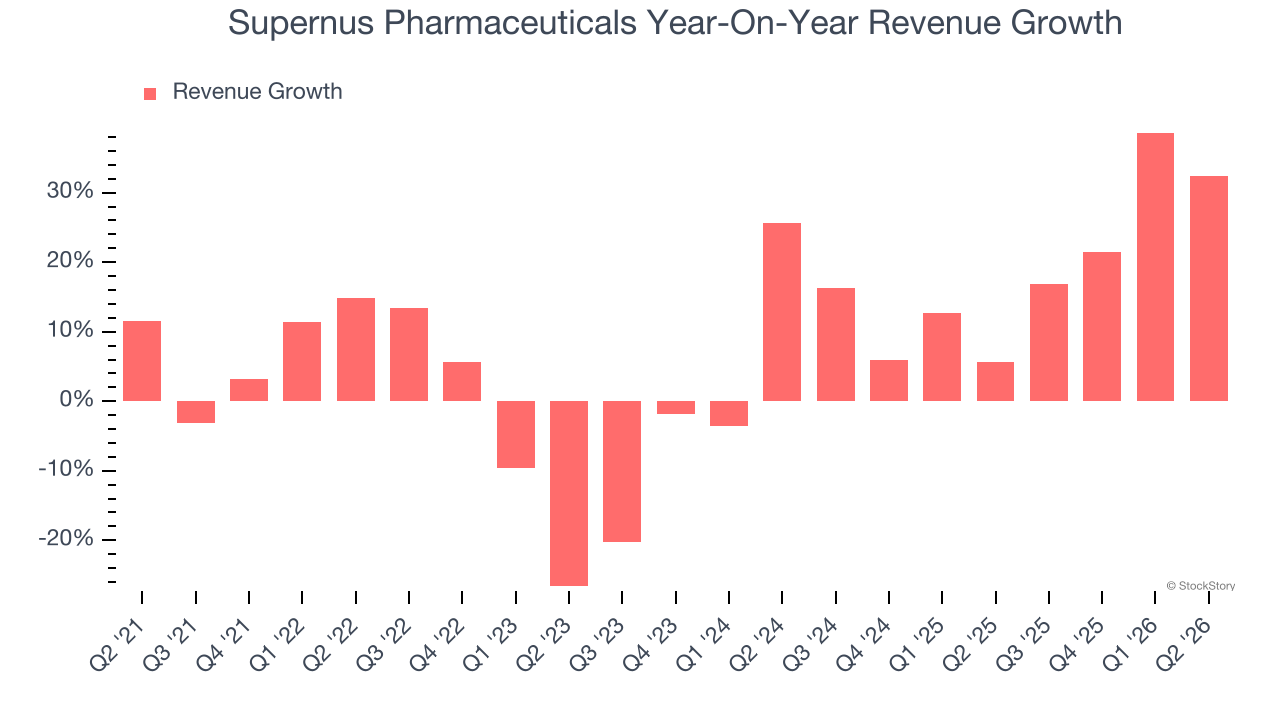
This quarter, Supernus Pharmaceuticals reported wonderful year-on-year revenue growth of 32.4%, and its $219.1 million of revenue exceeded Wall Street’s estimates by 6.6%.
Looking ahead, sell-side analysts expect revenue to grow 13.1% over the next 12 months, a deceleration versus the last two years. Still, this projection is healthy and suggests the market sees success for its products and services.
ONE MORE THING: The $21 AI Application Stock Wall Street Forgot. While Wall Street obsesses over who’s building AI, one company is already using it to print money. And nobody’s paying attention.
AI chip stocks trade at ridiculous valuations. This company processes a trillion consumer signals monthly using AI and trades at a third of the price. The gap won’t last. The institutions will figure it out. You need to see this first. Read the FREE Report Before They Notice.
Adjusted Operating Margin
Supernus Pharmaceuticals has been an efficient company over the last five years. It was one of the more profitable businesses in the healthcare sector, boasting an average adjusted operating margin of 20.2%.
Analyzing the trend in its profitability, Supernus Pharmaceuticals’s adjusted operating margin decreased by 16.5 percentage points over the last five years. This performance was caused by more recent speed bumps as the company’s margin fell by 18.2 percentage points on a two-year basis. We’re disappointed in these results because they show its expenses were rising and it couldn’t pass those costs onto its customers.
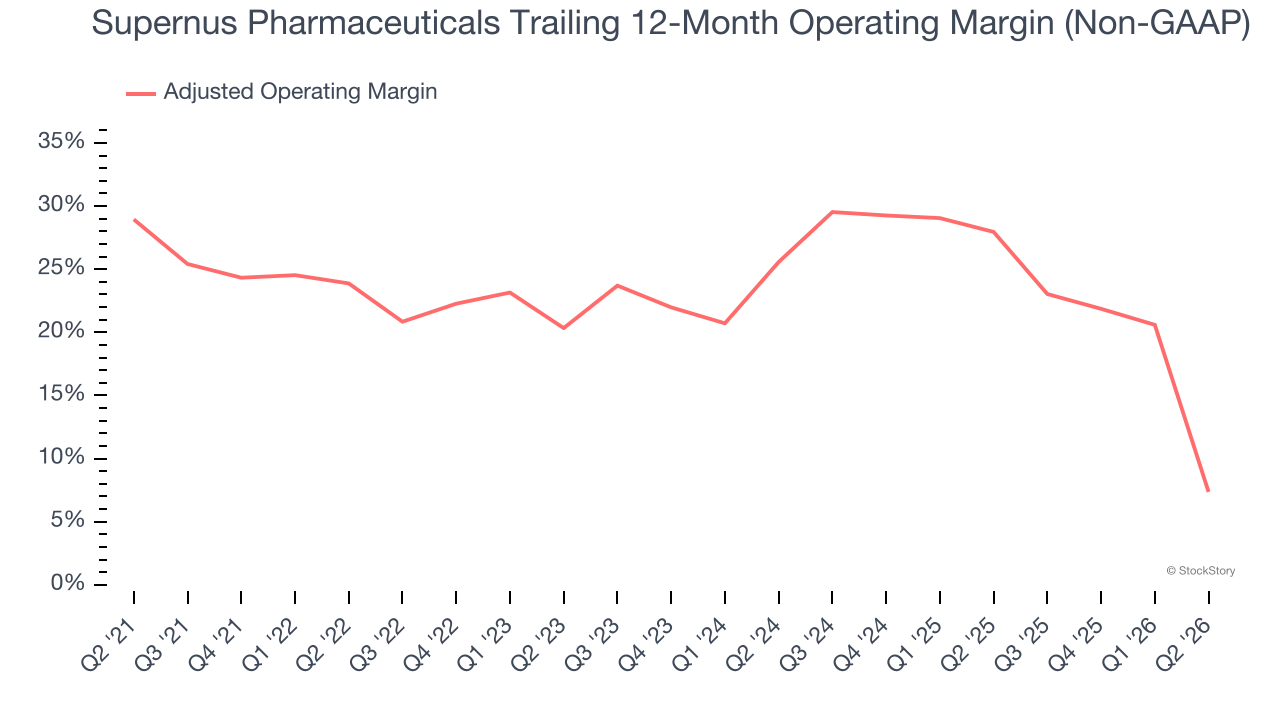
This quarter, Supernus Pharmaceuticals generated an adjusted operating margin profit margin of negative 26.5%, down 51.2 percentage points year on year. This contraction shows it was less efficient because its expenses grew faster than its revenue.
Earnings Per Share
Revenue trends explain a company’s historical growth, but the long-term change in earnings per share (EPS) points to the profitability of that growth — for example, a company could inflate its sales through excessive spending on advertising and promotions.
Sadly for Supernus Pharmaceuticals, its EPS declined by 24.9% annually over the last five years while its revenue grew by 6.7%. This tells us the company became less profitable on a per-share basis as it expanded.
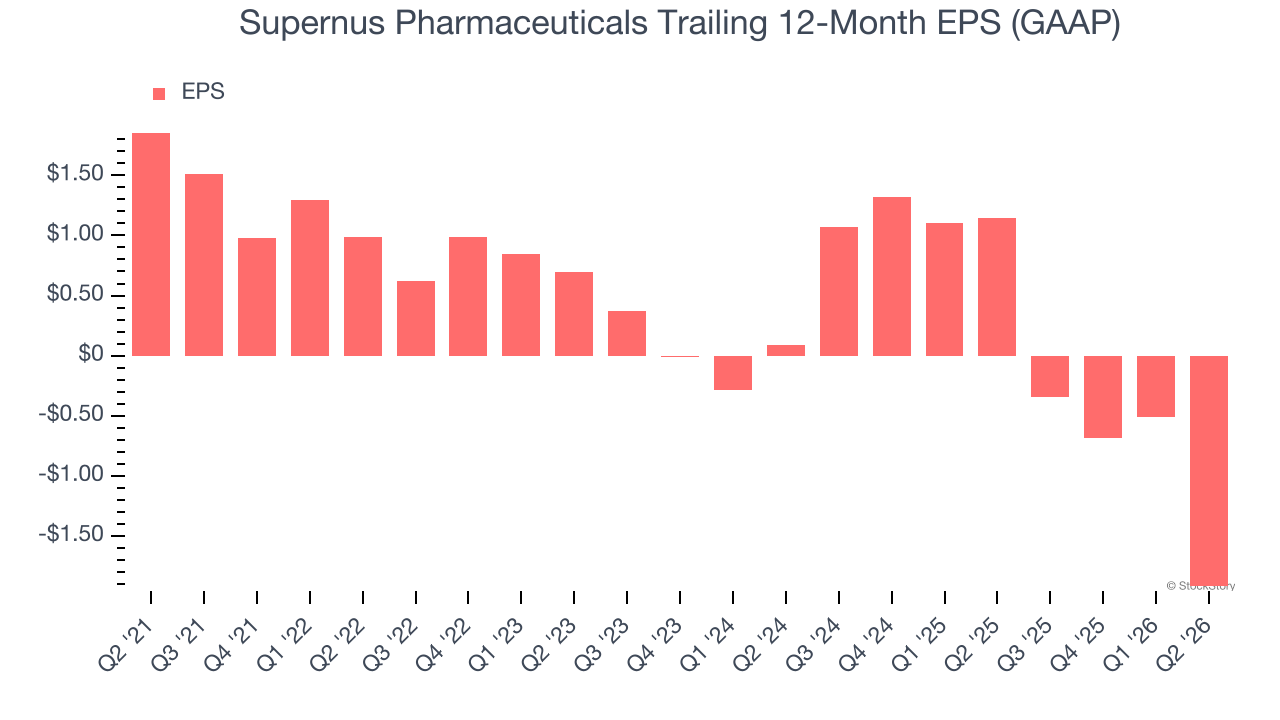
We can take a deeper look into Supernus Pharmaceuticals’s earnings to better understand the drivers of its performance. As we mentioned earlier, Supernus Pharmaceuticals’s adjusted operating margin declined by 16.5 percentage points over the last five years. Its share count also grew by 6.1%, meaning the company not only became less efficient with its operating expenses but also diluted its shareholders. 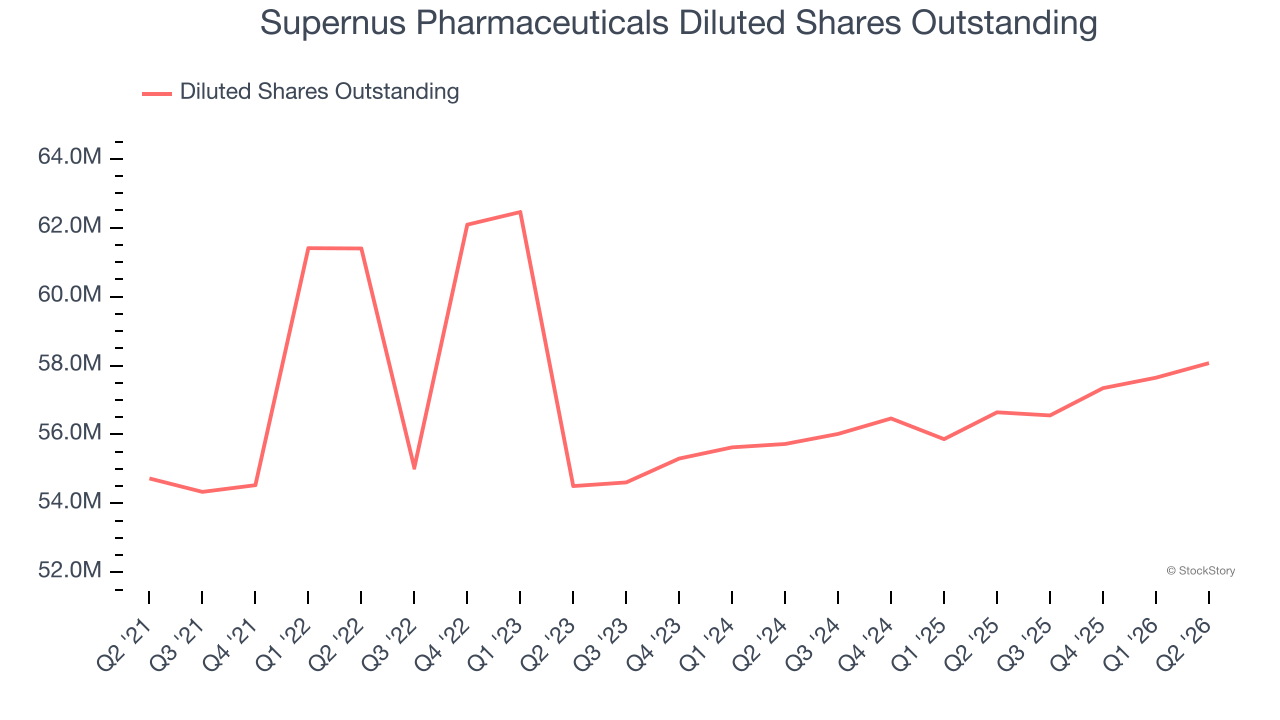
In Q2, Supernus Pharmaceuticals reported EPS of negative $1.01, down from $0.40 in the same quarter last year. This print missed analysts’ estimates. Over the next 12 months, Wall Street is optimistic. Analysts forecast Supernus Pharmaceuticals’s full-year EPS will flip from negative $1.92 to positive $1.27.
Key Takeaways from Supernus Pharmaceuticals’s Q2 Results
We were impressed by how significantly Supernus Pharmaceuticals blew past analysts’ revenue expectations this quarter. We were also glad its full-year operating income guidance trumped Wall Street’s estimates. The company announced today an agreement to merge with Indivior Pharmaceuticals. The stock traded up 24.9% to $55.75 immediately following the results.
Supernus Pharmaceuticals put up rock-solid earnings, but one quarter doesn’t necessarily make the stock a buy. Let’s see if this is a good investment. What happened in the latest quarter matters, but not as much as longer-term business quality and valuation, when deciding whether to invest in this stock. We cover that in our actionable full research report which you can read here (it’s free).