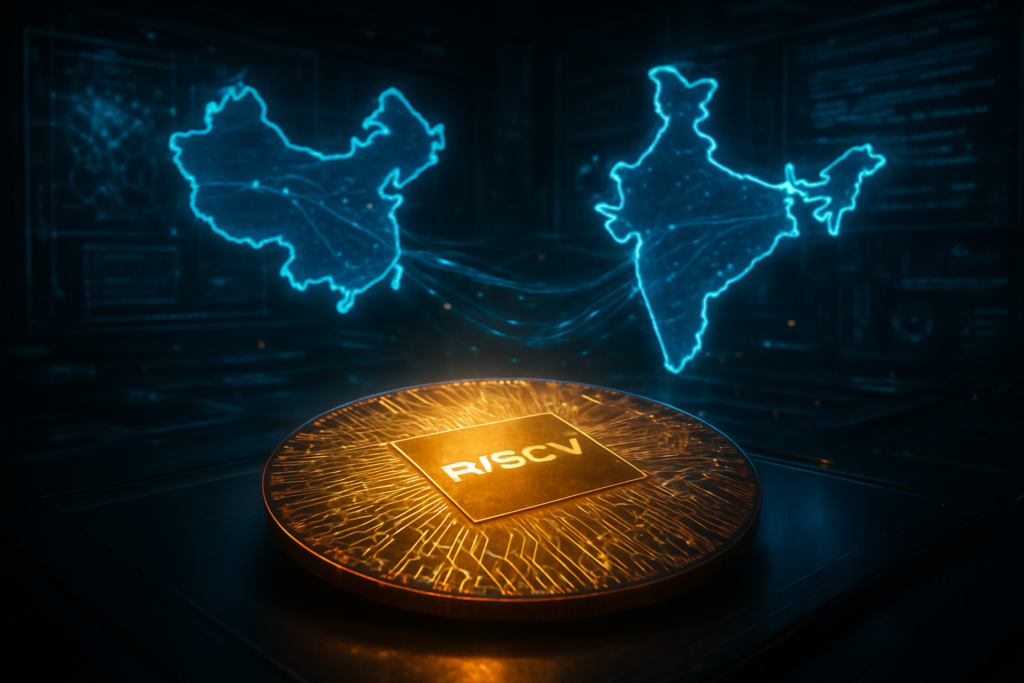
As 2025 draws to a close, the global semiconductor landscape has undergone a seismic shift, driven not by a new proprietary breakthrough, but by the rapid ascent of an open-source architecture. RISC-V, the open-standard instruction set architecture (ISA), has officially transitioned from an academic curiosity to a central pillar of geopolitical strategy. In a year defined by escalating trade tensions and tightening export controls, Beijing has aggressively positioned RISC-V as the cornerstone of its "semiconductor sovereignty," aiming to permanently bypass the Western-controlled duopoly of x86 and ARM.
The significance of this movement cannot be overstated. By leveraging an architecture maintained by a Swiss-based non-profit, RISC-V International, China has found a strategic loophole that is largely immune to unilateral U.S. sanctions. This year’s nationwide push, codified in landmark government guidelines, signals a point of no return: the era of Western dominance over the "brains" of computing is being challenged by a decentralized, open-source insurgency that is now powering everything from IoT sensors to high-performance AI data centers across Asia.
The Architecture of Autonomy: Technical Breakthroughs in 2025
The technical momentum behind RISC-V reached a fever pitch in March 2025, when a coalition of eight high-level Chinese government bodies—including the Ministry of Industry and Information Technology (MIIT) and the Cyberspace Administration of China (CAC)—released a comprehensive policy framework. These guidelines mandated the integration of RISC-V into critical infrastructure, including energy, finance, and telecommunications. This was not merely a suggestion; it was a directive to replace systems powered by Intel Corporation (NASDAQ: INTC) and Advanced Micro Devices, Inc. (NASDAQ: AMD) with "indigenous and controllable" silicon.
At the heart of this technical revolution is Alibaba Group Holding Limited (NYSE: BABA) and its dedicated chip unit, T-Head. In early 2025, Alibaba unveiled the XuanTie C930, the world’s first truly "server-grade" 64-bit multi-core RISC-V processor. Unlike its predecessors, which were relegated to low-power tasks, the C930 features a sophisticated 16-stage pipeline and a 6-decode width, achieving performance metrics that rival mid-range server CPUs. Fully compliant with the RVA23 profile, the C930 includes essential extensions for cloud virtualization and Vector 1.0 for AI workloads, allowing it to handle the complex computations required for modern LLMs.
This development marks a radical departure from previous years, where RISC-V was often criticized for its fragmented ecosystem. The 2025 guidelines have successfully unified Chinese developers under a single set of standards, preventing the "forking" of the architecture that many experts feared. By standardizing the software stack—from the Linux kernel to AI frameworks like PyTorch—China has created a plug-and-play environment for RISC-V that is now attracting massive investment from both state-backed enterprises and private startups.
Market Disruption and the Threat to ARM’s Hegemony
The rise of RISC-V poses an existential threat to the licensing model of Arm Holdings plc (NASDAQ: ARM). For decades, ARM has enjoyed a near-monopoly on mobile and embedded processors, but its proprietary nature and UK/US nexus have made it a liability in the eyes of Chinese firms. By late 2025, RISC-V has achieved a staggering 25% market penetration in China’s specialized AI and IoT sectors. Companies are migrating to the open-source ISA not just to avoid millions in annual licensing fees, but to eliminate the risk of their licenses being revoked due to shifting geopolitical winds.
Major tech giants are already feeling the heat. While NVIDIA Corporation (NASDAQ: NVDA) remains the king of high-end AI training, the "DeepSeek" catalyst of late 2024 and early 2025 has shown that high-efficiency, low-cost AI models can thrive on alternative hardware. Smaller Chinese firms are increasingly deploying RISC-V AI accelerators that offer a 30–50% cost reduction compared to sanctioned Western hardware. While these chips may not match the raw performance of an H100, their "good enough" performance at a fraction of the cost is disrupting the mid-market and edge-computing sectors.
Furthermore, the impact extends beyond China. India has emerged as a formidable second front in the RISC-V revolution. Under the Digital India RISC-V (DIR-V) program, India launched the DHRUV64 in December 2025, its first homegrown 1.0 GHz dual-core processor. By positioning RISC-V as a tool for "Atmanirbhar" (self-reliance), India is creating a parallel ecosystem that mirrors China’s pursuit of sovereignty but remains integrated with global markets. This dual-pronged pressure from the world’s two most populous nations is forcing traditional chipmakers to reconsider their long-term strategies in the Global South.
Geopolitical Implications and the Quest for Sovereignty
The broader significance of the RISC-V surge lies in its role as a "sanction-proof" foundation. Because the RISC-V instruction set itself is open-source and managed in Switzerland, the U.S. Department of Commerce cannot "turn off" the architecture. While the manufacturing of these chips—often handled by Taiwan Semiconductor Manufacturing Company (NYSE: TSM) or Samsung—remains a bottleneck subject to export controls, the ability to design and iterate on the core architecture remains firmly in domestic hands.
This has led to a new era of "Semiconductor Sovereignty." For China, RISC-V is a shield against containment; for India, it is a sword to carve out a niche in the global design market. This shift mirrors previous milestones in open-source history, such as the rise of Linux in the server market, but with much higher stakes. The 2025 guidelines in Beijing represent the first time a major world power has officially designated an open-source hardware standard as a national security priority, effectively treating silicon as a public utility rather than a corporate product.
However, this transition is not without concerns. Critics argue that China’s aggressive subsidization could lead to a "dumping" of low-cost RISC-V chips on the global market, potentially stifling innovation in other regions. There are also fears that the U.S. might respond with even more stringent "AI Diffusion Rules," potentially targeting the collaborative nature of open-source development itself—a move that would have profound implications for the global research community.
The Horizon: 7nm Dreams and the Future of Compute
Looking ahead to 2026 and beyond, the focus will shift from architecture to manufacturing. China is expected to pour even more resources into domestic lithography to ensure that its RISC-V designs can be produced at advanced nodes without relying on Western-aligned foundries. Meanwhile, India has already announced a roadmap for a 7nm RISC-V processor led by IIT Madras, aiming to enter the high-end computing space by 2027.
In the near term, expect to see RISC-V move from the data center to the desktop. With the 2025 guidelines providing the necessary tailwinds, several Chinese OEMs are rumored to be preparing RISC-V-based laptops for the education and government sectors. The challenge remains the "software gap"—ensuring that mainstream applications run seamlessly on the new architecture. However, with the rapid adoption of cloud-native and browser-based workflows, the underlying ISA is becoming less visible to the end-user, making the transition easier than ever before.
Experts predict that by 2030, RISC-V could account for as much as 30-40% of the global processor market. The "Swiss model" of neutrality has provided a safe harbor for innovation during a time of intense global friction, and the momentum built in 2025 suggests that the genie is officially out of the bottle.
A New Chapter in Computing History
The events of 2025 have solidified RISC-V’s position as the most disruptive force in the semiconductor industry in decades. Beijing’s nationwide push has successfully turned an open-source project into a formidable tool of statecraft, allowing China to build a resilient, indigenous tech stack that is increasingly decoupled from Western control. Alibaba’s XuanTie C930 and India’s DIR-V program are just the first of many milestones in this new era of sovereign silicon.
As we move into 2026, the key takeaway is that the global chip industry is no longer a monolith. We are witnessing the birth of a multi-polar computing world where open-source standards provide the level playing field that proprietary architectures once dominated. For tech giants, the message is clear: the monopoly on the instruction set is over. For the rest of the world, the rise of RISC-V promises a future of more diverse, accessible, and resilient technology—albeit one shaped by the complex realities of 21st-century geopolitics.
Watch for the next wave of RISC-V announcements at the upcoming 2026 global summits, where the battle for "silicon supremacy" will likely enter its most intense phase yet.
This content is intended for informational purposes only and represents analysis of current AI and semiconductor developments.
TokenRing AI delivers enterprise-grade solutions for multi-agent AI workflow orchestration, AI-powered development tools, and seamless remote collaboration platforms.
For more information, visit https://www.tokenring.ai/.