Since its debut in late 2024, Microsoft’s (NASDAQ: MSFT) Magentic-One has evolved from a sophisticated research prototype into the cornerstone of the modern "agentic" economy. As we enter 2026, the system's multi-agent coordination framework is no longer just a technical curiosity; it is the blueprint for how businesses deploy autonomous digital workforces. By moving beyond simple text generation to complex, multi-step execution, Magentic-One has bridged the gap between artificial intelligence that "knows" and AI that "does."
The significance of Magentic-One lies in its modularity and its ability to orchestrate specialized agents to solve open-ended goals. Whether it is navigating a dynamic web interface to book travel, debugging a legacy codebase, or synthesizing vast amounts of local data, the system provides a structured environment where specialized AI models can collaborate under a centralized lead. This transition from "chat-based" AI to "action-based" systems has fundamentally altered the productivity landscape, forcing every major tech player to rethink their approach to automation.
The Orchestrator and Its Specialists: A Deep Dive into Magentic-One’s Architecture
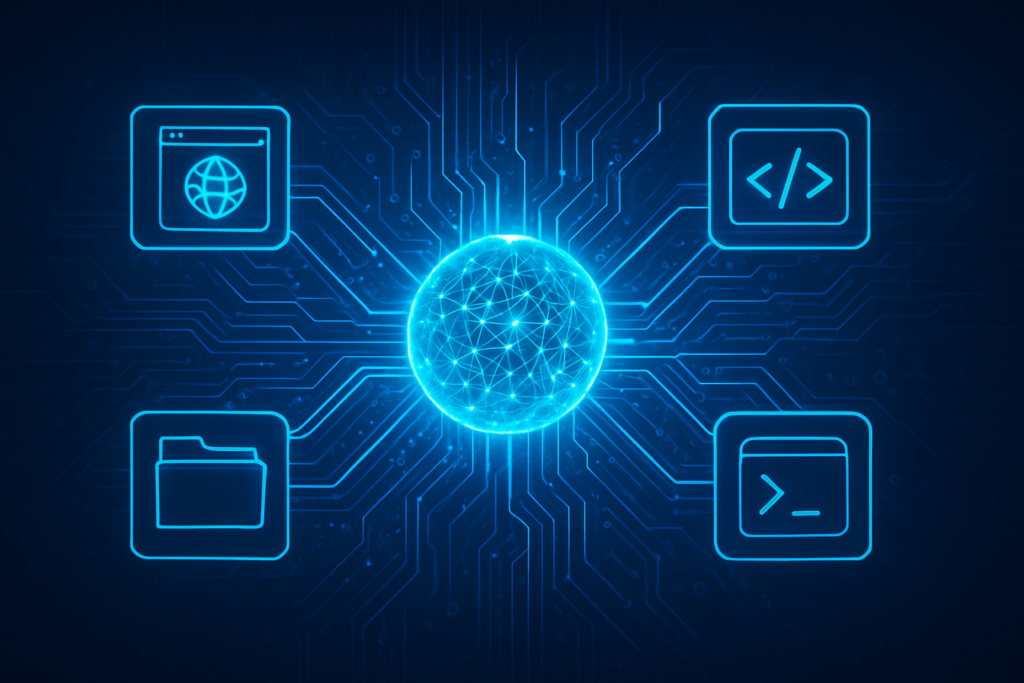
At the heart of Magentic-One is the Orchestrator, a high-level reasoning agent that functions as a project manager for complex tasks. Unlike previous monolithic AI models that attempted to handle every aspect of a request simultaneously, the Orchestrator decomposes a user’s goal into a structured plan. It manages two critical components: a Task Ledger, which stores facts and "educated guesses" about the current environment, and a Progress Ledger, which allows the system to reflect on its own successes and failures. This "two-loop" system enables the Orchestrator to monitor progress in real-time, dynamically revising its strategy if a sub-agent encounters a roadblock or an unexpected environmental change.
The Orchestrator directs a specialized team of agents, each possessing a distinct "superpower." The WebSurfer agent utilizes advanced vision tools like Omniparser to navigate a Chromium-based browser, interacting with buttons and forms much like a human would. The Coder agent focuses on writing and analyzing scripts, while the ComputerTerminal provides a secure console environment to execute and test that code. Completing the quartet is the FileSurfer, which manages local file operations, enabling the system to retrieve and organize data across complex directory structures. This division of labor allows Magentic-One to maintain high accuracy and reduce "context rot," a common failure point in large, single-model systems.
Built upon the AutoGen framework, Magentic-One represents a significant departure from earlier "agentic" attempts. While frameworks like OpenAI’s Swarm focused on lightweight, decentralized handoffs, Magentic-One introduced a hierarchical, "industrial" structure designed for predictability and scale. It is model-agnostic, meaning a company can use a high-reasoning model like GPT-4o for the Orchestrator while deploying smaller, faster models for the specialized agents. This flexibility has made it a favorite among developers who require a "plug-and-play" architecture for enterprise-grade applications.
The Hyperscaler War: Market Positioning and Competitive Implications
The release and subsequent refinement of Magentic-One sparked an "Agentic Arms Race" among tech giants. Microsoft has positioned itself as the "Runtime of the Agentic Web," integrating Magentic-One’s logic into Copilot Studio and Azure AI Foundry. This strategic move allows enterprises to build "fleets" of agents that are not just confined to Microsoft’s ecosystem but can operate across rival platforms like Salesforce or SAP. By providing the governance and security layers—often referred to as "Agentic Firewalls"—Microsoft has secured a lead in enterprise trust, particularly in highly regulated sectors like finance and healthcare.
However, the competition is fierce. Alphabet (NASDAQ: GOOGL) has countered with its Antigravity platform, leveraging the multi-modal capabilities of Gemini 3.0 to focus on "Agentic Commerce." While Microsoft dominates the office workflow, Google is attempting to own the transactional layer of the web, where agents handle everything from grocery delivery to complex travel itineraries with minimal human intervention. Meanwhile, Amazon (NASDAQ: AMZN) has focused on modularity through its Bedrock Agents, offering a "buffet" of models from various providers, appealing to companies that want to avoid vendor lock-in.
The disruption to traditional software-as-a-service (SaaS) models is profound. In the pre-agentic era, software was a tool that humans used to perform work. In the era of Magentic-One, software is increasingly becoming the worker itself. This shift has forced startups to pivot from building "AI features" to building "Agentic Workflows." Those who fail to integrate with these orchestration layers risk becoming obsolete as users move away from manual interfaces toward autonomous execution.
The Agentic Revolution: Broader Significance and Societal Impact
The rise of multi-agent systems like Magentic-One marks a pivotal moment in the history of AI, comparable to the launch of the first graphical user interface. We have moved from a period of "stochastic parrots" to one of "digital coworkers." This shift has significant implications for how we define productivity. According to recent reports from Gartner, nearly 40% of enterprise applications now include some form of agentic capability, a staggering jump from less than 1% just two years ago.
However, this rapid advancement is not without its concerns. The autonomy granted to systems like Magentic-One raises critical questions about safety, accountability, and the "human-in-the-loop" necessity. Microsoft’s recommendation to run these agents in isolated Docker containers highlights the inherent risks of allowing AI to execute code and modify file systems. As "agent fleets" become more common, the industry is grappling with a governance crisis, leading to the development of new standards for agent interoperability and ethical guardrails.
The transition also mirrors previous milestones like the move to cloud computing. Just as the cloud decentralized data, agentic AI is decentralizing execution. Magentic-One’s success has proven that the future of AI is not a single, all-knowing "God Model," but a collaborative network of specialized intelligences. This "interconnected intelligence" is the new standard, moving the focus of the AI community from increasing model size to improving model agency and reliability.
Looking Ahead: The Future of Autonomous Coordination
As we look toward the remainder of 2026 and into 2027, the focus is shifting from "can it do it?" to "how well can it collaborate?" Microsoft’s recent introduction of Magentic-UI suggests a future where humans and agents work in a "Co-Planning" environment. In this model, the Orchestrator doesn't just take a command and disappear; it presents a proposed plan to the user, who can then tweak subtasks or provide additional context before execution begins. This hybrid approach is expected to be the standard for mission-critical tasks where the cost of failure is high.
Near-term developments will likely include "Cross-Agent Interoperability," where a Microsoft agent can seamlessly hand off a task to a Google agent or an Amazon agent using standardized protocols. We also expect to see the rise of "Edge Agents"—smaller, highly specialized versions of Magentic-One agents that run locally on devices to ensure privacy and reduce latency. The challenge remains in managing the escalating costs of inference, as running multiple LLM instances for a single task can be resource-intensive.
Experts predict that by 2027, the concept of "building an agent" will be seen as 5% AI and 95% software engineering. The focus will move toward the "plumbing" of the agentic world—ensuring that agents can securely access APIs, handle edge cases, and report back with 100% reliability. The "Agentic Era" is just beginning, and Magentic-One has set the stage for a world where our digital tools are as capable and collaborative as our human colleagues.
Summary: A New Chapter in Artificial Intelligence
Microsoft’s Magentic-One has successfully transitioned the AI industry from the era of conversation to the era of coordination. By introducing the Orchestrator-Specialist model, it provided a scalable and reliable framework for autonomous task execution. Its foundation on AutoGen and its integration into the broader Microsoft ecosystem have made it the primary choice for enterprises looking to deploy digital coworkers at scale.
As we reflect on the past year, the significance of Magentic-One is clear: it redefined the relationship between humans and machines. We are no longer just prompting AI; we are managing it. In the coming months, watch for the expansion of agentic capabilities into more specialized verticals and the emergence of new governance standards to manage the millions of autonomous agents now operating across the global economy. The architect of autonomy has arrived, and the way we work will never be the same.
This content is intended for informational purposes only and represents analysis of current AI developments.
TokenRing AI delivers enterprise-grade solutions for multi-agent AI workflow orchestration, AI-powered development tools, and seamless remote collaboration platforms.
For more information, visit https://www.tokenring.ai/.