For so long, Intel had been the tech powerhouse to beat. However, back in 2020, cracks began to appear in its business model. Much-awaited chips were delayed, released CPUs had massive design flaws, and its foundry business became a money pit.
All of it couldn’t have happened at a worse time, because when the AI boom hit, Nvidia and AMD were in a good position to capitalize on the trend.
As such, Intel was left behind. Far behind.
But now, things have changed. The company is on the path to recovery, thanks to timely government support, a sharp refocus on its data center business, and promising new products like the 18A process nodes.
The result? Market reactions were largely positive, driving the price to a new all-time high of $85.22 before retreating to around $82.
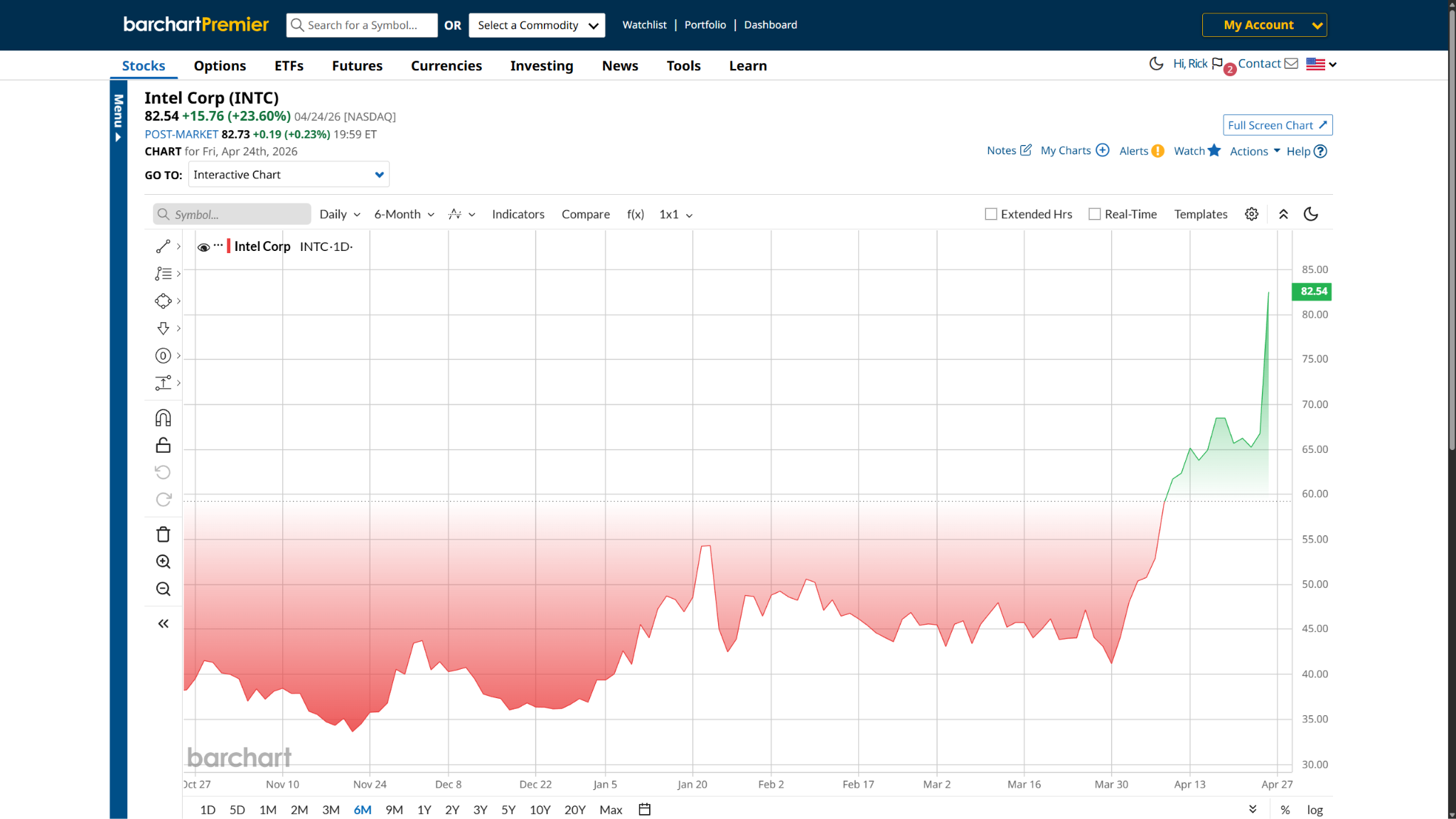
And with that sharp price move and the market’s eyes on the company, volatility has increased, which means option prices are likely high.
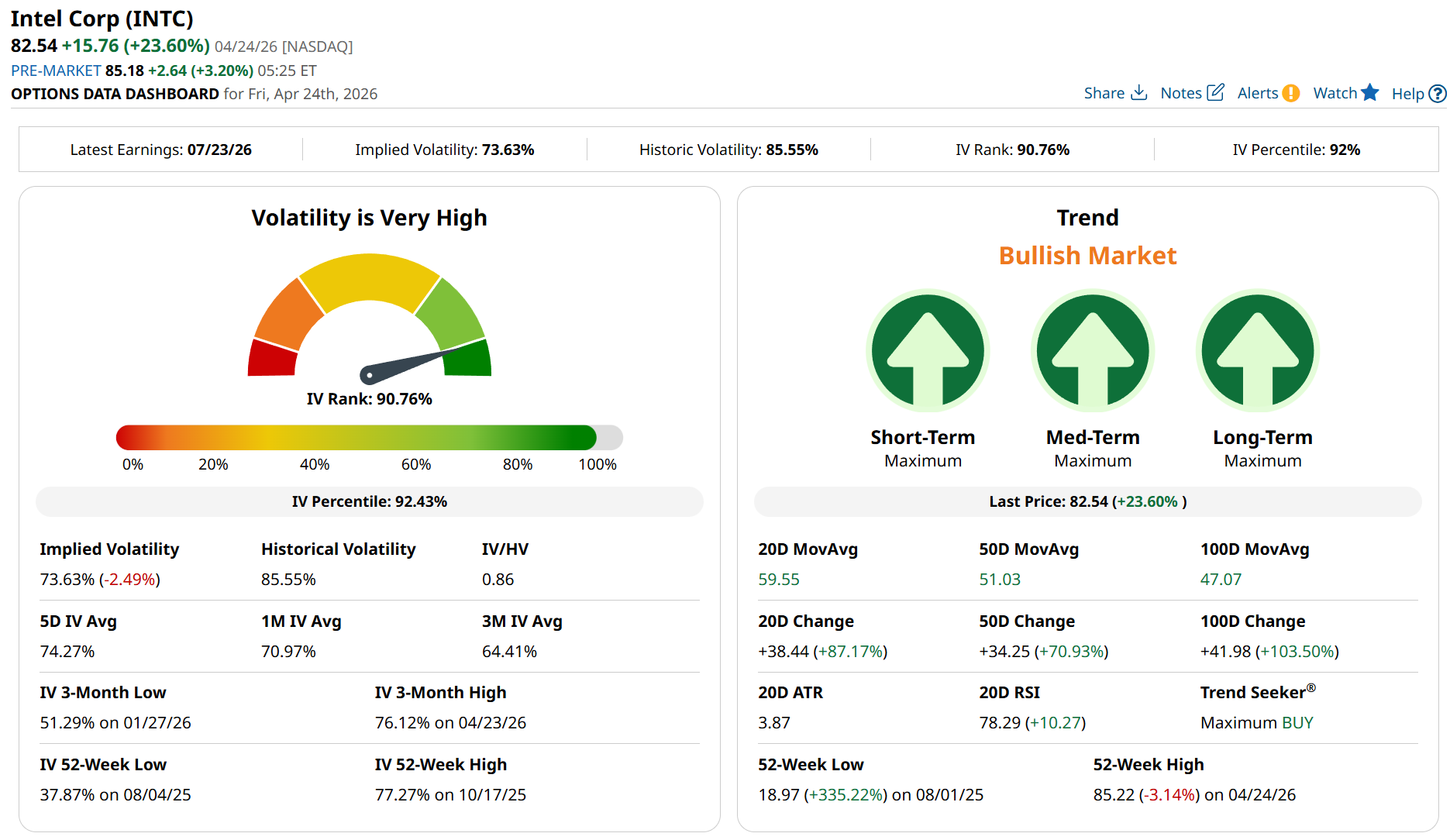
So how do you capitalize on this opportunity?
You have two easy options: selling a cash-secured put or a bull put. Let’s talk about both of them and see which one fits your investment profile.
What is a cash-secured put (CSP)?
Let’s start with the easier strategy.
A cash-secured put is an options income strategy that involves selling a put option on an underlying asset to earn a premium while setting aside enough capital to buy the shares should you get assigned. With this strategy, you want the stock to stay above the strike price at expiration.
Cash-secured puts are a clean way to earn income during bullish markets, while still allowing you to line up and buy your preferred stock at your desired price level if it goes below your strike price.
Looking for cash-secured put trades
So, right now, Intel is trading at $82, but say you'd be happy to buy it at a slightly lower level, like maybe $75.
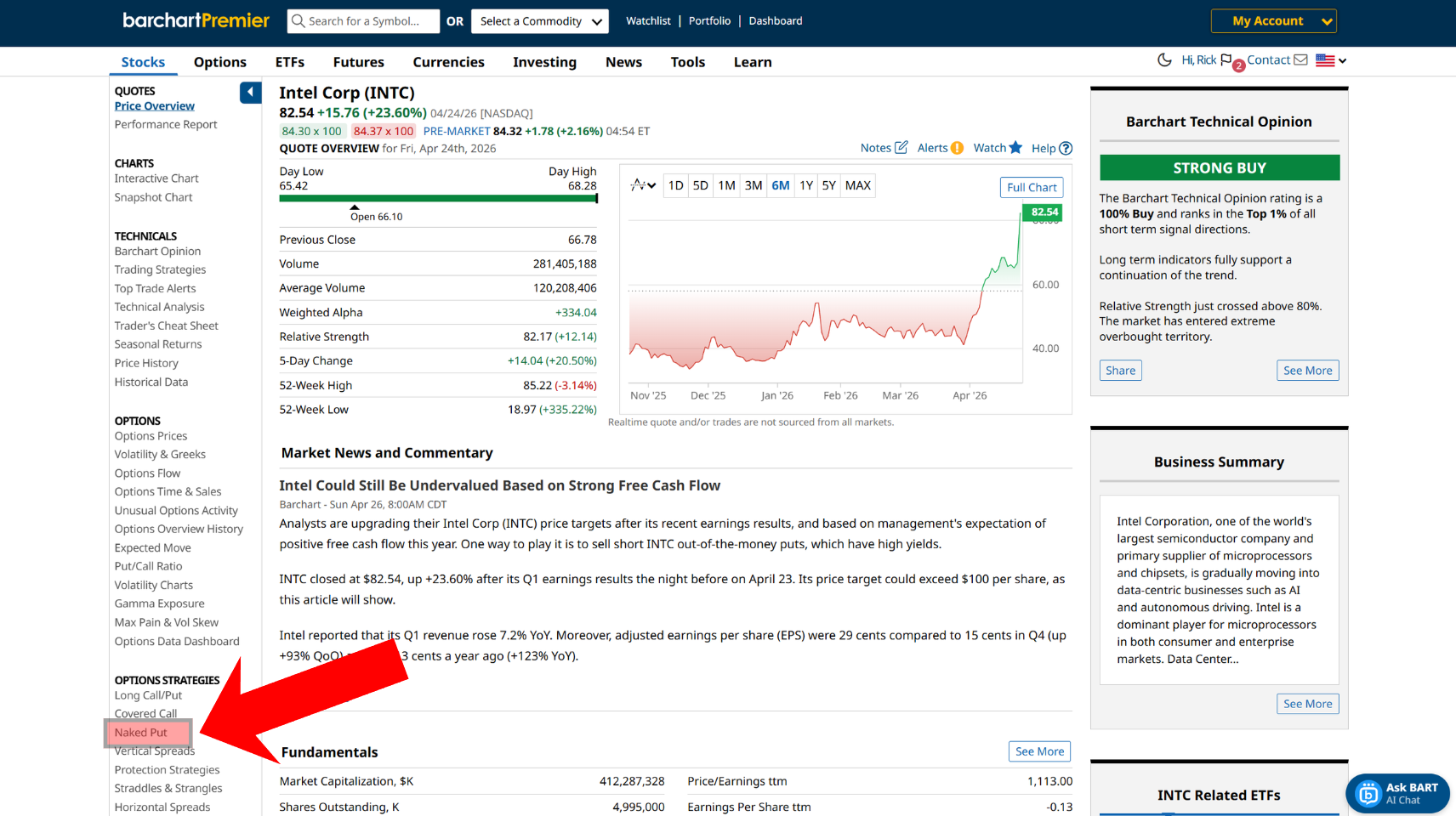
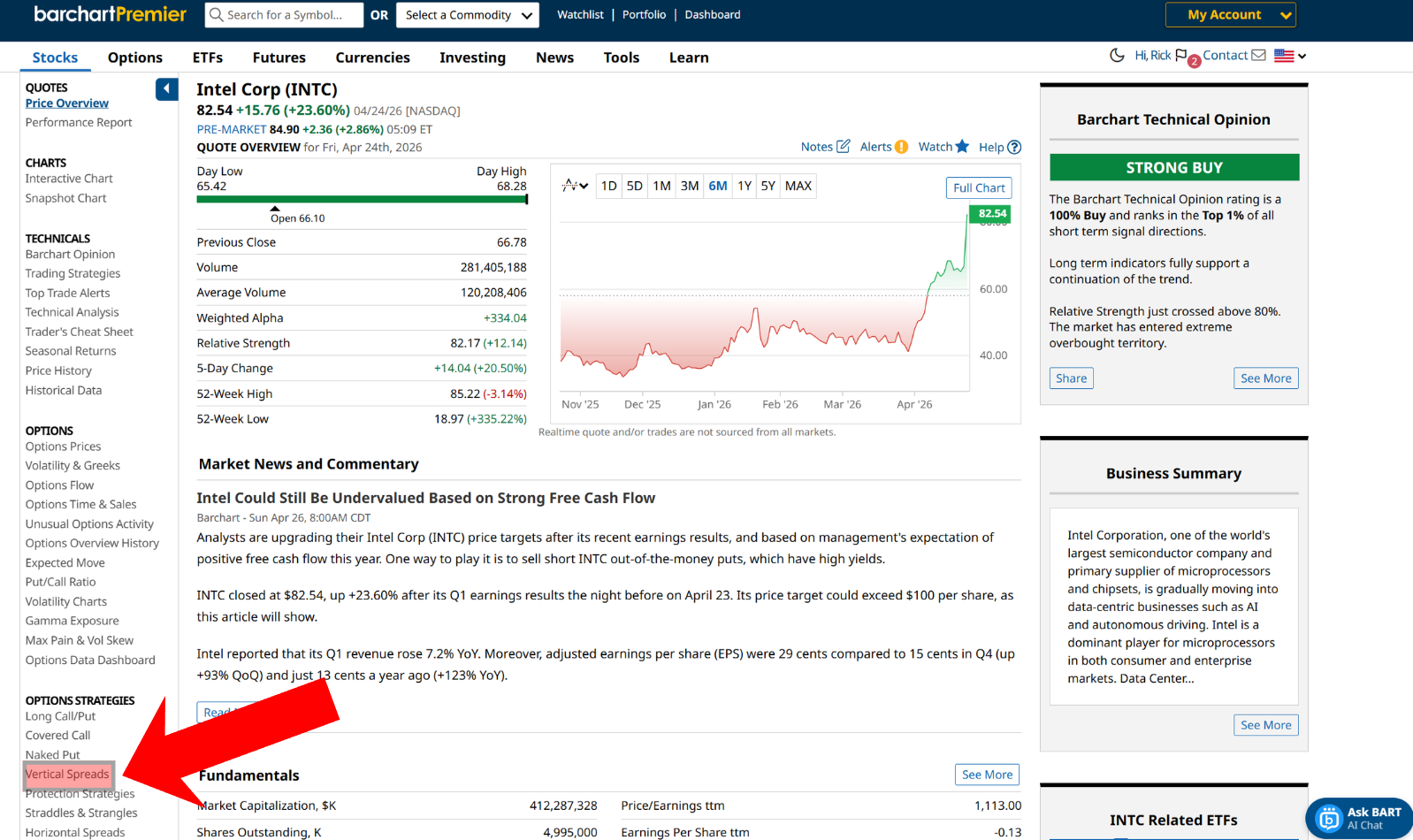
The next step is to find suitable cash-secured put trades at that strike. To do that, go to Barchart.com, then to Intel’s stock profile page, and look to the lower left to click Naked Put under Options Strategies.
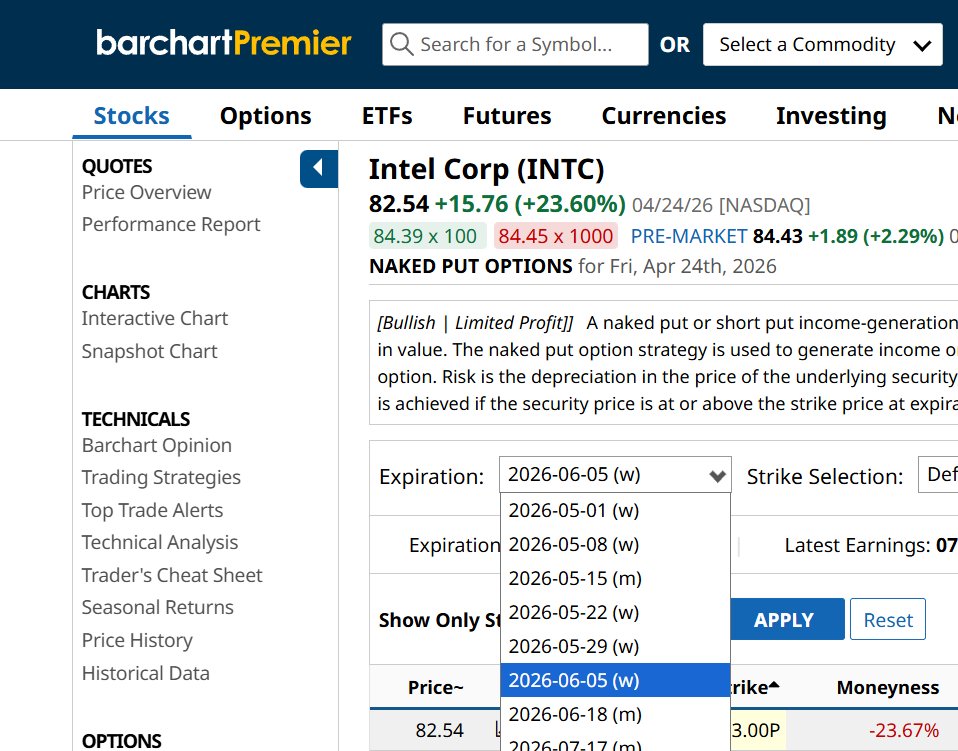
The next thing you need to decide is the expiration date, or how long you want the put to be active.
When selling options, many traders default to between 30 and 45 days to expiration (DTE). This ensures higher premiums due to greater time value and gives you enough time to react and adjust the trade, should it be necessary.
So, you can change the expiration date here to June 5, which is 41 days away.
Trade example
According to the results, you can sell a 75-strike put on Intel and receive $4 per share. Since every contract is worth 100 shares, the total premium you receive is $400, less trading fees.
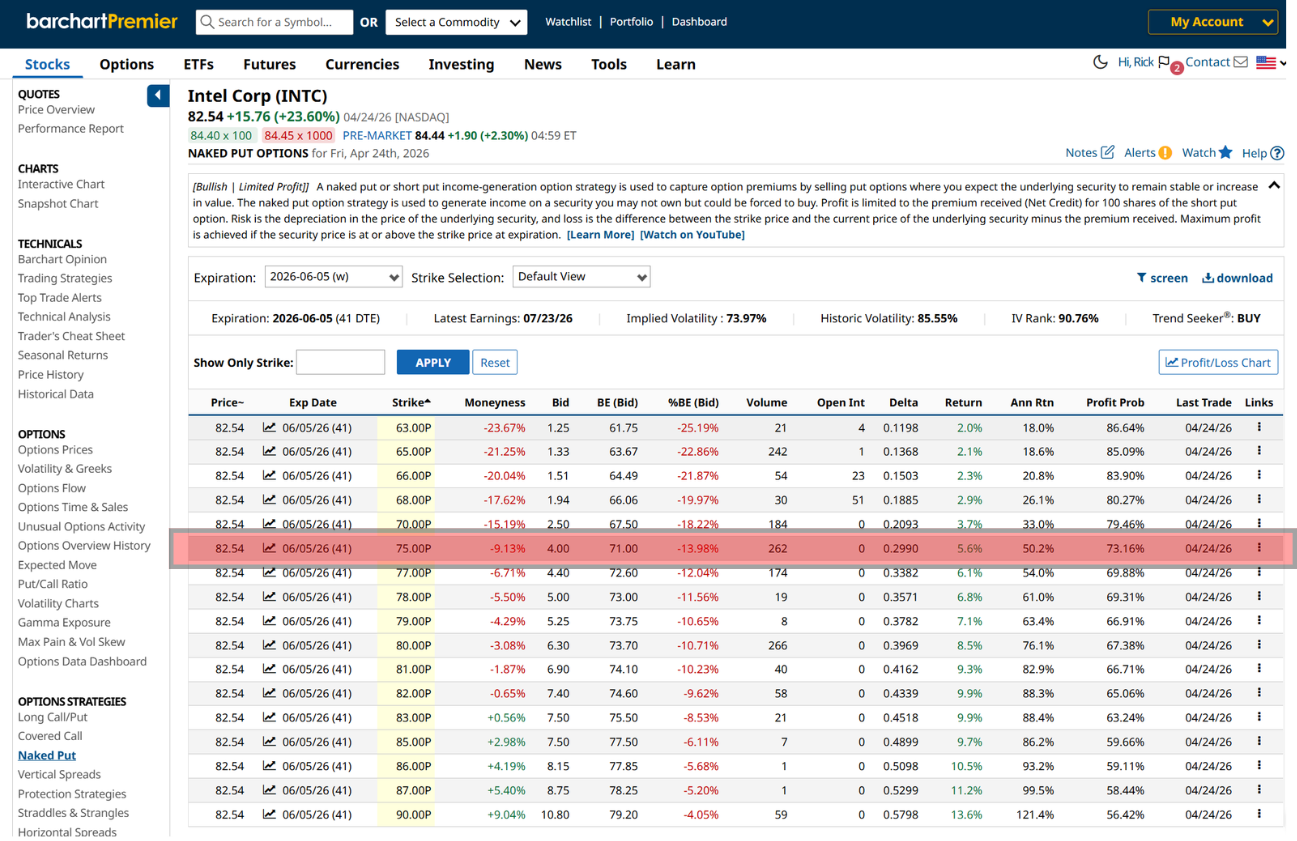
If Intel trades above $75 by June 5, the option expires out of the money. You get to keep the $400, and you're free from further obligation.
However, if Intel trades at or below $75 by expiration, your put will be assigned. That means you are now obligated to buy 100 shares of Intel for $75, regardless of what it’s trading for at that time.
So even if it crashed to $50 by June 5, you’re still on the hook to buy it for $75 each. That’s the biggest risk when selling cash-secured puts. However, it’s slightly mitigated if you actually choose a stock you believe in and would like to keep long-term.
Bull Put
A bull put, also known as a short put spread or put credit spread, is a strategy that earns money right off the bat by selling a put option and then buying another one on the same underlying asset at a lower strike price. Like with a cash-secured put, you want the stock to trade above your short strike price at expiration.
Now, the difference between a cash-secured put and a bull put lies largely in their risk profiles.
With a cash-secured put, you face the full risk of assignment in exchange for a potentially higher premium. That’s why you set aside capital for that eventuality.
With a bull put, assignment risk is covered by the long put, though you have to pay for that protection, and the trade can end at a loss without stock ownership. The maximum loss happens if the stock trades below the long strike at expiration.
In short, a bull put is a good strategy for earning income in moderately bullish markets without having to set aside thousands of dollars to buy the stock, but it comes with a different risk profile.
Looking for bull put trades
On Barchart, bull put trades are available under Vertical Spreads, then the Bull Put tab.
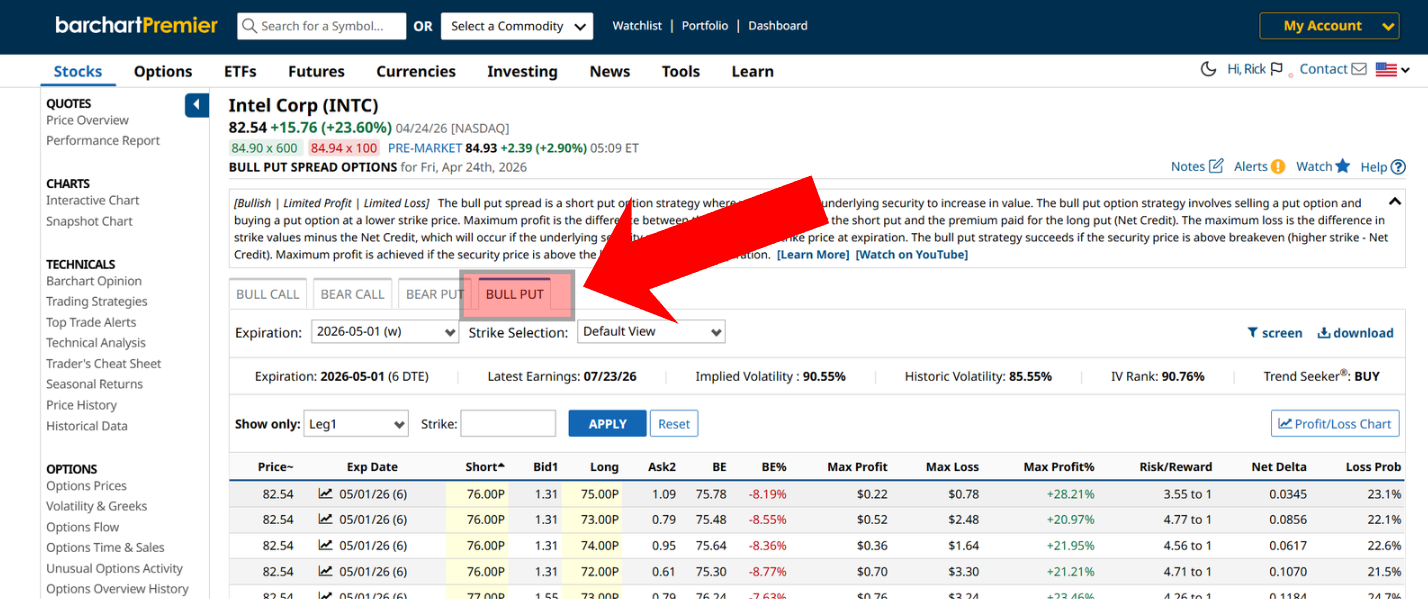
Using the same June 5 expiration date and $75 short strike price, you can search for screen trades by adding 75 to the Leg 1 field here and clicking apply.
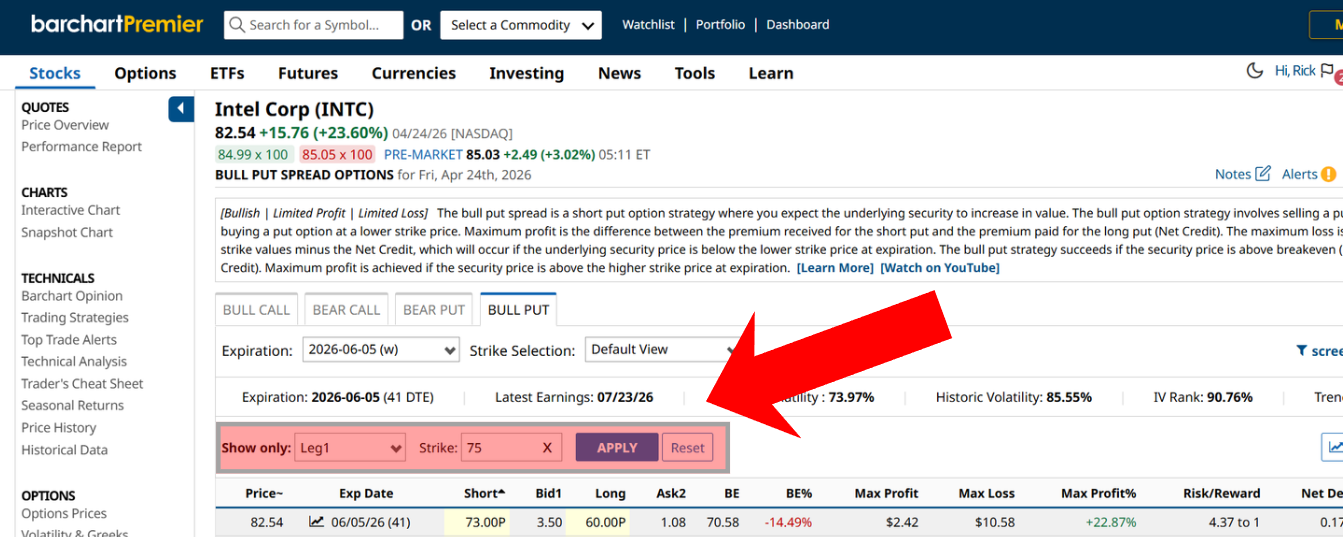
You’ll get a good selection of trades across different risk levels.
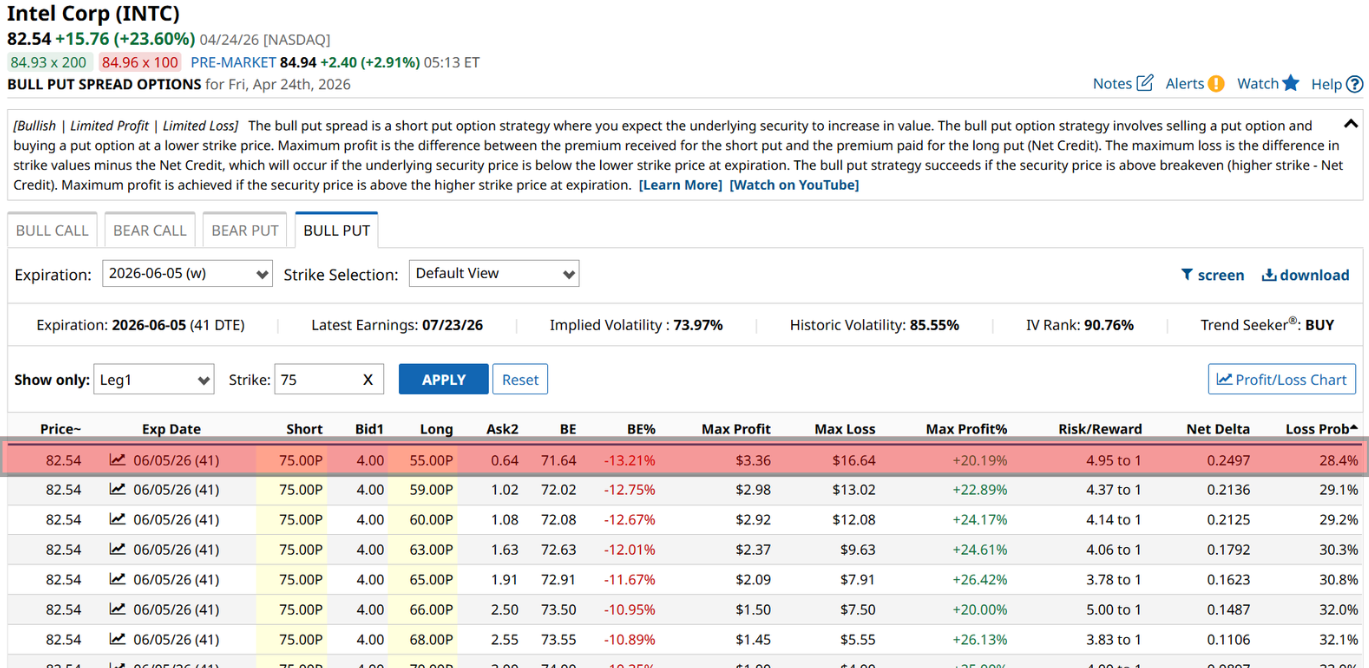 Now, I often start with Loss Probability for guidance here. So let’s take a look at the safest trade on the list.
Trade example
According to the screener, you can sell a 75-strike put on Intel for $4 per share, then buy a 55-strike put for 64 cents per share. This bull put spread results in a net credit of $3.36 per share or $336 per contract and has a 28% chance of ending at a loss.
One thing about bull puts is that their maximum potential loss is calculated by subtracting the net credit from the spread width.
So, the wider your spread, the safer you are from maximum losses. However, that also means your maximum losses get bigger.
In this case, the maximum potential loss is $16.64 per share or $1,664 per contract, since the put spread is $20 wide, minus $3.36.
Contrast that with a naked put, and you're reducing downside risk by about 77.8% at the cost of only 64 cents a share.
Position sizing for bull put spreads
Knowing your maximum loss is important because many traders sell multiple bull puts simultaneously to increase their net credit. The problem is, it also increases their maximum loss.
When you’re selling bull puts or any option strategy, you always need to look at how much you could lose instead of how much you could gain. That way, you don’t blow up your account with a couple of bad trades.
Final thoughts
With sharper price action and an overall bullish outlook, Intel is ripe for selling cash-secured and bull puts. However, always remember that increased volatility also comes with higher assignment and loss probabilities.
So, don’t be blinded by high premiums. Trade conservatively - trust me, your account will thank you for not blowing it up on one trade. Additionally, always trade with an exit strategy in mind, and monitor your positions consistently so you won’t get blindsided by sudden news.
On the date of publication, Rick Orford did not have (either directly or indirectly) positions in any of the securities mentioned in this article. All information and data in this article is solely for informational purposes. For more information please view the Barchart Disclosure Policy here.
More news from Barchart
- "Sell in May" Could Be Bad News for the Kiwi Dollar
- Micron Stock Keeps Soaring, as Investors Make Unusually Heavy MU Option Trades
- Intel Just Hit an All-Time High Above $85. Here Are 2 Options Trades That Pay You as the Comeback Continues.
- Why General Motors (GM) Stock Offers a Difficult But Enticing Bullish Trade