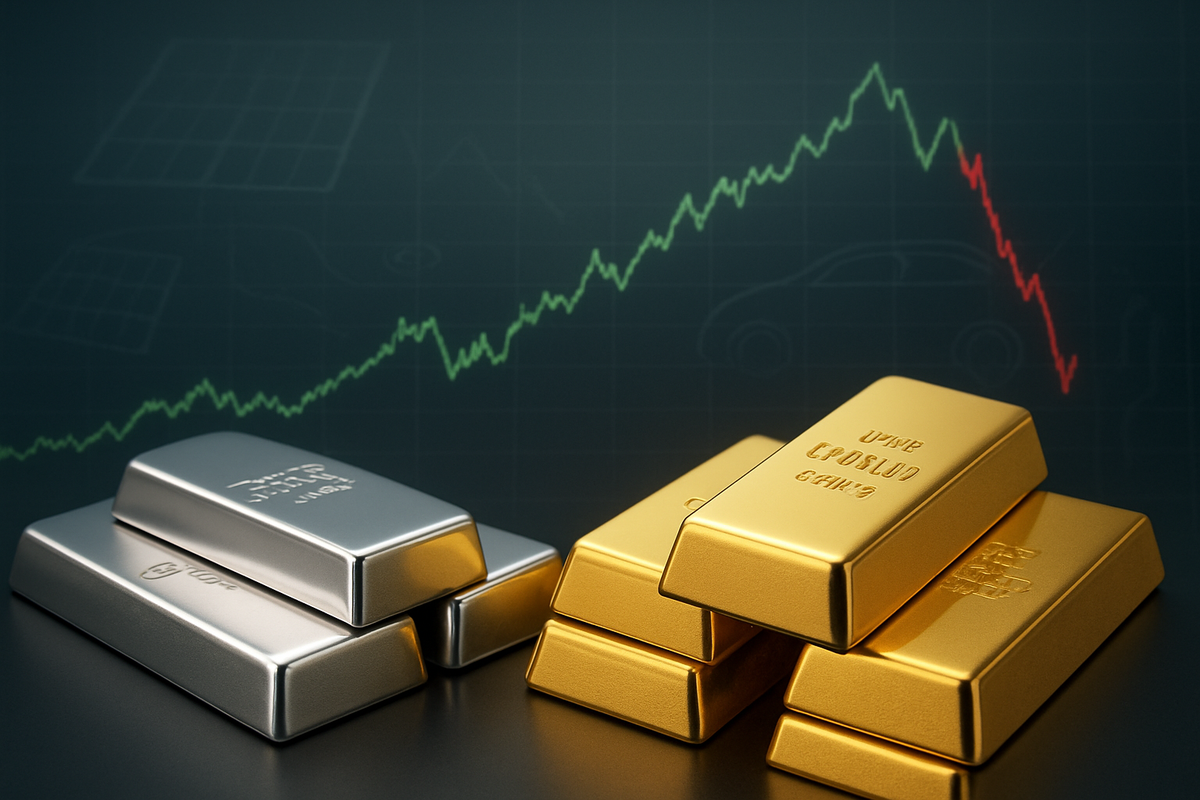
The precious metals market witnessed a momentary pause on December 16, 2025, as both silver and gold experienced a daily decline, primarily driven by profit-taking after an extraordinary year of gains. This "downturn," while notable for its immediate impact on daily trading, is contextualized within a broader, robust bull market that has seen both metals achieve near-record and record-breaking valuations throughout 2025. The dip prompts a re-evaluation of short-term market dynamics, but the underlying sentiment for the precious metals sector remains cautiously optimistic.
This recent price adjustment highlights the inherent volatility of the commodities market, especially after sustained periods of upward momentum. For investors and industry stakeholders, the immediate implications involve a recalibration of expectations and a close watch on upcoming economic indicators that could either solidify the long-term bullish trend or signal further short-term corrections.
A Fleeting Dip in a Year of Golden Gains
The specific details of the December 16, 2025, market activity saw silver fall below the mid-$62.00s, registering a loss exceeding 2.5% for the day in the Asian session, even dropping by Rs 3.90 per gram in India. Gold followed suit, with 24 Karat gold in India falling by Rs 152 per gram, and global prices slipping 0.4% to $4,285.5 per ounce, down to $4,294.17 USD/t.oz from the previous day. This synchronized dip underscores the historical correlation between the two metals, though silver's higher volatility often leads to amplified movements.
This temporary decline comes after an exceptional year for precious metals. Silver, in particular, has been a standout performer in 2025, shattering previous all-time highs and touching an impressive $62.89 per ounce earlier in December, reflecting a remarkable 90% year-over-year gain. Gold also achieved near-record levels, boasting an impressive annual increase of over 65%, trading around $4,300 per ounce before the recent correction. The primary driver for this specific day's downturn was widespread profit-taking by investors looking to lock in gains after the significant rallies.
Key players observing these movements include individual and institutional investors, who are now closely monitoring the US Federal Reserve's monetary policy outlook. Hints from early December 2025 Federal Reserve meeting minutes suggested a continued restrictive monetary policy, which can influence market sentiment for non-yielding assets. Furthermore, the global manufacturing PMI for November 2025 dipping to 49.5 indicated a slight contraction, potentially reducing industrial demand for silver and adding to the cautious mood.
Initial market reactions saw the gold/silver ratio widening to 85:1, an increase from the average of 81:1 in the third quarter of 2025, suggesting that silver might have become overvalued relative to gold during its preceding surge. Investors are now cautiously awaiting key US economic reports, including non-farm payrolls, retail sales, and inflation data, which are anticipated to influence the Federal Reserve's policy direction and, consequently, the strength of the dollar and precious metals.
Corporate Crossroads: Winners and Losers in the Volatile Precious Metals Market
The short-term price dip on December 16, 2025, while a blip in a larger bull market, creates distinct immediate impacts for various public companies. Mining companies, whose fortunes are directly tied to commodity prices, are likely to experience a temporary setback, while silver-reliant industries could see a brief reprieve in their input costs.
Mining Companies: Feeling the Immediate Pinch For major gold and silver mining companies, a one-day price drop typically translates into an immediate, and often amplified, decline in their stock performance due to their high beta to commodity prices. Companies like Newmont Corporation (NYSE: NEM), Barrick Gold Corporation (NYSE: GOLD), and Agnico Eagle Mines Limited (NYSE: AEM) in the gold sector, and Pan American Silver Corp. (NASDAQ: PAAS), First Majestic Silver Corp. (NYSE: AG), and Hecla Mining Company (NYSE: HL) in the silver sector, would likely see their share prices dip in response to the metals' decline. While a single day's movement may not drastically alter their long-term revenue outlook, it would directly impact the revenue realized from any metal sold on that specific day, potentially affecting short-term quarterly earnings if the dip were to extend. However, given the context of a robust bull market, many analysts might view this as a "healthy market adjustment" or a "buying opportunity" rather than a fundamental shift.
Silver-Reliant Industries: A Momentary Sigh of Relief Conversely, industries heavily reliant on silver as a critical input material could experience a short-term benefit from the price dip. Silver is indispensable in sectors such as solar energy, electric vehicles (EVs), and electronics due to its superior electrical conductivity. For companies like First Solar, Inc. (NASDAQ: FSLR) and JinkoSolar Holding Co., Ltd. (NYSE: JKS) in the solar industry, where silver can account for a significant portion of photovoltaic (PV) cell production costs (up to 14% in 2025), a price reduction offers immediate relief on input costs.
Similarly, EV manufacturers such as Tesla, Inc. (NASDAQ: TSLA) and General Motors Company (NYSE: GM), which use substantial amounts of silver in electrical components and battery systems, would see a temporary reduction in their raw material expenses. In the broader electronics sector, giants like Apple Inc. (NASDAQ: AAPL), Samsung Electronics Co., Ltd. (KRX: 005930), and Intel Corporation (NASDAQ: INTC), along with Dell Technologies Inc. (NYSE: DELL) and HP Inc. (NYSE: HPQ), rely on silver for circuit boards and electrical contacts. For these companies, a price dip can translate into improved short-term profit margins or at least alleviate the cost pressures experienced throughout a year of record-high silver prices, providing a momentary boost to their financial performance. Despite this short-term benefit, the long-term upward trend in silver prices due to persistent supply deficits and surging industrial demand means these companies will likely continue their focus on supply chain security and exploring silver reduction and alternative materials.
Broader Implications: A Bull Market's Nuances
This recent dip in silver and gold, despite its short-term nature, offers valuable insights into the broader dynamics of the precious metals market. It underscores a continued bullish trajectory for the sector, even with periodic profit-taking corrections. The re-evaluation of silver's industrial and investment utility is a significant trend, particularly its surging demand from green energy technologies like solar panels and electric vehicles, as well as advanced electronics and AI infrastructure. This industrial appetite, coupled with a persistent supply deficit for silver—approaching a cumulative shortfall of 800 million ounces since 2021—forms a strong fundamental basis for its long-term appreciation.
The ripple effects of this environment are far-reaching. Sustained high precious metal prices can impact manufacturing costs across various industries, prompting innovation in material science and supply chain management. Furthermore, the global landscape, marked by geopolitical risks, structural debt problems, and economic uncertainties, continues to fuel demand for gold and silver as hedging instruments. This heightened demand for safe-haven assets is expected to persist, supporting the metals' long-term value.
Regulatory and policy implications also play a crucial role. Expectations of continued interest rate cuts by the US Federal Reserve in 2026, even amidst persistent inflation, are anticipated to keep real interest rates low, a favorable environment for non-yielding assets like gold. Additionally, US tariffs have been cited as a factor driving an influx of bullion into the US, further influencing domestic prices. Historically, silver has demonstrated higher volatility than gold, tending to outperform during strong rallies and experience sharper declines during corrections. This characteristic was evident in silver's 113% year-to-date gain compared to gold's 59% in 2025, highlighting its leveraged performance in a precious metals bull market, albeit with greater risk.
What Comes Next: Navigating the Precious Metals Landscape
Looking ahead, the precious metals market is poised for continued dynamism. In the short term, investors can expect ongoing volatility as the market digests the recent gains and corrections. The focus will be acutely on upcoming US economic data, including non-farm payrolls, retail sales, and inflation figures, which will provide further cues on the Federal Reserve's policy direction. Any hints of a stronger US dollar could put renewed pressure on gold and silver prices, while softer economic data might reinforce their safe-haven appeal. Further instances of profit-taking after significant rallies should not be unexpected.
For the long term, the outlook remains largely bullish for 2026. Analysts project gold prices could reach $5,000 per ounce, and silver could ascend to $75-$80 per ounce, with some even suggesting three-digit marks, provided the current market environment persists. This optimism is underpinned by sustained industrial demand for silver, particularly from the burgeoning green energy and technology sectors, coupled with continued monetary policy support in the form of expected interest rate cuts. Strategic pivots may be required from investors, who might use these temporary dips as opportunities to re-evaluate entry or exit points. Companies in silver-reliant industrial sectors will likely continue to explore long-term supply contracts and research into alternative materials or silver reduction techniques to mitigate future price volatility.
Market opportunities may emerge in the form of temporarily undervalued mining stocks after a dip, offering attractive entry points for long-term investors. However, challenges include the debate surrounding the sustainability of this rally, with some institutions hinting at potential "bubbles." A significant slowdown in global manufacturing could also dampen silver's industrial demand-driven momentum. Potential scenarios range from a sustained, albeit volatile, bull run to more pronounced corrections if economic or monetary policy shifts significantly.
Comprehensive Wrap-up: A Market in Motion
The recent downturn in the silver and gold markets on December 16, 2025, serves as a crucial reminder that even within a powerful bull market, corrections are an inherent and often healthy part of the cycle. The key takeaway is that this dip was primarily driven by profit-taking after a year of unprecedented gains for both metals, rather than a fundamental weakening of their underlying drivers. The robust industrial demand for silver, persistent supply deficits, expectations of continued accommodative monetary policy from the US Federal Reserve, and ongoing geopolitical and economic uncertainties continue to provide strong tailwinds for the precious metals sector.
Moving forward, the market sentiment remains cautiously optimistic for 2026. While short-term volatility is to be expected, the long-term trajectory for both gold and silver appears to be upward, supported by a confluence of factors that reinforce their dual roles as both investment hedges and critical industrial commodities. The lasting impact of 2025's remarkable performance, even with temporary setbacks, will likely be a reinforced appreciation for precious metals in diversified portfolios and as essential components of the green economy.
Investors should closely watch for several key indicators in the coming months: the direction and pace of the Federal Reserve's interest rate policy, forthcoming US economic data (especially inflation and employment figures), the global manufacturing Purchasing Managers' Index (PMI) for insights into industrial demand, and the gold/silver ratio for relative valuation cues. Geopolitical developments will also continue to play a significant role in shaping safe-haven demand. Understanding these dynamics will be crucial for navigating a precious metals market that is clearly in motion, offering both opportunities and challenges.
This content is intended for informational purposes only and is not financial advice