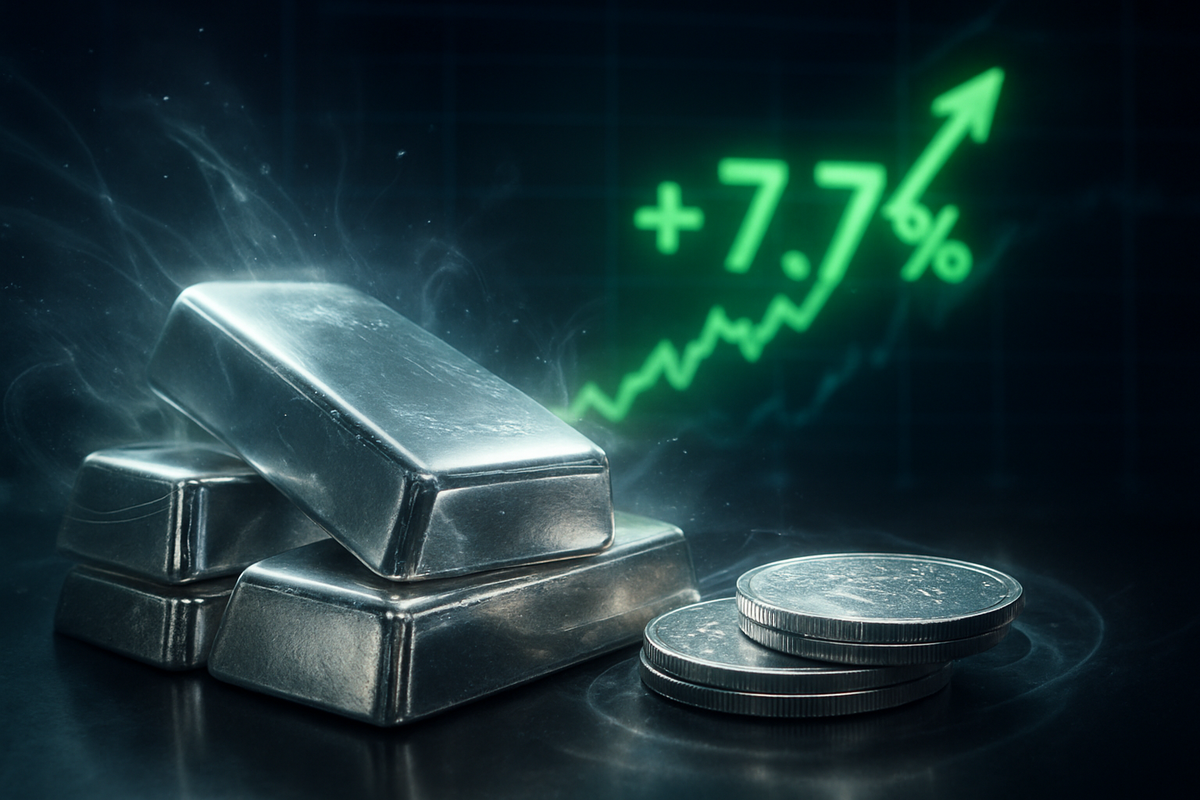
In a stunning display of market momentum, silver futures surged 7.7% on December 26, 2025, pushing the "white metal" to historic intraday highs between $75 and $79 per ounce. This dramatic spike caps off a year of unprecedented growth for precious metals, which have transitioned from defensive hedges to aggressive performance leaders. The rally is particularly noteworthy as it coincides with the broader stock market hitting fresh record highs, creating a rare "everything rally" that has left traditional analysts questioning long-held correlations between risk-on and safe-haven assets.
The immediate implications of this surge are profound, signaling a fundamental re-rating of silver’s value in the global economy. As the S&P 500 hovers near the 6,930 mark, the simultaneous ascent of precious metals suggests that investors are no longer choosing between growth and protection—they are demanding both. This 7.7% daily jump has triggered a wave of short-covering and speculative buying, further tightening a market already strained by structural supply deficits and a new strategic status in the United States.
The Perfect Storm: From the Thanksgiving Squeeze to Critical Status
The path to today’s 7.7% surge was paved by a series of high-impact events throughout late 2025. The momentum began in earnest during the "Thanksgiving Squeeze" in late November, when a 10-hour technical failure at a CME Group (NASDAQ: CME) data center halted trading. This disruption inadvertently exposed a massive lack of deliverable physical silver against outstanding futures contracts. Once trading resumed, the realization of this supply-demand mismatch sent prices spiraling upward from the mid-$40s, culminating in the explosive price action seen this week.
Adding fuel to the fire was the landmark decision by the U.S. Department of the Interior in November 2025 to officially add silver to the U.S. Critical Minerals List. This policy shift was a watershed moment, reclassifying silver from a mere precious metal to a strategic industrial asset essential for national security and the green energy transition. The designation has unlocked federal stockpiling initiatives and streamlined permitting for domestic mining operations, fundamentally altering the long-term valuation model for the metal.
By the time markets opened on December 26, the convergence of these factors—combined with rising geopolitical tensions in South America and expectations of Federal Reserve rate cuts in early 2026—created a vacuum of selling pressure. The resulting 7.7% jump represents one of the largest single-day percentage gains in silver’s history, effectively compressing the gold-to-silver ratio to roughly 60:1, down from over 85:1 just eighteen months ago.
Winners and Losers in the Great Silver Revaluation
The primary beneficiaries of this price explosion have been the primary silver producers and specialized exchange-traded funds. Hecla Mining (NYSE: HL) has emerged as a top performer, with its share price gaining nearly 278% over the course of 2025 as its high-grade domestic assets in Idaho and Alaska became more valuable under the new "Critical Mineral" status. Similarly, Pan American Silver (NYSE: PAAS) and First Majestic Silver (NYSE: AG) have seen their margins expand exponentially; with all-in sustaining costs (AISC) remaining relatively stable, the jump to $75+ silver has turned these miners into massive cash-flow engines.
Investors in diversified vehicles have also reaped significant rewards. The iShares Silver Trust (NYSE Arca: SLV) has tracked the spot price's 150% year-to-date climb, while the Amplify Junior Silver Miners ETF (NYSE Arca: SILJ) has provided even greater leverage, surging nearly 195% as smaller explorers become attractive acquisition targets for larger players. Even base metal giants like Freeport-McMoRan (NYSE: FCX) have seen a significant lift, as their byproduct silver and gold production now contributes a much larger share to the bottom line.
However, the rally creates a challenging environment for industrial consumers. Industries such as solar photovoltaics and high-end electronics, which rely heavily on silver’s conductivity, are facing a "cost cliff." If silver prices remain at these elevated levels, manufacturers may be forced to pass costs on to consumers or accelerate the search for less efficient substitutes like copper. This could lead to a short-term slowdown in the deployment of certain green technologies unless government subsidies—ironically triggered by the critical mineral status—can offset the raw material price hikes.
A Break from Tradition: Precious Metals in a Record-High Equity Market
The current market environment is historically anomalous. Traditionally, gold and silver move inversely to the stock market; when the S&P 500 and Dow Jones Industrial Average hit record highs, precious metals typically languish as "dead money." In December 2025, this 40-year correlation has broken. The market is currently pricing in two distinct narratives: the AI-driven productivity boom fueling equity valuations, and a deep-seated concern over currency debasement and sovereign debt that is driving "hard asset" demand.
This "dual-track" rally suggests that the market is hedging against its own success. While investors are bullish on the earnings potential of big tech and industrial automation, they are simultaneously paying a premium for silver and gold (which has surpassed $4,500 per ounce) as a safeguard against a ballooning U.S. deficit. This mirrors the "Supercycle" of the late 1970s, but with the added complexity of silver’s modern role in the global energy transition.
Furthermore, the ripple effects are being felt in the regulatory sphere. With silver now a critical mineral, we are likely to see increased scrutiny of futures market positioning. The "Thanksgiving Squeeze" has already prompted calls for more robust physical delivery requirements to prevent technical glitches from causing systemic price shocks. This could lead to a more "physical-backed" pricing mechanism, reducing the influence of paper derivatives over time.
Looking Ahead: Can the $75 Floor Hold?
As we move into 2026, the primary question for investors is whether this 7.7% surge is a blow-off top or the establishment of a new price floor. Short-term volatility is almost guaranteed, as some institutional players will likely look to book profits following silver’s 150% annual run. However, the fundamental landscape remains incredibly supportive. If the Federal Reserve follows through with projected rate cuts in the first half of 2026, the resulting weakness in the U.S. Dollar Index (DXY) could provide the next leg up for the metals complex.
Strategic pivots are already underway within the mining industry. Companies are shifting capital away from base metal exploration and toward high-grade silver targets that were previously deemed uneconomical at $20 or $30 prices. We may also see a wave of consolidation, as cash-rich majors like Newmont (NYSE: NEM) or Barrick Gold (NYSE: GOLD) look to bolster their silver reserves to capitalize on the metal’s new strategic importance.
The most likely scenario for early 2026 is a period of consolidation between $70 and $80, followed by a potential challenge of the $100 psychological barrier if industrial demand remains resilient. Investors should watch for any changes in the U.S. government’s stockpiling pace, as well as the quarterly earnings reports from the major miners, which will reveal the true extent of the margin expansion from this historic December rally.
Summary and Final Thoughts
The 7.7% surge in silver futures on December 26, 2025, marks a definitive turning point in the current market cycle. By reaching the $75-$79 range, silver has not only outperformed nearly every other asset class this year but has also redefined its role in the modern portfolio. The simultaneous rise of precious metals and record-breaking equities signals a complex investment landscape where "safety" and "growth" are no longer mutually exclusive, but rather two sides of the same inflationary coin.
Moving forward, the market will be characterized by this tension between record-high stock valuations and the urgent revaluation of tangible assets. The "Silver Supercycle" of 2025 has been driven by a unique combination of technical failures, policy shifts, and a genuine scarcity of physical metal. For investors, the takeaway is clear: the era of "cheap silver" is likely over, and the metal’s new status as a critical strategic asset will keep it at the center of financial discourse for months, if not years, to come.
This content is intended for informational purposes only and is not financial advice.