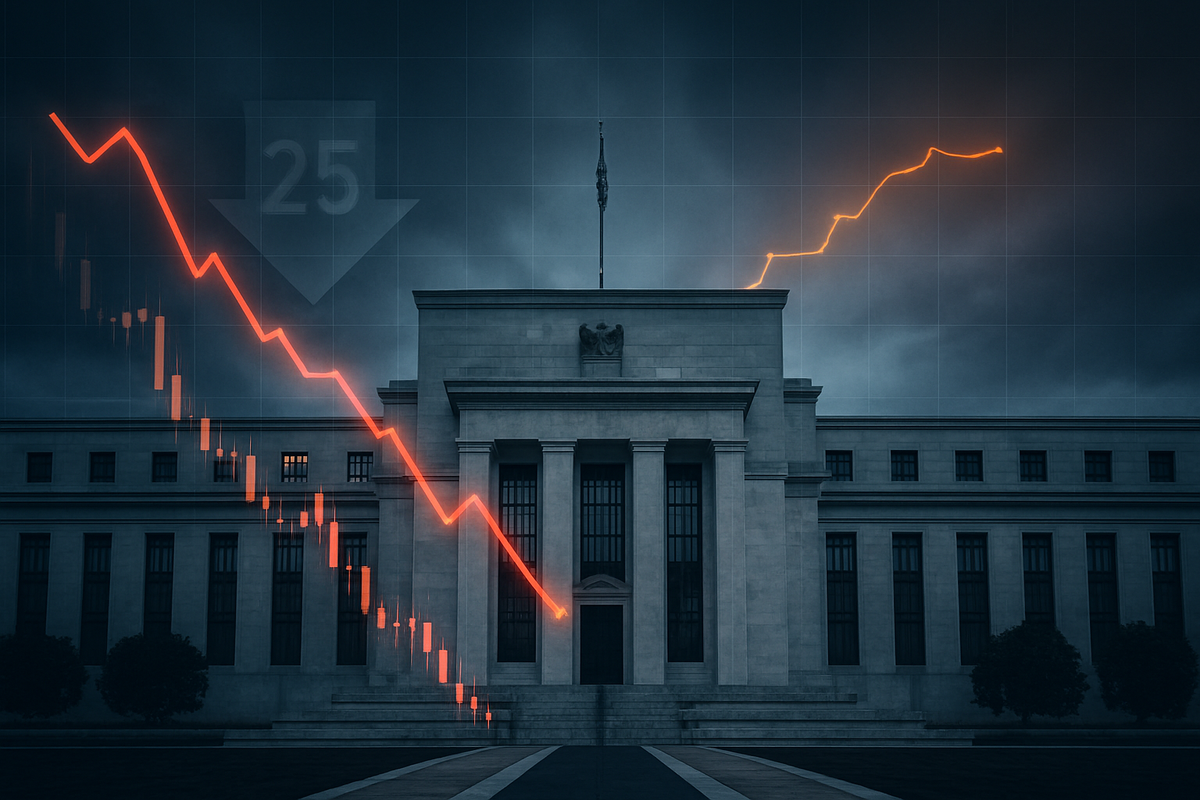
The Federal Reserve concluded its final policy meeting of 2025 with a move that, on the surface, appeared to be a gift to investors: a 25-basis-point reduction in the federal funds rate. However, the accompanying message from the central bank was anything but festive. By signaling that the easing cycle is rapidly approaching its conclusion and that the "neutral" rate may be higher than previously thought, Chair Jerome Powell effectively pulled the rug out from under a market that had been pricing in a much more aggressive path for 2026.
The immediate aftermath of the December 10 announcement saw a sharp reversal in market sentiment. While equity futures initially spiked on the news of the cut, they quickly plunged as traders digested the "hawkish" tone of the Summary of Economic Projections (SEP). The pivot from a celebratory year-end rally to a defensive posture underscores a growing realization on Wall Street: the era of cheap money is not returning, and the "higher-for-longer" floor is being set much higher than many had anticipated.
A Contentious Cut Amidst 'Data Fog'
The Federal Open Market Committee (FOMC) meeting on December 9–10, 2025, resulted in a target range of 3.50%–3.75% for the federal funds rate. This was the third consecutive quarter-point cut of the year, following moves in September and October. Yet, the decision was far from unanimous. In a rare display of internal friction, the vote was 9–3—the most dissents in a single meeting since 2019. The dissenters represented a "three-way split" in ideology: Governor Stephen Miran pushed for a larger 50-basis-point "jumbo" cut to protect a softening labor market, while Chicago Fed President Austan Goolsbee and Kansas City Fed President Jeffrey Schmid voted to keep rates unchanged, citing "sticky" services inflation.
The timeline leading up to this moment was fraught with economic uncertainty. A 43-day government shutdown earlier in the fourth quarter had created a "data fog," leaving the Fed to rely on private-sector metrics rather than official government payroll reports. Jerome Powell acknowledged this challenge during his press conference, warning that underlying labor strength might be weaker than headline figures suggested. Despite this, the Fed felt compelled to move toward a "neutral" stance, which Powell defined as a level that neither stimulates nor restricts economic growth. By declaring that the Fed had reached the "range of plausible estimates of neutral," Powell signaled that the urgency to cut further has evaporated.
Winners and Losers: The Yield Curve Shift
The "hawkish cut" created a stark divergence across corporate America, as the 10-year Treasury yield surged toward 4.2% in the wake of the meeting. Among the primary losers were high-duration growth stocks, most notably Nvidia Corp. (Nasdaq: NVDA) and Apple Inc. (Nasdaq: AAPL). As long-term yields remained elevated, the valuations of these tech giants faced a "profitability reckoning." Nvidia, in particular, saw increased volatility as investors shifted focus from AI potential to the reality of a higher cost of capital. JPMorgan Chase & Co. (NYSE: JPM) also faced headwinds; despite the rate cut, shares slid nearly 5% after CFO Jeremy Barnum warned that 2026 expenses would climb past $92 billion due to AI investments and regulatory pressures.
Conversely, the regional banking sector emerged as a surprising winner. The SPDR S&P Regional Banking ETF (NYSEARCA: KRE) hit 52-week highs following the meeting. The "bear steepening" of the yield curve—where long-term rates rise faster than short-term rates—is expected to boost net interest margins for smaller lenders in 2026. Meanwhile, the housing sector remained a battleground of conflicting forces. While the rate cut offered some relief, homebuilders like Lennar Corp. (NYSE: LEN) and D.R. Horton Inc. (NYSE: DHI) continued to see margin pressure as they were forced to fund expensive mortgage rate buy-downs to keep inventory moving in a high-rate environment.
The 'OBBBA' Factor and the Great Rotation
The Fed’s cautious stance cannot be viewed in isolation from the fiscal landscape. A major driver of the Fed’s "hawkish hold" mentality was the "One Big Beautiful Bill Act" (OBBBA), signed into law in July 2025. This massive fiscal package made permanent several tax provisions while injecting hundreds of billions into defense and border security. While stimulative for the economy, the OBBBA added an estimated $3.3 trillion to the deficit, creating what many analysts call "fiscal-led inflation." The Fed is now in the difficult position of trying to cool the economy even as the government continues to spend, leading to a "Great Rotation" from growth stocks to value-oriented sectors like Energy and Financials.
This shift has been categorized by analysts as the "TACO" trade—an acronym for Tariffs, AI, Central Banks, and OPEC. Success in the late-2025 market was defined by how well companies navigated these four pillars. The Fed's December message confirmed that the "Central Bank" pillar would no longer be a tailwind for growth. This mirrors historical precedents where the Fed has had to maintain a restrictive posture longer than expected to counter-balance fiscal expansion, similar to the late 1970s and early 1980s, though with much lower absolute rate levels.
Looking Ahead: The 2026 Outlook
As we move into early 2026, the Fed’s "Dot Plot" suggests a significant slowdown in policy adjustments. The median projection now shows only one additional 25-basis-point cut for the entirety of 2026, which would bring the terminal rate to 3.4%. This is a far cry from the multiple cuts that were anticipated just a few months ago. A pause at the January 2026 meeting is now the consensus base case, as the committee waits for the "data fog" from the government shutdown to clear and for the full effects of the OBBBA stimulus to manifest in inflation prints.
The short-term challenge for investors will be navigating a market where "bad news is no longer good news." If the labor market continues to soften, the Fed may not be as quick to jump to the rescue as it has been in the past, given its focus on reaching the 2% inflation target. Market opportunities may emerge in "old economy" stocks that can generate consistent cash flow without relying on cheap credit, while the high-flying AI sector will need to prove its monetization capabilities to justify current valuations in a 4% yield environment.
Closing the Books on 2025
The December 2025 FOMC meeting marks a definitive end to the post-pandemic easing narrative. The Fed has successfully transitioned the economy from a high-inflation emergency to a "soft landing" scenario, but the price of that landing is a permanent shift in the interest rate floor. Key takeaways for the coming months include the Fed's newfound sensitivity to fiscal policy and its willingness to tolerate higher-for-longer yields to ensure inflation remains anchored.
As investors look toward 2026, the focus will shift from "when will they cut?" to "how long will they stay here?" The market's resilience will be tested as it adjusts to a world where the Federal Reserve is no longer the primary driver of equity gains. For the first time in years, fundamental earnings growth and fiscal policy may matter more than the next move from the Eccles Building.
This content is intended for informational purposes only and is not financial advice.