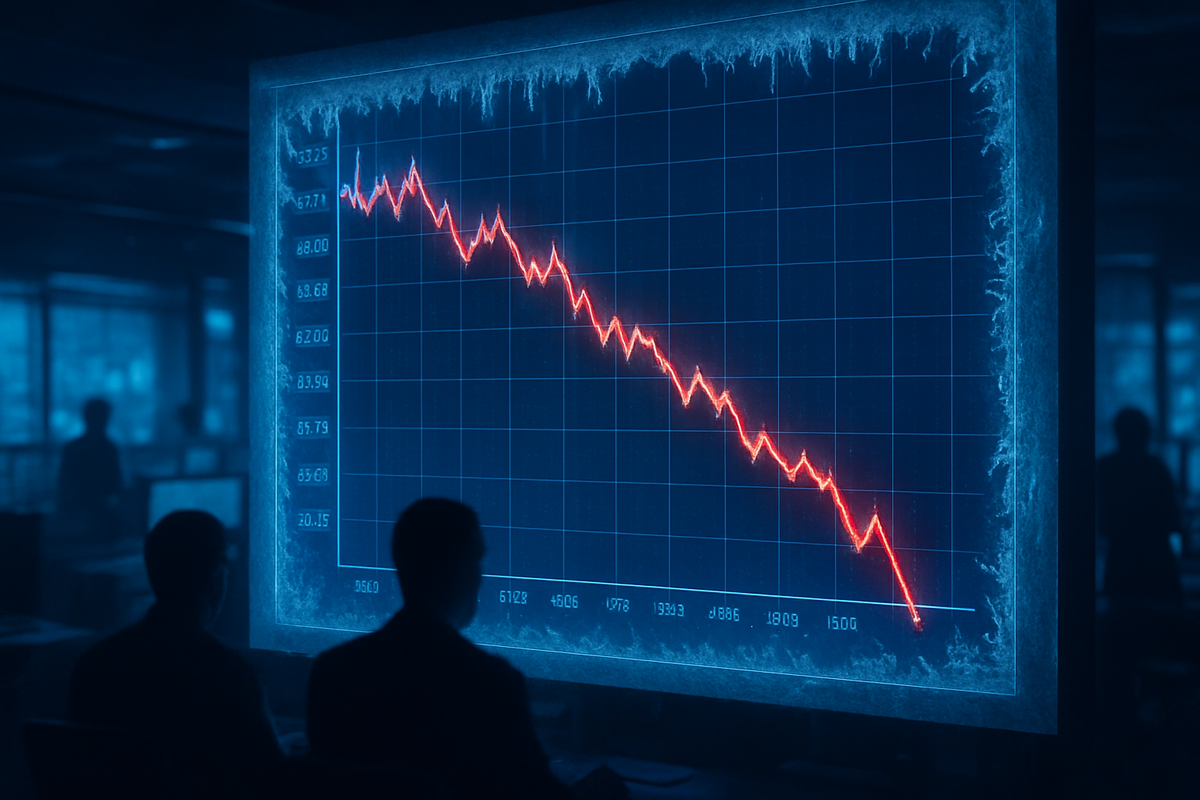
As the calendar turns to 1/2/2026, investors are finding little comfort in the traditional optimism of a new year. The final trading sessions of 2025 were marked by a sobering reality check, as a synchronized market decline effectively neutralized the long-awaited "Santa Claus Rally." While the S&P 500 (INDEXSP: .INX) managed to finish 2025 with a respectable 16% gain, the late-December slump has left a bitter taste in the mouths of institutional and retail traders alike, raising urgent questions about whether this momentum-killer is a temporary blip or a harbinger of a stagnant year ahead.
The immediate implications are already being felt across global exchanges. The failure of the year-end rally—the third such failure in as many years—has historically served as a warning sign for January’s performance. With inflation remaining stubbornly "sticky" and the "honeymoon phase" of the current administration giving way to the legislative friction of a midterm year, the market is entering 2026 on a defensive footing, bracing for what many analysts describe as a year of "valuation consolidation."
A Historic Triple-Failure: The December Decline Detailed
The final week of 2025 was a masterclass in market exhaustion. The S&P 500 fell for four consecutive sessions ending December 31, closing the final day down 0.74%. The tech-heavy Nasdaq Composite (INDEXNASDAQ: .IXIC) followed suit with an 0.8% decline, while the Dow Jones Industrial Average (INDEXDJX: .DJI) shed nearly 300 points to finish the year at 48,063.29. This late-stage retreat was not merely a result of holiday low-volume trading; it was a calculated de-risking by major players.
The timeline leading to this slump began in November 2025, as the markets struggled to recover from the economic hangover of a 43-day federal government shutdown. While a 25-basis-point rate cut by the Federal Reserve on December 17 initially sparked hope, that optimism was quickly eclipsed by Personal Consumption Expenditures (PCE) data showing inflation hovering between 2.4% and 2.9%. Investors, who had priced in a more aggressive "dovish pivot," were forced to recalibrate their expectations for 2026.
Key stakeholders, including institutional asset managers, reportedly moved to lock in gains following the massive recovery from the "Liberation Day" tariff crash in April 2025. This profit-taking created a downward spiral that prevented the "Santa Claus Rally"—the period covering the last five days of December and the first two of January—from materializing. This marks the first time in market history that this seasonal indicator has failed for three consecutive years (2023, 2024, and 2025), a statistical anomaly that has technical analysts sounding the alarm.
Winners, Losers, and the "K-Shaped" Retreat
The year-end slump was far from uniform, creating a "K-shaped" divide between sectors. High-flying technology stocks, which carried the market for much of 2025, bore the brunt of the December sell-off. Nvidia (NASDAQ: NVDA), despite a stellar 40% gain throughout the year, saw its shares drop nearly 2% in the final week as "valuation fatigue" set in. Investors began questioning the long-term sustainability of its aggressive capital allocation, particularly its high-stakes partnerships with emerging AI hardware firms.
Conversely, the automotive sector faced a more fundamental crisis. Tesla (NASDAQ: TSLA) saw its shares tumble 4.5% on December 29 alone, following the official repeal of the $7,500 federal EV tax credit. This policy shift, effective in late 2025, triggered a 50% plunge in new EV sales and left dealers with bloated inventories. In the healthcare space, UnitedHealth Group (NYSE: UNH) ended the year as the Dow’s worst performer, down roughly 34% for 2025, as rising medical costs and increased regulatory scrutiny over Medicare Advantage plans weighed heavily on its bottom line.
On the winning side, defensive staples and certain financial institutions managed to weather the storm. Companies like Procter & Gamble (NYSE: PG) saw modest inflows as investors sought safety in consumer non-discretionaries. Meanwhile, Deutsche Bank (NYSE: DB) maintained a bullish stance, projecting an S&P 500 target of 8,000 for 2026, arguing that the underlying earnings power of the "Magnificent Seven" remains intact despite the year-end volatility. However, even these optimists concede that the "AI Capex story" must now evolve into a "show-me" story of tangible profitability.
Cycles and Sentiment: The Midterm Year Headwinds
The significance of the 2025 slump is amplified when viewed through the lens of historical market cycles. As we enter 2026, we are moving into "Year 2" of the four-year presidential cycle—historically the most volatile and lowest-performing year for equities. Since 1950, midterm years have seen an average intra-year pullback of 17.5%, as the political honeymoon ends and the reality of legislative gridlock and midterm election posturing takes hold.
Historical precedents for a failed Santa Claus Rally are equally concerning. When "Santa fails to call," the "January Barometer" often follows suit. Statistically, when the year-end rally is positive, the S&P 500 averages a 1.4% gain in January. When it fails, as it just did, that average drops to a 0.2% loss. The 2025 failure mirrors the market behavior seen in 1999 and 2007—years that preceded significant structural shifts and downturns.
Furthermore, the transition from 2025 to 2026 represents a broader industry trend of "AI normalization." The speculative fervor that drove Salesforce (NYSE: CRM) and others to record highs in previous years has cooled, as seen by Salesforce's 22% decline in 2025. The market is no longer rewarding the mere mention of artificial intelligence; it is now demanding evidence of its threat to or enhancement of core software business models. This shift in sentiment is likely to dictate the pace of the 2026 recovery.
The Road Ahead: Consolidation or Collapse?
In the short term, investors should prepare for a "January Hangover." If the first five trading days of 2026 continue the downward trend established in late December, the probability of a positive annual return drops significantly. Strategic pivots will be required; companies that relied on cheap credit and "AI hype" will likely underperform, while those with strong free cash flow and "sticky" revenue models will become the new market darlings.
Long-term, 2026 is shaping up to be a year of "consolidation." Most analysts expect modest gains in the range of 3% to 6%, a far cry from the double-digit returns of the mid-2020s. The primary challenge will be navigating the "Tax Credit Cliff" in the green energy sector and the potential for further "sticky" inflation reports that could force the Federal Reserve to pause its rate-cutting cycle.
Potential scenarios range from a "soft landing" consolidation to a more pronounced "midterm correction." The key variable will be the Q4 2025 earnings season, which kicks off in mid-January. If the tech titans can prove that their AI investments are translating into bottom-line growth, the 2025 slump may be remembered as a healthy correction. If they miss, the December decline could be the first chapter of a much larger retracement.
Final Thoughts for the 2026 Investor
The 2025 year-end slump serves as a potent reminder that the market does not move in a straight line. The failure of the Santa Claus Rally, combined with the historical headwinds of a midterm year, suggests that 2026 will be a year where "stock picking" matters more than "index riding." The era of easy gains driven by post-pandemic recovery and initial AI euphoria has officially concluded.
Moving forward, the market will be hyper-focused on two things: PCE inflation data and AI monetization. Investors should keep a close eye on the "January Barometer" and watch for any signs of a rebound in the first two weeks of the month. While the 16% gain in 2025 provided a solid cushion, the late-year retreat has proven that the market is entering the new year with a "prove it" mentality.
In summary, while 2026 may not be the disaster that some bears predict, it is unlikely to be the runaway success of years past. Resilience, patience, and a focus on fundamental value will be the hallmarks of the successful 2026 investor. As we navigate the shadows of the 2025 slump, the goal is no longer just growth, but the preservation of the gains hard-won in the previous cycle.
This content is intended for informational purposes only and is not financial advice.