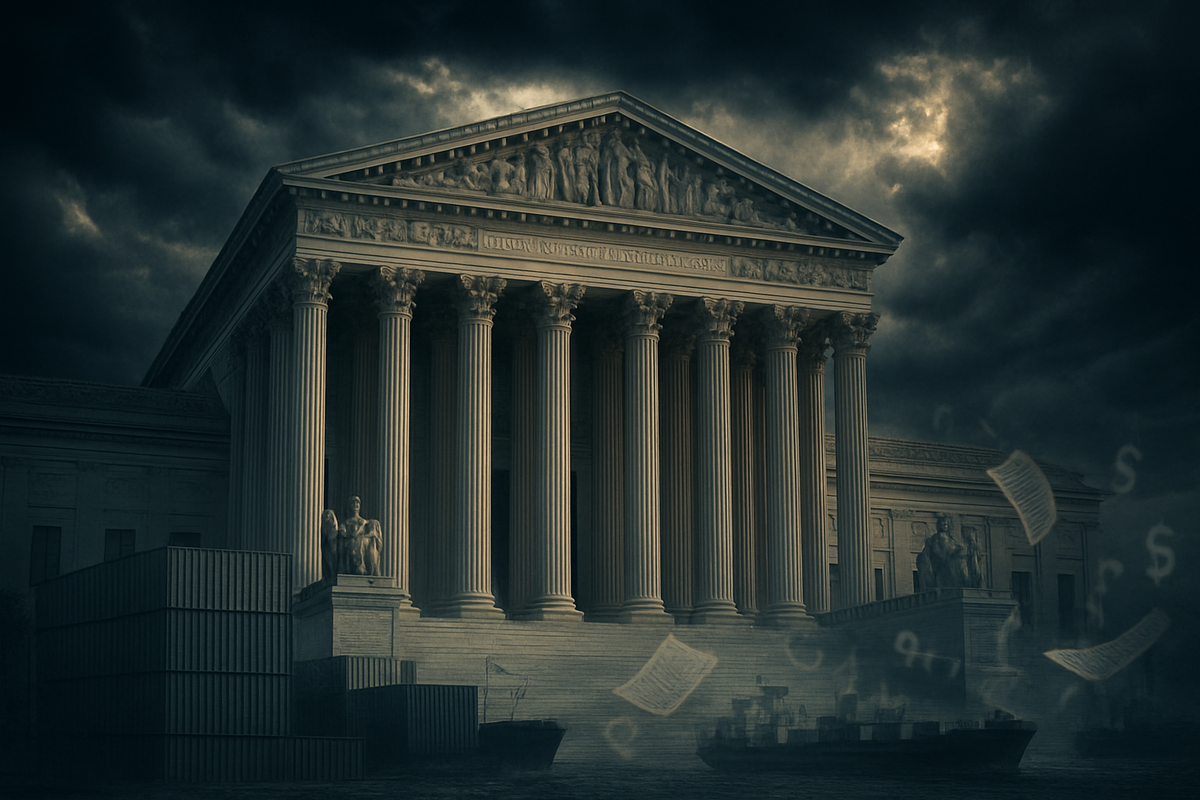
In a landmark decision that has sent shockwaves through global supply chains and the halls of power in Washington, the U.S. Supreme Court ruled 6–3 on February 20, 2026, in Learning Resources, Inc. v. Trump that the executive branch overstepped its constitutional authority by using the International Emergency Economic Powers Act (IEEPA) to unilaterally impose sweeping trade tariffs. The ruling effectively dismantles the "Reciprocal Tariffs" and "Drug Trafficking Surcharges" that have defined U.S. trade policy for the past year, declaring that the power to "lay and collect duties" remains an exclusive prerogative of Congress under Article I of the Constitution.
The immediate fallout is nothing short of a legal earthquake. U.S. Customs and Border Protection (CBP) is now sitting on an estimated $175 billion in duties collected since early 2025—funds that the Court has essentially labeled as "refundable overpayments." While the ruling provides a massive potential windfall for major retailers and tech giants, it has also plunged the federal budget into a tailspin and sparked an immediate retaliatory attempt by the Trump administration to re-impose the tariffs under alternative statutes, setting the stage for a prolonged constitutional standoff.
The Verdict That Reclaimed Article I
The ruling, authored by Chief Justice John Roberts, centered on the challenge brought by Learning Resources, Inc., a family-owned educational toy company, and V.O.S. Selections, Inc., a boutique wine importer. The plaintiffs argued that the IEEPA, originally intended to freeze foreign assets during national emergencies, was never meant to serve as a blank check for the President to tax the American people or its trading partners for general economic or social goals. The majority opinion invoked the "Major Questions Doctrine," asserting that because broad-based tariffs have "vast economic and political significance," any such delegation of power from Congress must be explicit—which the 1977 IEEPA was not.
The timeline leading to this moment began in April 2025, when the administration introduced 10% global "Liberation Day" tariffs, followed by 25% surcharges on goods from Mexico, Canada, and China aimed at curbing fentanyl trafficking. Lower courts in the District of Columbia and the Court of International Trade (CIT) initially sided with the importers in mid-2025, leading to an expedited appeal to the high court. Justice Brett Kavanaugh, leading the three-justice dissent, argued that the term "regulate" in the IEEPA historically included the power to tax in trade contexts, suggesting the ruling leaves the nation vulnerable during international crises. However, the majority's decision was final, vacating the tariffs effective immediately.
Market Winners and Losers: A $175 Billion Jackpot
The financial markets reacted with a mixture of euphoria and anxiety. Leading the "winners" circle are the nation's largest importers, who have spent the last year passing through—or absorbing—multi-billion dollar tariff costs. Amazon (NASDAQ: AMZN) saw its stock climb 3.4% over the three days following the ruling, as it stands to recover a significant portion of the duties paid on its private-label imports. Tech titan Apple (NASDAQ: AAPL), which faced an estimated $3.3 billion tariff bill on its hardware products, rallied 1.5% as the hardware margins for its flagship devices are expected to widen almost overnight.
Retailers like Walmart (NYSE: WMT) and Target (NYSE: TGT) also stand to benefit from a potential share of the $175 billion refund pool, though their gains were partially tempered by the administration’s immediate pivot to "Plan B" tariffs. Meanwhile, logistics powerhouse FedEx (NYSE: FDX) took a proactive stance, filing a high-profile lawsuit in the CIT on February 23 to expedite the refund process, causing its stock to surge 3.2% as investors bet on a swift return of capital.
Conversely, domestic producers that had enjoyed a period of protectionism are bracing for a cold front. Domestic steel and manufacturing firms, such as U.S. Steel (NYSE: X) and Nucor (NYSE: NUE), saw their shares come under pressure as the removal of duties makes cheaper international materials more competitive. Furthermore, the bond market signaled distress; as the federal government prepares for a potential $175 billion outflow, 10-year Treasury yields spiked toward 4.25% on fears that a widening deficit will require increased debt issuance, potentially cooling the broader economy.
A Constitutional Pivot and Global Ripple Effects
Beyond the immediate balance sheets, the Learning Resources ruling marks a significant shift in the balance of power within the U.S. government. For decades, the executive branch has incrementally expanded its use of emergency powers to manage trade, often with the tacit approval of a gridlocked Congress. By reasserting that trade is a legislative function, the Supreme Court has forced the hand of lawmakers. Congress must now decide whether to codify these tariffs into law or allow the nation to return to a more open-market stance—a decision fraught with political risk ahead of the 2026 midterm elections.
The ruling also carries heavy international implications. Trading partners like Canada and Mexico, who were hit by the "fentanyl surcharges," have already hailed the decision as a victory for the USMCA trade agreement. However, the ripple effect on global supply chains remains uncertain. Many companies had begun diversifying away from China and Mexico to avoid the IEEPA duties; with those duties now invalidated, the economic incentive for "near-shoring" or "friend-shoring" may weaken, potentially causing a second wave of supply chain realignments that could take years to stabilize.
What Comes Next: The Battle for Refunds and "Plan B"
The path forward is far from certain. While the $175 billion is theoretically refundable, the Supreme Court remanded the case to the Court of International Trade to determine the mechanics of the payout. Legal experts anticipate a "procedural nightmare" as thousands of companies scramble to file claims. There is no guarantee of an automatic check in the mail; instead, many importers may face years of administrative hurdles and further litigation before seeing a dime of their money.
Furthermore, the Trump administration has already attempted a strategic pivot. Within hours of the ruling on February 20, the President signed an executive order invoking Section 122 of the Trade Act of 1974 to re-impose a 15% global tariff, claiming a "balance of payments emergency." This new move has already been met with fresh lawsuits from industry groups, creating a "cat-and-mouse" game between the executive and judicial branches that will keep market volatility high for the foreseeable future.
Closing Thoughts: A New Era of Trade Volatility
The Learning Resources, Inc. v. Trump decision will likely be remembered as the most consequential trade ruling of the 21st century. It has not only disrupted $175 billion in federal revenue but has also fundamentally challenged the "imperial presidency" model of trade management. For investors, the takeaway is clear: the era of predictable, executive-led trade policy is over. The volatility that once originated in the Oval Office has now shifted to the courtrooms and the halls of Congress.
In the coming months, market participants should keep a close watch on the Court of International Trade’s rulings regarding refund procedures and the success (or failure) of the administration's "Section 122" workarounds. As the $175 billion legal battle unfolds, the true cost of this trade war—and the value of its reversal—will finally be tallied on the balance sheets of corporate America.
This content is intended for informational purposes only and is not financial advice.