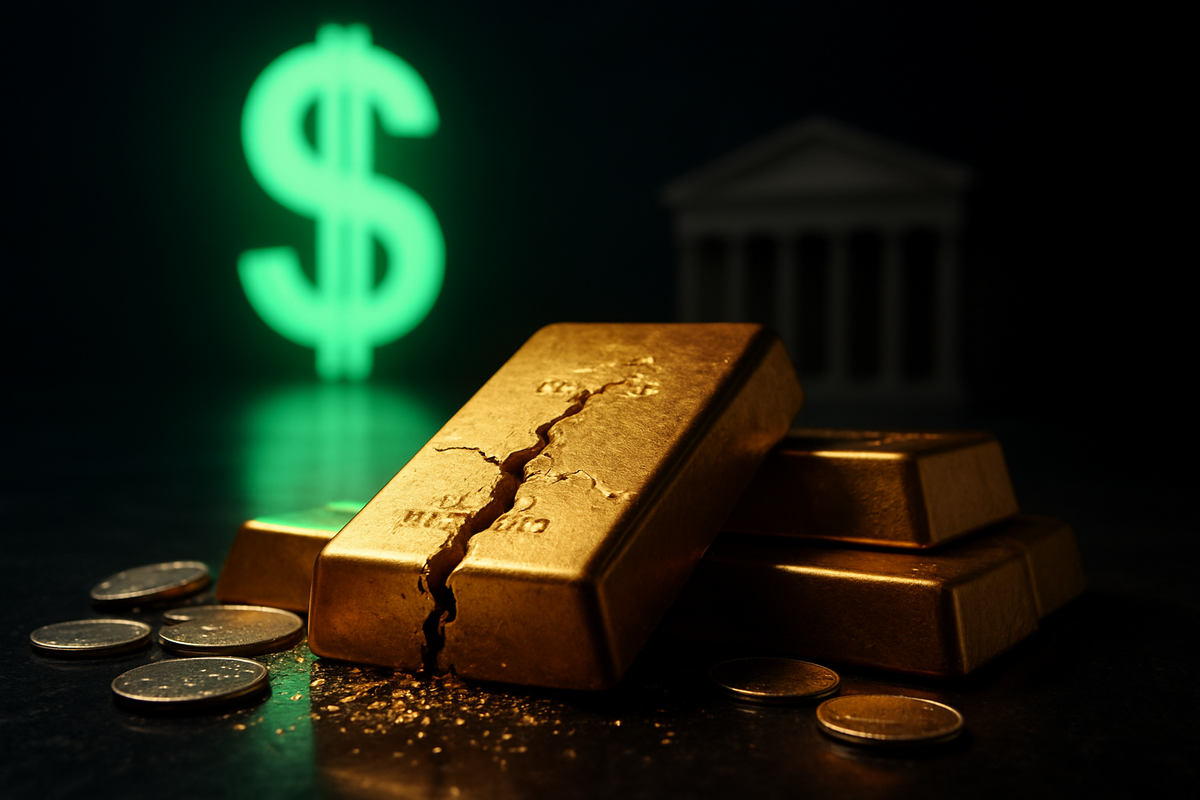
The precious metals market has entered a tailspin, with gold and silver experiencing one of their most aggressive sell-offs in decades. On April 2, 2026, a "perfect storm" of hawkish Federal Reserve signals and hotter-than-expected inflation data converged to strip gold and silver of their safe-haven status, sending prices tumbling as the U.S. Dollar asserted its dominance. Institutional investors, reeling from a "liquidity rupture," have begun a mass exodus from non-yielding commodities in favor of the surging greenback.
The immediate fallout saw spot gold prices drop 2.7% in a single session to $4,622.59 per ounce, following a disastrous March that marked the metal’s worst monthly performance since the 2008 financial crisis. Silver, often the more volatile sibling, plummeted over 5%, breaching critical support levels and settling near $71.44 per ounce. As inflation nowcasts for April climbed to 3.71%, far exceeding the Federal Reserve's comfort zone, the market has effectively "priced out" any remaining hopes for interest rate cuts in 2026, leaving precious metals exposed to the high "carry cost" of a rising-rate environment.
The 'Warsh Shock' and the Inflationary Surge
The roots of this week’s carnage trace back to the strategic nomination of Kevin Warsh as the next Federal Reserve Chair, a move that markets have dubbed the "Warsh Shock." Nominated by President Trump to succeed Jerome Powell, Warsh has a long-standing reputation as a monetary hawk. His recent public comments advocating for a "neutral" rate and a focus on the dollar’s "scarcity value" signaled to investors that the era of aggressive liquidity support was over. By April 2, 2026, the prospect of a "Volcker-esque" regime—one that prioritizes price stability and dollar strength above all else—became the dominant market narrative.
This shift was compounded by the release of early April inflation data. The Consumer Price Index (CPI) nowcast surged to 3.71%, up from March’s 3.25%, driven largely by an energy shock originating from the escalating Iran conflict. The Federal Reserve’s preferred gauge, the Personal Consumption Expenditures (PCE) index, similarly spiked to a projected 3.58%. In any other era, such high inflation might have driven investors toward gold as a hedge; however, with a hawkish nominee at the helm and the 10-year Treasury yield climbing rapidly, the "inflation hedge" narrative was replaced by a "higher-for-longer" reality.
The final blow to market sentiment came from President Trump’s "Stone Age" address regarding the Iran crisis. While geopolitical tension usually supports bullion, the address signaled a significant military escalation that triggered a frantic rotation into the US Dollar Index (DXY), which climbed to 100.13. Simultaneously, the CME Group hiked margin requirements for precious metals by 30%, forcing institutional funds to liquidate gold and silver positions to cover margin calls elsewhere in their portfolios.
Mining Giants Reeling as Margin Compression Bites
The collapse in metal prices has sent shockwaves through the equities of major producers. Newmont Corporation (NYSE: NEM) has been among the hardest hit, with the company officially declaring 2026 a "trough year." Shares of the gold giant faced heavy pressure on April 2 as management lowered production guidance to 5.3 million ounces while warning of a spike in All-In Sustaining Costs (AISC) to $1,680 per ounce. Adding to its woes, Newmont is currently embroiled in a legal battle with Barrick Gold (NYSE: GOLD) over their Nevada joint venture, having recently issued a formal Notice of Default to its partner.
Barrick Gold itself has seen its stock price suppressed, not only by the legal "firestorm" with Newmont but also by its sensitivity to silver prices. Market analysts have increasingly viewed Barrick as a high-beta silver proxy, causing it to underperform even its gold-focused peers. Meanwhile, silver-heavy producers like First Majestic Silver (NYSE: AG) faced a brutal session, with its stock price cratering as Zacks Research downgraded the company to a "Hold." First Majestic's revenue miss, combined with a 7.7% drop in silver futures, highlighted the extreme vulnerability of miners in the current environment.
While the mining sector bleeds, a handful of financial instruments have emerged as victors. The Invesco DB US Dollar Index Bullish Fund (NYSEARCA:UUP) remained near 52-week highs, serving as the primary vehicle for investors fleeing the commodities rout. Similarly, inverse exchange-traded funds provided a lucrative refuge for bears; the ProShares UltraShort Gold (NYSEARCA:GLL) and the ProShares UltraShort Silver (NYSEARCA:ZSL) both saw massive intraday gains, with GLL rising over 5% as it capitalized on the -2x daily return of the falling gold price.
A Systemic Liquidity Rupture and Historical Parallels
The April 2026 crash represents more than just a bad day for gold; it signifies a broader shift in the global financial architecture. Industry analysts are drawing parallels to the 2013 "Taper Tantrum," when a sudden change in Federal Reserve communication led to a 25% crash in gold prices within three months. However, the current situation is perhaps more akin to the late 1970s, but with a modern twist. While the 1970s saw gold surge during an energy crisis, the 2026 "Warsh Shock" has preemptively fortified the dollar, preventing the debasement that historically fueled gold rallies.
This event fits into a broader industry trend of "Hard Money" resurgence. For years, the market operated under the assumption of a "Fed Put"—the belief that the central bank would always step in to support assets. The 2026 crisis has effectively dismantled this belief. Furthermore, the 40% surge in energy-related costs due to the Strait of Hormuz disruption has created an "energy-cost trap" for miners. They are being squeezed between a falling selling price for their product and a rising cost of production, a dynamic that may lead to widespread mine closures or "care and maintenance" statuses for higher-cost operations.
The regulatory implications are also significant. The Fed’s move away from "forward guidance" toward a "result-oriented" framework means that market volatility will likely remain high. Central banks are no longer prioritizing "stability" in the sense of low asset price volatility, but rather "stability" in terms of the dollar’s purchasing power. This policy shift has ripple effects on competitors and partners alike, as global trade partners are forced to adjust to a significantly stronger and more expensive U.S. currency.
What Comes Next: Margin Calls and Strategic Pivots
In the short term, the market will be laser-focused on Kevin Warsh’s confirmation hearings scheduled for April 13, 2026. Any further hawkish rhetoric from the nominee could trigger another round of liquidations. For the mining industry, the focus must shift from growth to "resilience." We expect to see major players like Agnico Eagle Mines (NYSE: AEM) and Pan American Silver (NYSE: PAAS) pivot their capital expenditures toward Tier 1 jurisdictions like Canada and Australia, moving away from high-risk regions that are vulnerable to the energy shocks currently paralyzing the Middle East.
Strategic adaptations will be required. Miners may increasingly seek to decouple their production from global energy volatility by integrating renewable power and localized processing. However, the immediate challenge remains liquidity. As the "deleveraging cascade" continues, even the most robust companies may find their valuations dragged down by the broader sector sell-off. Investors should be prepared for a period of extreme consolidation, as the lower-cost majors may look to acquire distressed junior miners whose market caps have been decimated by the falling silver and gold prices.
The long-term outlook for precious metals hinges on the Federal Reserve's ability to maintain its "Hard Money" stance in the face of a potential recession. If the high energy costs and surging dollar eventually choke off economic growth, the Fed may be forced to backtrack. Until then, however, the "Almighty Dollar" remains the undisputed king of the 2026 market.
Conclusion: The New Macro Reality
The events of April 2026 have delivered a clear message to the markets: the speculative "de-dollarization" trade of the mid-2020s has met its match in the form of a hawkish Federal Reserve and a resilient greenback. The sharp decline in gold and silver is a symptom of a broader transition toward a more disciplined monetary regime. For investors, the takeaway is one of caution; the traditional safe-haven status of precious metals has been temporarily overridden by a "liquidity rupture" that prioritizes cash and yield over non-productive assets.
Moving forward, the market will be defined by its reaction to the April 13th hearings and the evolving conflict in Iran. The era of "easy money" has been replaced by a "Higher for Longer" regime that demands a total reassessment of commodity-linked portfolios. Investors should watch for the $4,500 support level in gold and the $70 level in silver; a breach of these marks could signal even deeper systemic deleveraging.
The mining sector is entering a period of forced efficiency. Those companies that can manage their margins amid surging energy inputs will survive, while high-cost producers may become casualties of this "Warsh Shock." As we move into the second quarter of 2026, the resurgence of the dollar as a scarcity asset remains the single most important trend for global financial markets.
This content is intended for informational purposes only and is not financial advice.