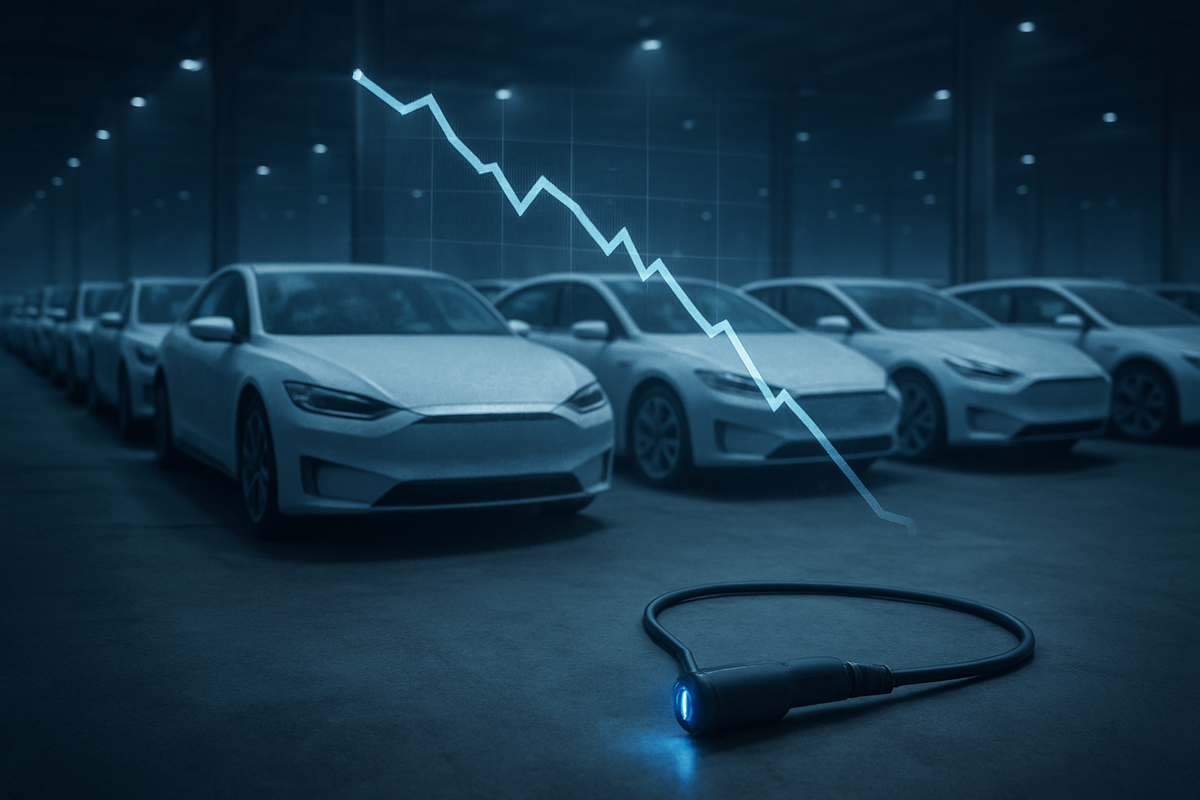
The electric vehicle (EV) market was sent into a tailspin on Thursday as Tesla (NASDAQ: TSLA) reported first-quarter 2026 delivery numbers that significantly trailed analyst projections. The results, which revealed a mounting inventory surplus and a cooling appetite for the company's aging vehicle lineup, triggered a sharp 5.5% drop in Tesla’s stock price, closing the session at $360.59. As the world’s most valuable automaker struggles to reconcile its high-growth valuation with stagnating sales, the miss has reignited fears that the "EV Winter" is deepening, forcing investors to question if the era of triple-digit growth is gone for good.
The delivery report, released early on April 2, 2026, showed that Tesla handed over 358,023 vehicles in the first three months of the year, missing the consensus Wall Street estimate of 365,645. Even more concerning for the market was the widening chasm between production and sales; Tesla manufactured 408,386 vehicles during the quarter, leaving more than 50,000 units sitting in inventory. This surplus suggests that Tesla’s long-celebrated "build-to-order" efficiency has given way to the inventory-bloated headaches more commonly associated with legacy manufacturers, signaling a fundamental shift in the supply-demand dynamic.
Inventory Bloat and Product Stagnation: Inside the Q1 Miss
The shortfall in deliveries was not an isolated event but the culmination of several months of waning momentum. Leading up to the April 2nd announcement, Tesla had already been grappling with the expiration of the $7,500 federal EV tax credit in the United States, which lapsed in late 2025. Without this critical incentive, the "price-to-value" proposition for the Model 3 and Model Y—the two vehicles that accounted for over 95% of the quarter’s deliveries—has become increasingly difficult for mass-market consumers to justify. Furthermore, the quarter saw the "honorable discharge" of the long-standing Model S and Model X platforms, which were officially discontinued to make room for dedicated robotics production lines, leaving Tesla without its premium halo products.
Key stakeholders, including institutional investors and retail "super-bulls," reacted with visible frustration to the production surplus. Tesla’s energy storage division, often cited as the company's next great growth engine, also stumbled significantly, deploying only 8.8 GWh against a projected 14.4 GWh. Industry analysts noted that the production-to-delivery gap of 50,363 units is a "red alert" for the company’s margins. As Tesla enters the second quarter of 2026, it faces the daunting task of either further slashing prices to move inventory—a move that would cannibalize profits—or significantly scaling back production, which would undermine the "unlimited growth" narrative that supports its 180x price-to-earnings ratio.
The market reaction was swift, with the stock opening down 3.3% in pre-market trading before accelerating its decline throughout the day. By the closing bell, Tesla had wiped billions off its market capitalization, bringing its year-to-date losses to nearly 17%. The narrative on the trading floor has shifted from "How many cars can Tesla build?" to "How many cars can the market actually absorb?"
The Rising Tide of Hybrids and Chinese Rivals
While Tesla’s miss is a blow to the EV-only narrative, it has provided a strategic opening for competitors. Legacy automakers like General Motors (NYSE: GM) and Ford (NYSE: F) have emerged as unexpected winners in this climate. Both companies spent 2025 aggressively pivoting their portfolios back toward hybrid and extended-range electric vehicles (EREVs), a strategy that now looks prophetic. As consumers balk at the range anxiety and high insurance costs of pure battery EVs, the flexible offerings from GM and Ford have captured the "pragmatic majority" of the car-buying public.
On the international stage, BYD (OTC: BYDDY) continues to exert immense pressure. After overtaking Tesla in total pure-EV sales in late 2025, the Chinese giant has used its vertically integrated supply chain to keep prices low while launching a barrage of new, tech-heavy models. In the wake of Tesla’s Q1 miss, BYD shares saw a modest uptick, as investors bet on the company’s ability to dominate the sub-$25,000 market—a segment Tesla has yet to enter. Conversely, pure-play EV startups like Rivian (NASDAQ: RIVN) and Lucid (NASDAQ: LCID) were dragged lower by Tesla’s results, falling 4% and 6% respectively, as concerns mounted that if the industry leader is struggling to find buyers, smaller players with less cash may face an existential crisis.
The traditional powerhouses of the industry are also finding new life. Toyota (NYSE: TM), which was once criticized for its slow adoption of pure EVs, is now being hailed by some analysts for its "hybrid-first" philosophy. As Tesla’s stock struggled on April 2, Toyota shares remained resilient, highlighting a shift in investor sentiment toward balanced powertrain strategies rather than all-or-nothing electrification.
Beyond the Balance Sheet: A Market in Transition
Tesla’s current predicament is indicative of a broader industry trend where the "early adopter" phase of the EV revolution has officially ended. The transition to the "late majority" of buyers is proving much more difficult than anticipated. High interest rates, which have remained stubbornly elevated throughout early 2026, have made the financing of high-ticket items like Teslas prohibitive for the average household. This economic backdrop, combined with a charging infrastructure that has struggled to keep pace with fleet growth, has created a "wait-and-see" attitude among potential EV buyers.
The regulatory landscape is also shifting. In Europe and the United States, the rollback of subsidies and the introduction of new purchase taxes have removed the financial floor that previously supported EV demand. Furthermore, the "Musk Effect"—the polarizing nature of CEO Elon Musk’s high-profile involvement in the Department of Government Efficiency and other political spheres—has begun to show up in brand sentiment surveys. Analysts at firms like Barclays have noted that brand fatigue in key markets like California and Germany is a non-negligible factor in Tesla’s recent sales deceleration.
Historical comparisons are already being drawn to the "Post-Model T" era of Ford, where a single dominant player eventually had to concede market share to a more diverse field of competitors offering more varied styles and price points. Tesla, which has relied on essentially two vehicle designs for over half a decade, is now facing the reality that software updates alone cannot substitute for fresh hardware in the eyes of the consumer.
The Road Ahead: Robots, Taxis, and the Model 2
Looking forward, the remainder of 2026 will be a period of intense strategic re-calibration for Tesla. The company is widely expected to double down on its AI and robotics initiatives to distract from the cooling automotive business. All eyes are now on the rumored August 2026 "Robotaxi" event, which Musk has promised will demonstrate a vehicle designed from the ground up for autonomous ride-sharing. However, the market’s patience is wearing thin; without a clear timeline for the "Model 2"—a high-volume, sub-$25,000 vehicle—Tesla’s ability to return to its previous growth trajectory remains in doubt.
Short-term scenarios for Tesla include further price cuts to liquidate the 50,000 unsold vehicles from Q1, which will likely lead to another quarter of compressed margins. Long-term, the company’s survival as a trillion-dollar entity hinges on its ability to prove that Full Self-Driving (FSD) and the Optimus humanoid robot are viable commercial products rather than perpetual "beta" projects. If these technologies fail to materialize as revenue drivers within the next 12 to 18 months, the company may be re-valued by the market as a high-margin, but mature, automotive manufacturer rather than a high-growth tech firm.
Final Assessment: A Reality Check for the Green Revolution
The 5.5% drop in Tesla stock on April 2, 2026, serves as a stark reality check for the entire green energy sector. The key takeaway from the Q1 miss is that the electric vehicle market is no longer a "if you build it, they will come" industry. Consumers are increasingly price-sensitive, demand-critical, and wary of the infrastructure gaps that still plague the EV experience. Tesla’s struggle to move inventory in a quarter where production was high suggests that the company’s historical advantage in manufacturing may now be working against it in a saturated market.
Moving forward, investors should keep a close watch on Tesla’s inventory levels in Q2 and any guidance regarding the production ramp-up of the next-generation platform. The broader market will also be looking for signs of a "bottoming out" in EV demand. As the "EV Winter" persists, the winners will be those who can maintain profitability while navigating a landscape that favors hybrids and affordable alternatives over premium, pure-electric status symbols. Tesla remains the benchmark for the industry, but for the first time in years, the benchmark is looking increasingly vulnerable.
This content is intended for informational purposes only and is not financial advice