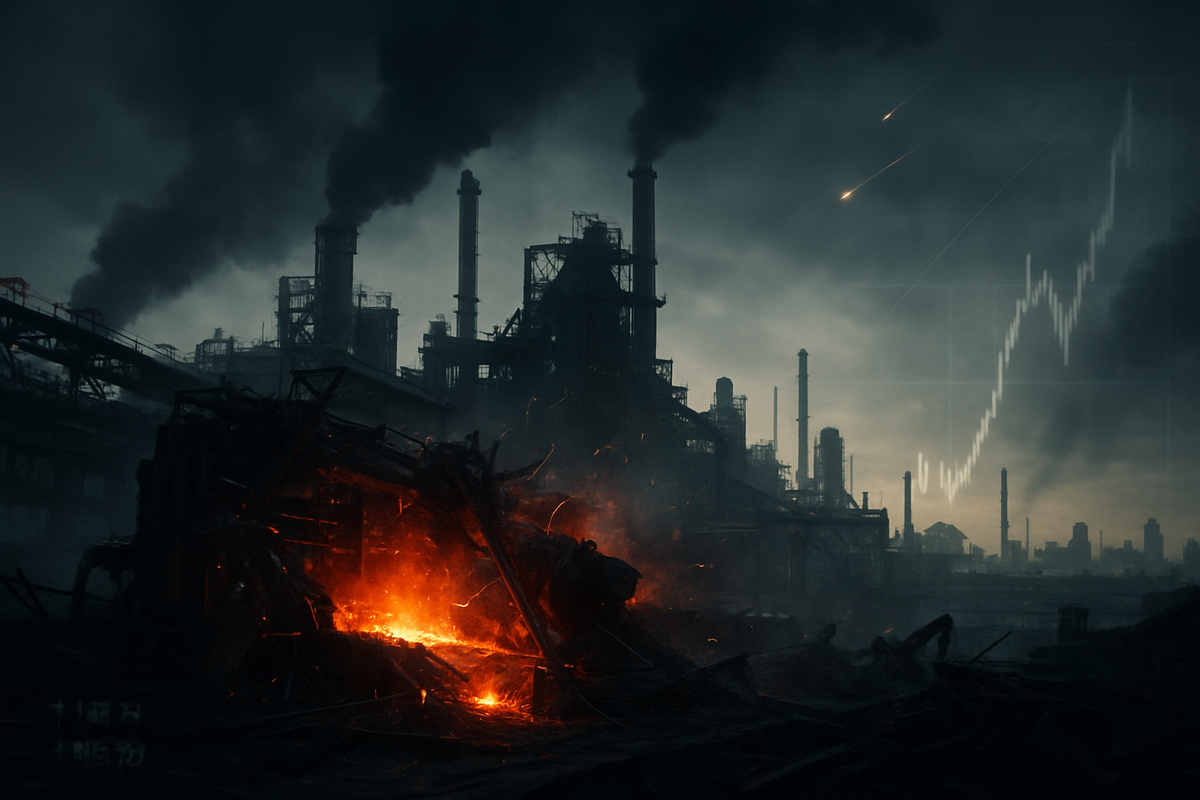
The global aluminum market has been thrust into a state of unprecedented chaos following a series of devastating missile and drone strikes on critical industrial infrastructure in the United Arab Emirates. Emirates Global Aluminium (EGA), the world’s largest producer of "premium aluminum," has been forced to halt operations at its flagship Al Taweelah and Jebel Ali sites. The strikes, which occurred during a geopolitical escalation involving Iranian forces, have caused catastrophic damage to the smelting circuits, effectively removing nearly 4% of the world's primary aluminum supply overnight.
As of April 3, 2026, the ripple effects of this supply shock are being felt across every corner of the global economy. Aluminum prices on the London Metal Exchange (LME) have skyrocketed past $3,500 per tonne, hitting levels not seen in years. With the Strait of Hormuz currently under a de facto blockade, the "premium" on physical metal for immediate delivery has soared, leaving aerospace, automotive, and packaging giants scrambling to secure whatever inventory remains in Western warehouses.
The "Weekend of Fire" and the Freezing of the Smelters
The crisis began on the night of March 28, 2026, a date now referred to by energy traders as the "Weekend of Fire." A coordinated wave of Iranian drones and precision-guided missiles bypassed regional defense umbrellas to strike the heart of the UAE’s industrial sector. At EGA’s Al Taweelah complex, the strikes targeted the massive power infrastructure and the smelting potlines. Reports from the ground indicate a "technical catastrophe": the loss of power caused the molten metal to solidify, or "freeze," inside the smelting circuits. Recovering from such an event is not a matter of weeks, but potentially years, as the solidified metal must be physically jackhammered out and the pots entirely relined.
The timeline leading up to this moment was marked by months of deteriorating relations in the Persian Gulf, yet the scale of the industrial sabotage caught the markets off guard. Simultaneous strikes also hit Aluminium Bahrain (Alba), further compounding the region's production loss. By the time markets opened on the Monday following the attacks, the industry realized that approximately 9% of global primary aluminum production had been sidelined or trapped behind the blockade of the Strait of Hormuz.
For EGA, a company that provides value-added products to over 50 countries, the damage represents more than just lost revenue; it is a structural blow to the UAE’s "Operation 300bn" industrial strategy. International stakeholders, including technology partners and major debt holders, are now assessing the viability of the Gulf as a stable production hub for the energy-intensive metals industry.
Winners and Losers in a High-Price Environment
The immediate beneficiary of this supply vacuum has been Alcoa Corporation (NYSE: AA). Shares of the Pittsburgh-based giant surged nearly 12% as investors pivoted toward North American assets that are insulated from Middle Eastern geopolitical risk. Alcoa’s integrated supply chain and significant smelting capacity in stable jurisdictions have positioned it as the primary "flight-to-safety" play for industrial buyers. Similarly, Rio Tinto (NYSE: RIO) has seen its valuation climb, as its low-cost, hydroelectric-powered smelters in Canada and New Zealand are now generating record margins. Rio Tinto is reportedly exploring the immediate restart of idled capacity at its Tiwai Point facility to capitalize on the $3,500/tonne price floor.
Conversely, the "losers" are the downstream manufacturers who rely on just-in-time delivery of specialized alloys. Aerospace titan The Boeing Company (NYSE: BA) and automotive leader Ford Motor Company (NYSE: F) are facing a dual threat: surging raw material costs and potential production line stoppages due to lack of specialized billets. Ford, in particular, has leaned heavily on EGA’s "CelestiAL" solar-powered aluminum to meet its sustainability targets; the loss of this "green" supply could force a retreat to higher-carbon alternatives, damaging both their balance sheets and their ESG ratings.
Century Aluminum Company (NASDAQ: CENX) presents a complex case. While its stock has rallied 7% on the back of higher spot prices, the company faces mounting pressure from high domestic energy costs in the United States. However, a recent joint venture with EGA to build a new 750,000-tonne smelter in Oklahoma—announced just months before the crisis—now looks like a prophetic strategic pivot, though it will take years to bring that capacity online.
A Structural Shift in Global Trade and "Green-flation"
This event is not merely a temporary disruption; it marks a fundamental shift in how the world views industrial commodity security. For decades, the Middle East was seen as a stabilizing force in the aluminum market due to its abundant and low-cost natural gas. That narrative has been shattered. We are now entering an era of "Green-flation," where the premium for "safe" and "green" aluminum produced in stable, renewable-energy-heavy regions like Scandinavia and Quebec will become the new global benchmark.
Norsk Hydro ASA (OTCMKTS:NHYDY) is already seeing this play out. Demand for their recycled aluminum products has reached "unprecedented" levels as primary smelting becomes too risky in volatile regions. The crisis is also likely to trigger a regulatory response in the West, with calls for increased subsidies for domestic smelting under the guise of national security. Policymakers in the U.S. and EU are already discussing "strategic metal reserves," similar to the Strategic Petroleum Reserve, to prevent such a supply shock from paralyzing the defense and transportation sectors again.
Historically, this event draws comparisons to the 2018 sanctions on Rusal, which sent aluminum prices spiraling. However, the physical destruction of smelting capacity makes the current crisis significantly more permanent. Unlike sanctions, which can be lifted with a pen stroke, a frozen smelting pot is a physical reality that requires years of engineering to resolve.
What Lies Ahead: The Path to Recovery
In the short term, the market will likely remain in "steep backwardation," with spot prices significantly higher than futures as users pay any price to keep their factories running. We expect to see a massive drawdown of LME inventories in the coming months, which were already at historically low levels. The long-term outlook will depend on how quickly EGA and Alba can restore partial operations and whether the blockade of the Strait of Hormuz is lifted.
Strategic pivots are already underway. Companies that have traditionally relied on Gulf aluminum are now aggressively seeking long-term offtake agreements with producers in Brazil, Australia, and Canada. This "re-shoring" of the aluminum supply chain will likely lead to higher consumer prices for everything from soda cans to electric vehicles, as the efficiency of the old globalized model is replaced by the cost of security and stability.
Closing Thoughts for Investors
The EGA crisis is a stark reminder of the fragility of global supply chains for critical minerals. The era of cheap, reliable energy and metals from the Persian Gulf may be over, replaced by a more fragmented and expensive landscape. Moving forward, the market will reward companies with geographically diverse assets and those who control their own energy sources.
Investors should closely watch the weekly LME inventory reports and the progress of the "safe-haven" smelter projects in North America. The key takeaway is that the "geopolitical risk premium" is no longer a theoretical concept in the aluminum market—it is now a permanent fixture of the balance sheet. Watch for the Q2 earnings calls of major industrial users; their ability to pass these costs on to consumers will be the next major indicator of market health.
This content is intended for informational purposes only and is not financial advice.