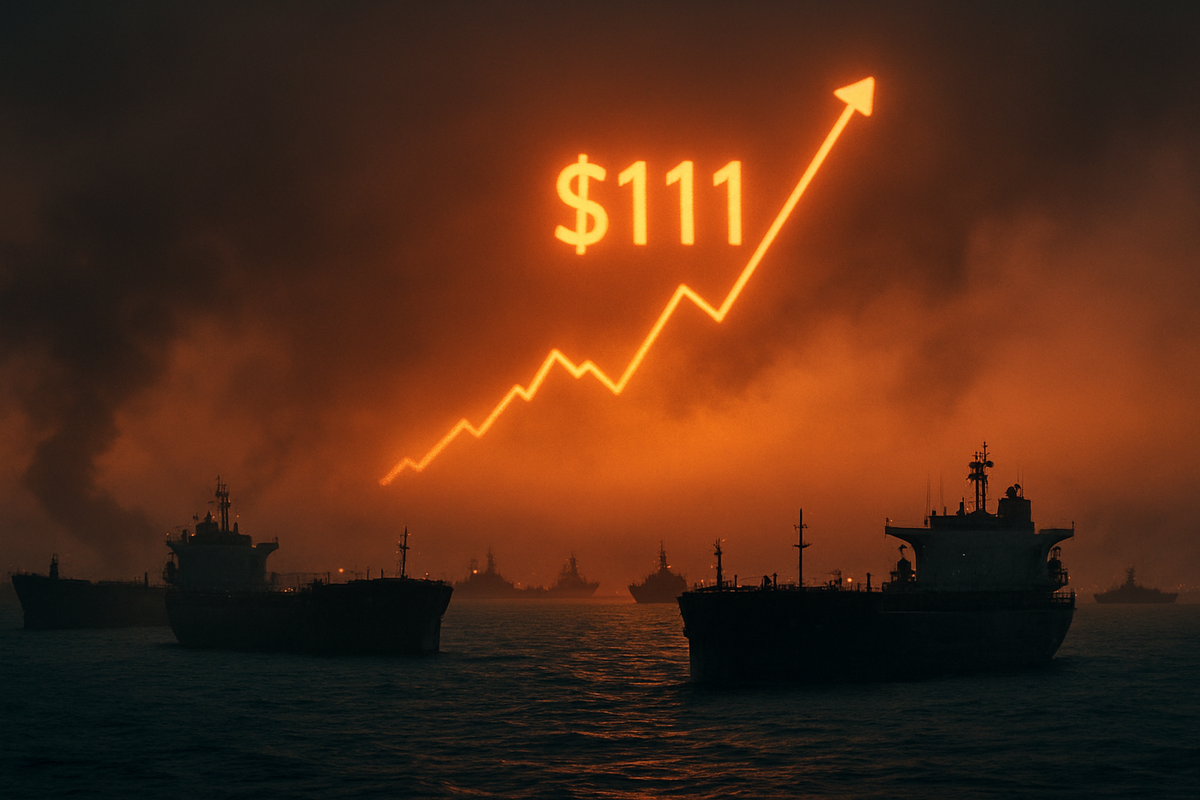
The global energy landscape shifted violently this week as West Texas Intermediate (WTI) crude oil surged past the $111 per barrel mark, a level not seen in years, following a catastrophic breakdown in Middle Eastern diplomacy. The sudden spike, which saw prices shatter the $104 resistance level in a matter of hours, comes as the Strait of Hormuz—the world’s most vital energy artery—has been effectively choked off by escalating military hostilities between the United States, Israel, and Iran.
The immediate implications are staggering: nearly 20% of the world’s daily oil supply is currently stranded in the Persian Gulf. With the risk of a prolonged blockade looming, the global economy is bracing for a massive inflationary shock that threatens to derail the fragile recovery of 2026. As tankers sit idle and insurance premiums for maritime transit skyrocket, the specter of "stagflation" has returned to the forefront of market discourse, sending shockwaves through equity and bond markets alike.
A Perfect Storm: The Path to $111 Oil
The current crisis traces its roots to late February 2026, when long-simmering tensions over regional influence and nuclear proliferation reached a breaking point. Following a series of joint U.S.-Israeli strikes on Iranian military and energy infrastructure, the Islamic Revolutionary Guard Corps (IRGC) executed its long-held threat to weaponize the Strait of Hormuz. On March 27, 2026, Tehran officially declared the waterway closed to any vessel linked to the "Axis of Aggression," a move that was met with a defiant televised address from President Donald Trump on April 1. In his speech, the President vowed to "finish the job" and use full military force to reopen the passage, further heightening the risk of a total regional war.
The market reaction was instantaneous. By April 2, WTI crude futures jumped 11% to settle at $111.54, while Brent crude shadowed the move, trading near $109. This marks a historic deficit, as approximately 21 million barrels of oil per day are now locked behind the blockade. Despite a coordinated release of 400 million barrels from the Strategic Petroleum Reserve (SPR) by G7 nations, traders remain skeptical that these stockpiles can replace the sheer volume of Persian Gulf exports for more than a few months.
Key stakeholders, including the International Energy Agency (IEA) and OPEC+ leadership, have held emergency meetings, but the geopolitical divide remains wide. While Saudi Arabia and the United Arab Emirates have attempted to reroute some supply via terrestrial pipelines, these routes can only handle roughly 9 million barrels per day, leaving a massive 12-million-barrel hole in the daily global balance. The chaos has turned the Strait into a "no-go zone" for commercial shipping, with most major insurers withdrawing coverage for any vessel entering the Gulf of Oman.
Winners and Losers: Corporate America Reacts
In the equity markets, the energy sector has become a lone island of green in a sea of red. Integrated oil giants like ExxonMobil (NYSE: XOM) and Chevron (NYSE: CVX) have seen their stock prices climb as they benefit from the immediate appreciation of their global reserves and domestic production. Exploration and production companies with heavy footprints in the Permian Basin, such as Occidental Petroleum (NYSE: OXY) and ConocoPhillips (NYSE: COP), are also viewed as primary beneficiaries, as the "U.S. energy independence" narrative gains renewed fervor.
Conversely, the transportation and logistics sectors are reeling. The airline industry, already struggling with fluctuating fuel costs, faces an existential threat. Delta Air Lines (NYSE: DAL) and United Airlines (NASDAQ: UAL) saw their shares tumble by double digits this week, as the prospect of jet fuel prices doubling threatens to wipe out annual profit margins. Similarly, global shipping and delivery giants like FedEx (NYSE: FDX) and United Parcel Service (NYSE: UPS) are preparing to implement aggressive "emergency fuel surcharges" to combat the rising cost of operations, a move that will likely be passed directly to the consumer.
Retail and consumer discretionary stocks are also under pressure. High fuel prices act as a regressive tax on consumers, siphoning away disposable income that would otherwise be spent on goods and services. Companies like Amazon (NASDAQ: AMZN), which rely heavily on vast delivery networks, face a dual threat: rising logistics costs and a potentially cooling consumer base. Analysts at major banks are already revising their earnings estimates for the second half of 2026, citing the "oil tax" as a primary headwind for corporate growth.
Strategic Shock: Inflation and the Shadow of the 1970s
The wider significance of this event cannot be overstated; it is a fundamental challenge to the global energy security framework established after the 20th-century oil shocks. Analysts at Societe Generale have issued a dire warning, suggesting that if the Hormuz blockade persists for more than two months, WTI could easily reach $150 per barrel. Macquarie has gone even further, modeling a "black swan" scenario where prices hit $200 per barrel by June 2026 if military engagement escalates into a multi-front conflict.
This event fits into a broader trend of "geopolitical fragmentation," where energy is increasingly used as a tool of statecraft rather than a simple commodity. The policy implications are immediate: central banks, including the Federal Reserve, find themselves in a "policy straitjacket." They must decide whether to raise interest rates further to combat the inflationary pressure of $111 oil or hold steady to avoid crushing an economy already burdened by high energy costs. This situation bears a striking resemblance to the 1973 oil embargo, which led to a decade of stagnant growth and high inflation.
Furthermore, this crisis may accelerate the regulatory push toward renewable energy and electric vehicle (EV) infrastructure as a matter of national security. However, in the short term, the urgent need for fossil fuel stability is likely to lead to a temporary roll-back of environmental regulations to encourage domestic drilling. The irony is not lost on market observers: while the long-term goal remains a "green transition," the immediate survival of the global economy currently depends on the very carbon-intensive resources it seeks to replace.
What Comes Next: The Road to $200 or De-escalation?
In the short term, all eyes are on the U.S. Navy’s Fifth Fleet and its ability to secure the Strait. A successful "freedom of navigation" operation could see oil prices retreat as quickly as they rose, potentially stabilizing in the $85–$95 range. However, any military miscalculation—such as the sinking of a major tanker or a direct strike on Saudi oil fields—could trigger the $200 "nightmare scenario" forecasted by Macquarie.
Strategic pivots are already underway. European nations, still scarred by the 2022 energy crisis, are moving to lock in long-term LNG contracts with Qatar and the U.S., though even these supplies are at risk if the Gulf remains a combat zone. We may see a shift toward "near-shoring" of manufacturing to reduce the energy intensity of global supply chains. For investors, the emergence of "energy volatility" as a permanent market fixture means that hedging strategies, particularly through energy derivatives and commodities, will become essential components of a diversified portfolio.
Long-term, this conflict may force a total re-evaluation of the global supply chain. If the Middle East remains a volatile chokepoint, the investment will likely pour into alternative routes and domestic production at an unprecedented scale. The challenge, however, is that these solutions take years to materialize, while the impact of $111 oil is felt at the gas pump today.
Market Wrap-Up: Navigating the New Oil Reality
The surge of WTI crude to $111 per barrel represents more than just a price spike; it is a signal of a world in geopolitical transition. The key takeaway for investors is that the "peace dividend" of the last few years has officially evaporated, replaced by a high-risk premium that will likely keep energy prices elevated for the foreseeable future. The potential for $150 to $200 oil is no longer a fringe theory but a legitimate baseline for risk management.
Moving forward, the market will be hyper-sensitive to any headlines regarding the Strait of Hormuz and diplomatic backchannels. Investors should watch for the next round of SPR releases, shifts in Federal Reserve rhetoric regarding "supply-side inflation," and the Q2 earnings reports of major transportation and energy firms. These will provide the first real data on how much "demand destruction" is occurring at these price levels.
The lasting impact of this week’s events will be measured in the structural changes to the global economy. Whether through a forced acceleration of the energy transition or a resurgence of domestic oil production, the world of April 2026 is one where energy security has once again become the ultimate currency of power.
This content is intended for informational purposes only and is not financial advice.