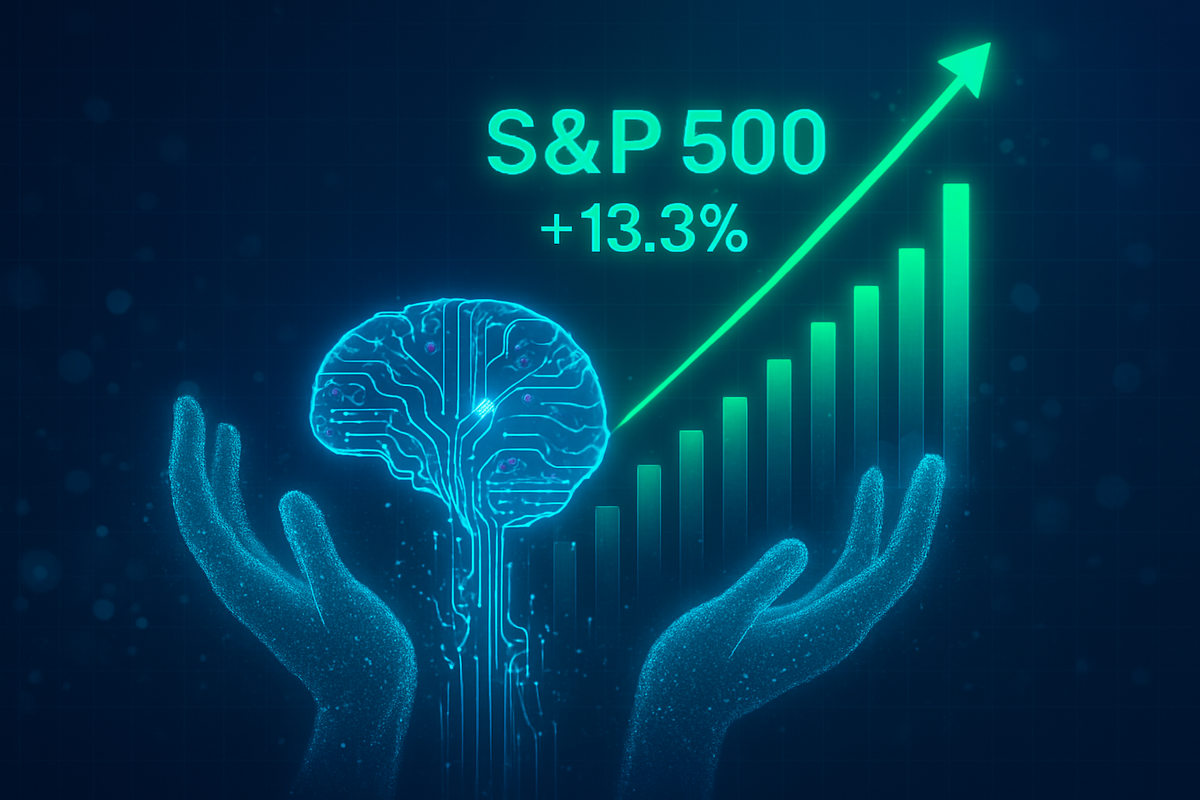
The fourth-quarter 2025 earnings season has officially drawn to a close, leaving market analysts and investors in awe of the S&P 500’s resilience. Defying high interest rates and a cooling labor market, the index posted a staggering 13.3% year-over-year growth in earnings per share (EPS). This robust performance marks a definitive turning point for the market, as corporate America appears to have successfully navigated the transition from an era of cheap capital to one of high-efficiency, AI-driven productivity.
The headline growth, however, masks a significant divergence within the index. While broad participation was noted in sectors like Industrials and Financials, the "heavy lifting" was undeniably performed by the technology sector. Driven by an insatiable global appetite for Artificial Intelligence (AI) infrastructure, tech companies provided the essential torque needed to propel the benchmark index to new heights, even as other sectors grappled with thinning margins and cautious consumers.
The Quarter of the "AI Arms Race"
The Q4 2025 earnings season, which played out across January and February of 2026, was characterized by a massive surge in capital expenditure and a shift from AI speculation to AI implementation. The S&P 500’s 13.3% EPS growth was bolstered by a record-breaking blended net profit margin of also 13.3%—the highest level recorded since tracking began in 2009. This margin expansion was largely attributed to the initial realization of productivity gains from internal AI integrations across the Fortune 500.
The timeline leading to this result was defined by a steady acceleration throughout 2025. Entering the fourth quarter, analysts had conservatively estimated earnings growth at roughly 8.3%. However, as results poured in from the Information Technology (NASDAQ: IT) sector, which reported a monumental 33.4% earnings increase, those estimates were shattered. Key players like Micron Technology (NASDAQ: MU) and Western Digital (NASDAQ: WDC) led the charge, benefiting from a "memory supercycle" triggered by the immense data requirements of new large language models.
Market reaction was a mixture of jubilation and "high-bar" skepticism. While the numbers were objectively strong, the "better than perfect" standard became the new norm. Companies that met earnings targets but failed to provide aggressive forward guidance or clarify their AI ROI (Return on Investment) were often punished by a discerning market. For instance, despite beating expectations, some software giants saw their stock prices stagnate as investors shifted focus toward the physical hardware and energy infrastructure required to keep the AI engines running.
Winners and Losers in the New Hierarchy
The clear winners of the Q4 season were the "architects of the new economy." Micron Technology (NASDAQ: MU) stood out as a premier performer, reporting a massive jump in revenue and triple-digit EPS growth as NAND and DRAM pricing soared. Similarly, Western Digital (NASDAQ: WDC) capitalized on the cloud storage boom, reporting significant revenue growth in its cloud end-segment. In the semiconductor space, NVIDIA (NASDAQ: NVDA) continued its reign, though its growth was so anticipated that the market reaction was surprisingly muted, suggesting that much of its "flawless execution" had already been priced into the stock.
On the other side of the ledger, consumer-facing companies in the Consumer Discretionary sector saw significantly more pressure. While General Motors (NYSE: GM) managed to surprise to the upside with strong earnings estimates, other retailers were squeezed by "value-conscious" shoppers. Procter & Gamble (NYSE: PG) and Mondelez International (NASDAQ: MDLZ) managed to maintain revenue through strategic price revisions, but their overall volume growth remained flat, highlighting a clear divide between the high-growth tech world and the sluggish "main street" economy.
The Financial sector also emerged as a surprise winner, with JPMorgan Chase (NYSE: JPM) leading a revival in investment banking. As M&A activity surged to nearly $5 trillion in 2025, the fees generated by these mega-deals provided a significant boost to the index’s bottom line. Meanwhile, companies like Interactive Brokers (NASDAQ: IBKR) benefited from increased retail and institutional trading volatility, further diversifying the S&P 500's growth drivers beyond just the "Magnificent 7."
The Wider Significance: A Structural Shift
This earnings season confirms that the AI revolution has moved past the "hype" phase and into a structural shift for the global economy. The 33.4% earnings growth in the technology sector illustrates a massive reallocation of capital toward digital transformation. This trend has created a ripple effect across the Industrials sector, where companies involved in data center construction and electrical grid modernization, such as those in aerospace and defense, reported a robust 26.7% earnings growth.
Historically, the S&P 500 has rarely seen such concentrated strength. The current forward 12-month P/E ratio of 21.6x is well above the 10-year average of 18.8x, suggesting that investors are "paying up" for the AI story. This creates a high-stakes environment where any deceleration in AI spending could trigger a broader market correction. Comparisons are already being made to the early 2000s, though today's tech leaders are backed by significantly stronger cash flows and real-world profitability than their predecessors during the dot-com era.
From a regulatory standpoint, the massive capex spent by companies like Microsoft (NASDAQ: MSFT)—which hit a record $37.5 billion in Q4—is beginning to draw scrutiny. Policymakers are closely watching the concentration of power among hyperscalers, and any future antitrust or data privacy legislation could serve as a headwind for the very companies currently doing the index's heavy lifting. Furthermore, the geopolitical climate, particularly the ongoing tensions in the Middle East, has started to impact sentiment, as energy price volatility remains a wildcard for 2026.
What Comes Next: The Road to 2027
As we look toward the remainder of 2026, the primary question for investors is whether this 13.3% growth rate is sustainable. In the short term, the momentum in AI hardware appears to have legs, but a strategic pivot toward "AI software monetization" will be required for the next leg of the bull market. Companies like Alphabet (NASDAQ: GOOGL) and Meta Platforms (NASDAQ: META) are already showing early success in using AI to boost ad revenue, but the broader software-as-a-service (SaaS) industry must prove it can turn AI features into premium subscription growth.
Strategic adaptations will also be necessary for non-tech firms. We expect to see more "AI-first" restructurings as companies attempt to defend their margins against rising labor costs. The success of Eli Lilly (NYSE: LLY) and Universal Health Services (NYSE: UHS) in the healthcare space suggests that innovation in GLP-1 drugs and medical efficiency will continue to be a secondary pillar of market strength. However, the high valuation of the S&P 500 leaves little room for geopolitical shocks or a "higher-for-longer" interest rate surprise from the Federal Reserve.
Final Wrap-Up: A Market at a Crossroads
The Q4 2025 earnings season was a masterclass in the power of technological innovation. With the S&P 500 delivering 13.3% EPS growth, the index has proved that it can thrive even in a challenging macroeconomic environment. The "heavy lifting" by the technology sector has provided a safety net for the broader market, but it has also created a dependency that investors must monitor closely.
As we move deeper into 2026, the key takeaways are clear: profitability is king, and AI is the engine of that profitability. However, the market’s "muted" reaction to spectacular beats suggests that we have entered a phase of high expectations. Investors should watch for a potential "broadening out" of the rally into mid-cap stocks or a rotation back into value if tech valuations become too stretched.
Moving forward, the focus will shift from who is building AI to who is making money from using it. The next few months will be a testing ground for the durability of this growth, and as always, the companies that can maintain these record-breaking 13.3% margins will be the ones that define the next era of the S&P 500.
This content is intended for informational purposes only and is not financial advice.