Waste management services provider Waste Management (NYSE: WM) beat Wall Street’s revenue expectations in Q3 2026, with revenue up 6.3% year on year to $6.85 billion. The company expects the full year’s revenue to be around $26.38 billion, close to analysts’ consensus estimates. Its non-GAAP profit of $2.15 per share was 1.4% below analysts’ consensus estimates.
For more on Waste Management, read the full research report, available free.
Waste Management (WM) Q3 2026 highlights:
- Revenue $6.85 billion vs S&P analysts’ consensus estimates of $6.81 billion (6.3% year-on-year growth, 0.5% beat)
- Adjusted EPS $2.15 vs S&P analysts’ consensus estimates of $2.18 (1.4% miss)
- Adjusted EBITDA $2.12 billion vs analysts’ consensus estimates of $2.16 billion (31% margin, 1.9% miss)
- Revenue guidance The company said revenue would be at the high end of the previously-provided guidance range for the full year, the midpoint of which was $26.38 billion
- EBITDA guidance $8.2 billion at the midpoint for the full year, in line with analysts’ consensus estimates
- Operating margin 18.7%, up from 15.3% in the same quarter last year
- Free cash flow margin 14.4%, up from 12.7% in the same quarter last year
- Market capitalization $96.34 billion
“WM delivered another quarter of solid operating and financial performance, in line with our expectations, underscoring the consistent execution of our strategy,” said Jim Fish, WM’s CEO. “Adjusted operating EBITDA increased 5.8% in the third quarter driven by strong price-to-cost spread in Collection and Disposal and growing contributions from our healthcare and sustainability businesses. Notably, Healthcare Solutions revenue grew 3.7% in the quarter and operating EBITDA increased more than 30%, driven by effective cost management, synergy capture, and pricing growth. Overall, our results reflect the earnings power of our diversified business and our ability to consistently create value for shareholders.”(a)
Revenue growth
A company’s long-term performance is an indicator of its overall quality. Any business can experience short-term success, but top-performing ones enjoy sustained growth for years. Waste Management’s 8.5% annualized revenue growth over the last five years was decent. Its growth was slightly above that of the average industrials company and shows its offerings resonate with customers.
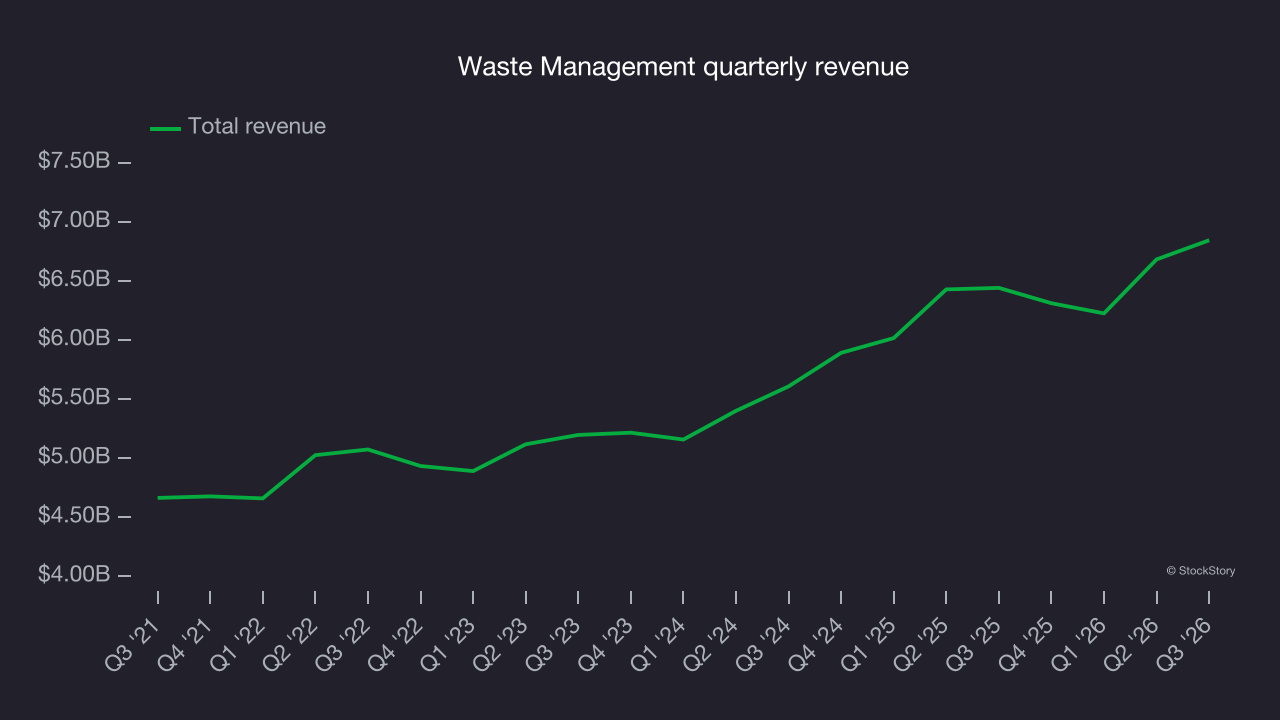
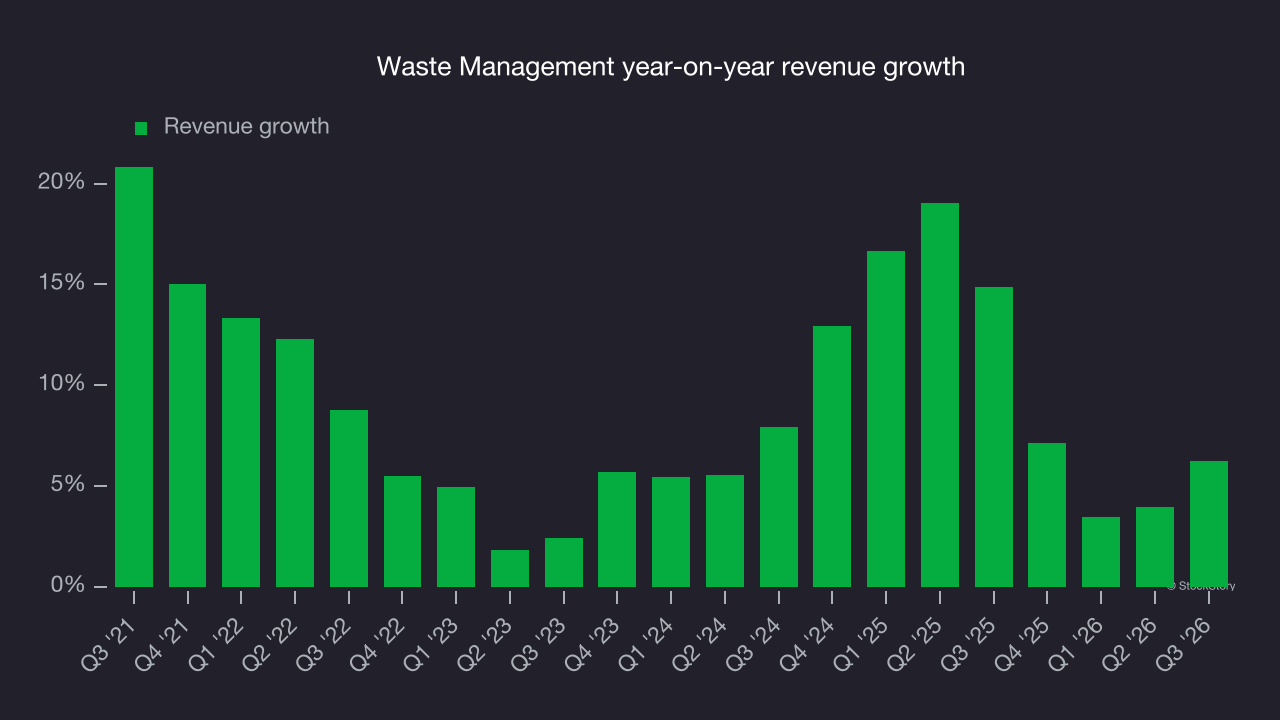
This quarter, Waste Management reported year-on-year revenue growth of 6.3%, and its $6.85 billion of revenue exceeded Wall Street’s consensus estimates by 0.5%.
Looking ahead, sell-side analysts expect revenue to grow 5.6% over the next 12 months, according to S&P, a deceleration versus the last two years. This projection is uninspiring and implies its products and services will face some demand challenges. Still, the company is performing well on other measures of financial health.
Operating margin
Waste Management has performed well over the last five years. It demonstrated strong profitability for an industrials business, with an average operating margin of 17.6%. That result is unsurprising given its favorable gross margin baseline.
Analyzing the trend in its profitability, Waste Management’s operating margin rose by 1.3 percentage points over the last five years, as its revenue growth provided operating leverage.
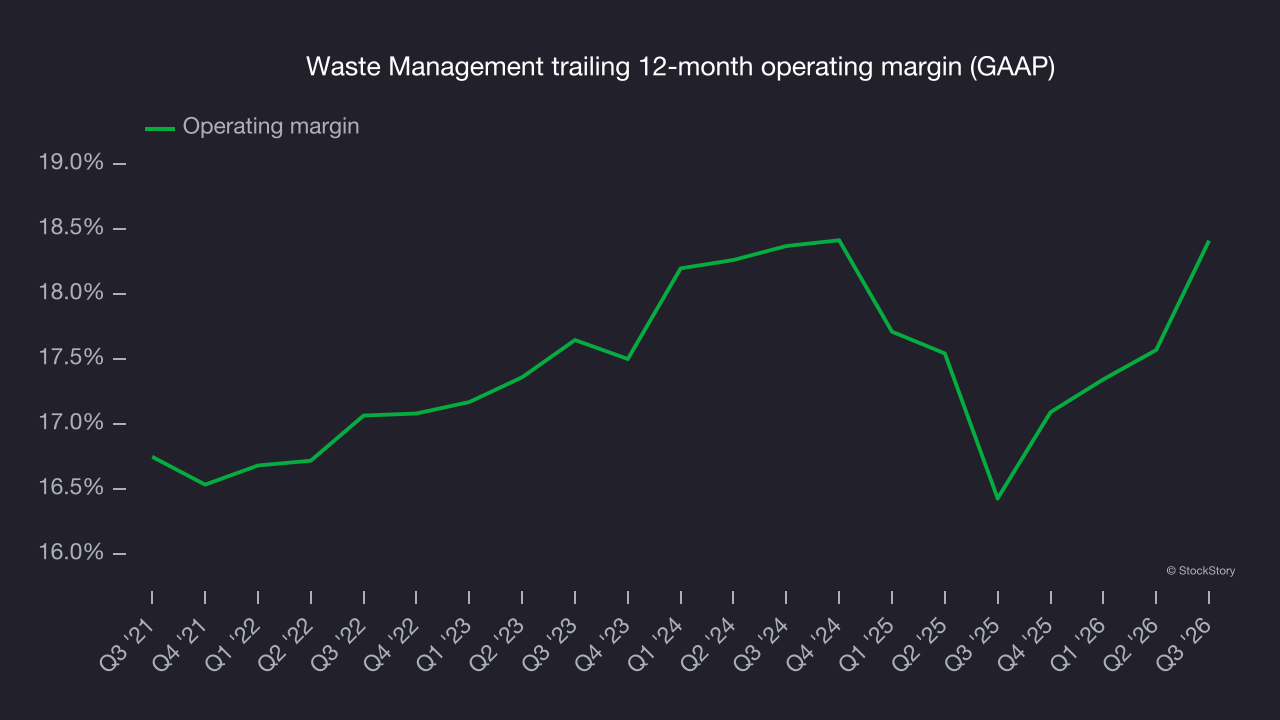
This quarter, Waste Management generated an operating margin of 18.7%, up 3.3 percentage points year on year. The increase was a positive development and shows its expenses recently grew more slowly than its revenue, leading to higher efficiency.
Earnings per share
We track the long-term change in earnings per share (EPS) for the same reason as long-term revenue growth. Compared to revenue, however, EPS highlights whether a company’s growth is profitable.
Waste Management’s EPS grew at a 10.9% compounded annual growth rate over the last five years, higher than its 8.5% annualized revenue growth. This tells us the company became more profitable on a per-share basis as it expanded.
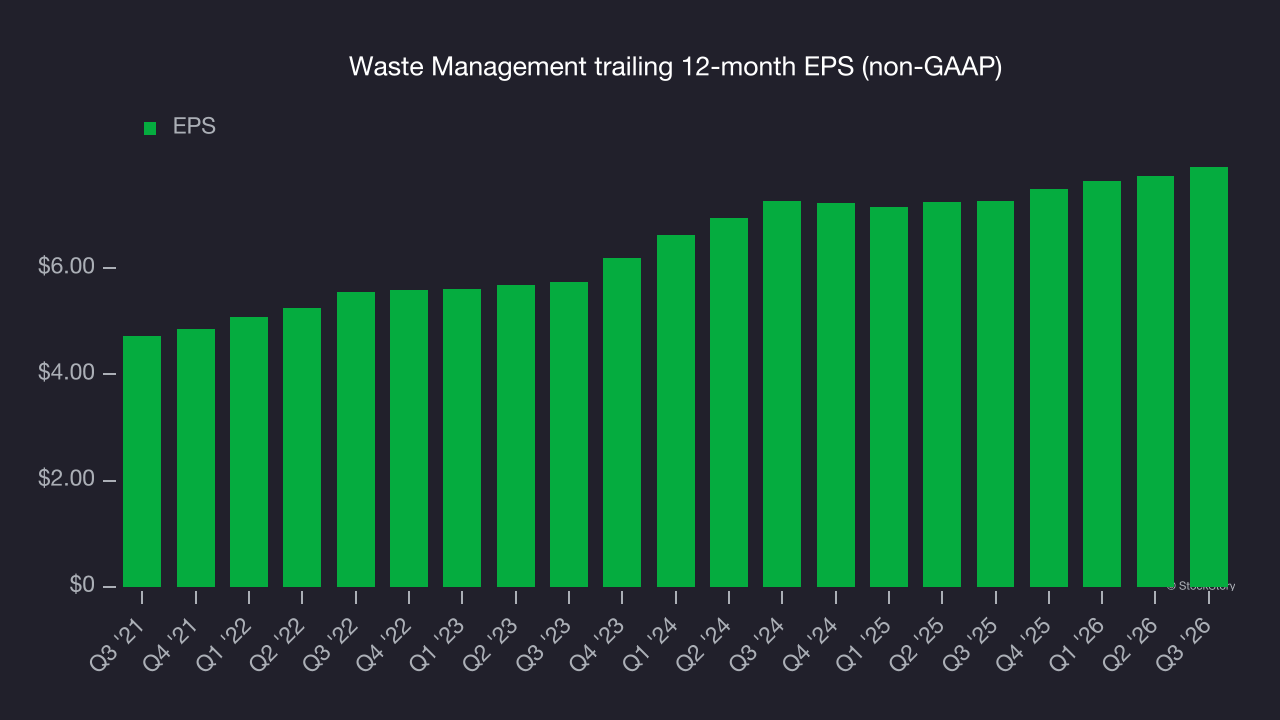
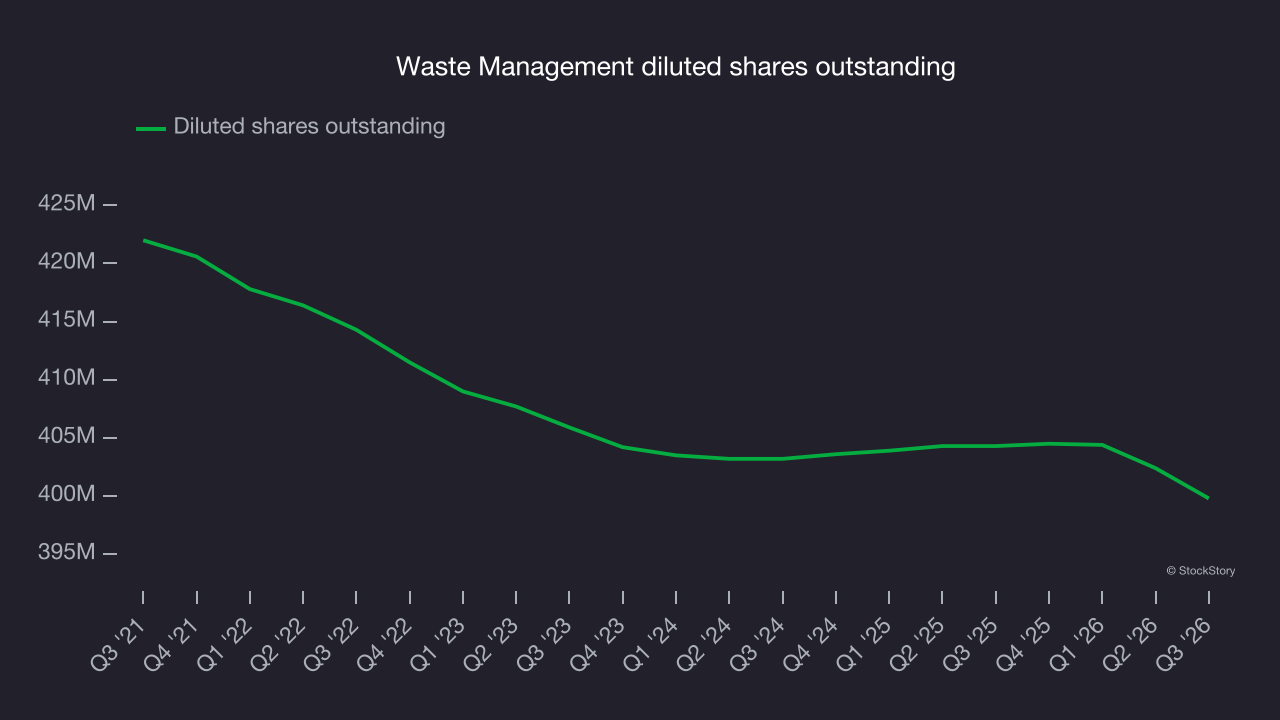
As with revenue, we analyze EPS over a shorter period to see if we are missing a change in the business.
For Waste Management, its two-year annual EPS growth of 4.3% was lower than its five-year trend. This was underwhelming, but the company still performed well on other measures of financial health.
In Q3, Waste Management reported adjusted EPS of $2.15, up from $1.98 in the same quarter last year. Despite growing year on year, this result slightly missed analysts’ consensus estimates, but long-term adjusted EPS growth matters more than short-term movements. Over the next 12 months, Wall Street expects Waste Management’s full-year EPS to grow 10.9% from $7.91 to $8.77, according to S&P.
Key takeaways from Waste Management’s Q3 results
Waste Management’s narrow revenue beat wasn’t enough to make this a solid quarter: EBITDA missed expectations and EPS fell a bit short of Wall Street’s consensus estimates. Taken together, the results were softer overall. Shares fell 2.3% to $230.13 immediately after the report.
Waste Management’s earnings report left more to be desired. A closer look can help assess whether this quarter has created an opportunity to buy the stock. That decision should take into account valuation, business quality and the latest earnings. For more on Waste Management, read the full research report here (it’s free).