Electronic system and device provider Bel Fuse (NASDAQ: BELFA) announced better-than-expected revenue in Q3 2026, with revenue up 23.2% year on year to $220.5 million. In addition, next quarter’s revenue guidance ($230 million at the midpoint) was unexpectedly strong, coming in 11.6% above analysts’ consensus estimates. Its non-GAAP profit of $2.92 per share was 38.7% above analysts’ consensus estimates.
For more on Bel Fuse, read our free full research report.
Bel Fuse (BELFA) Q3 2026 highlights:
- Revenue $220.5 million vs S&P analysts’ consensus estimates of $217.1 million (23.2% year-on-year growth, 1.6% beat)
- Adjusted EPS $2.92 vs S&P analysts’ consensus estimates of $2.11 (38.7% beat)
- Adjusted EBITDA $52.51 million vs analysts’ consensus estimates of $52.04 million (23.8% margin, 0.9% beat)
- Revenue guidance $230 million at the midpoint for Q4 2026, above analysts’ consensus estimates of $206.1 million
- Operating margin 17.9%, in line with the same quarter last year
- Free cash flow margin 12.7%, up from 11.4% in the same quarter last year
- Market capitalization $3.13 billion
Farouq Tuweiq, President and CEO of Bel, said, “We are pleased with our strong third quarter results, with performance led by our Data Solutions sector, Industrials end market, and across our distribution partners. The quarter reflects momentum across key end markets, supported by focused execution across our global organization.”
Revenue growth
Examining a company’s long-term performance can provide clues about its quality. Any business can put up a good quarter or two, but the best consistently grow over the long haul. Bel Fuse’s revenue grew at a decent 8.9% compounded annual growth rate over the last five years. Its growth was slightly above the average industrials company and shows its offerings resonate with customers.
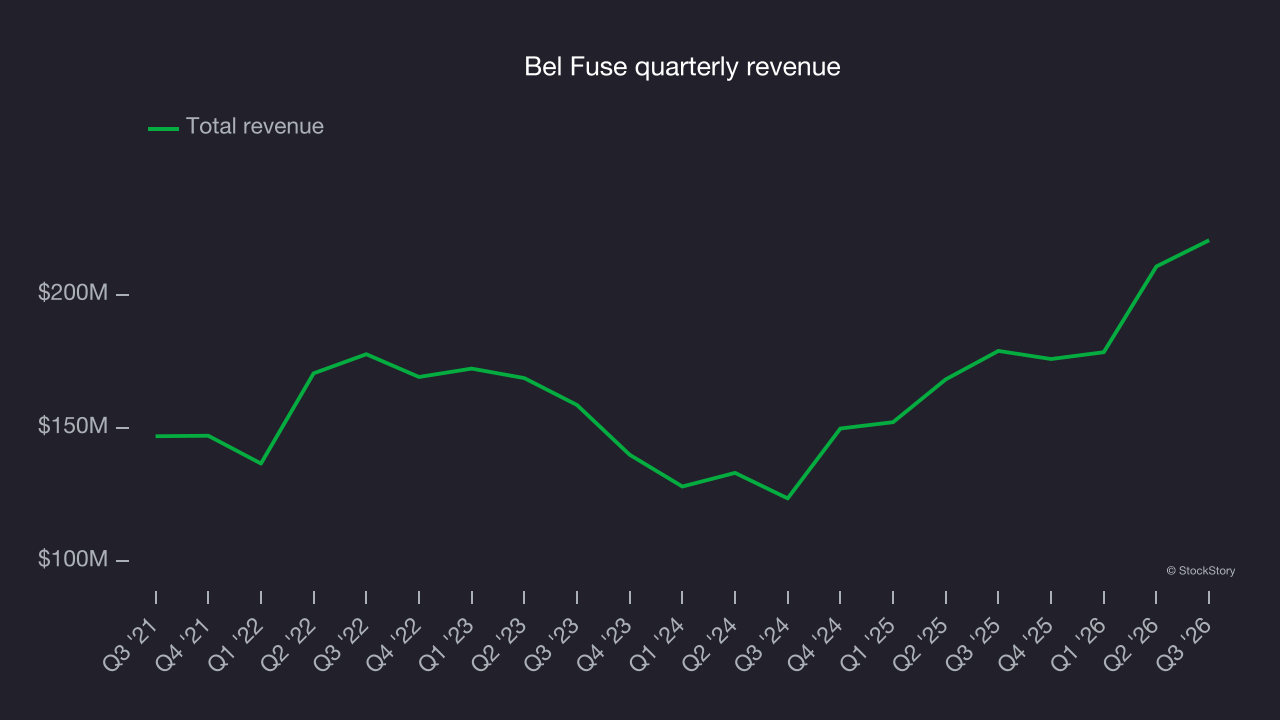
Long-term growth matters most, but within industrials, a half-decade historical view may miss cycles, industry trends or a company capitalizing on catalysts such as a new contract win or a successful product line. Bel Fuse’s annualized revenue growth of 22.3% over the last two years is above its five-year trend, suggesting its demand recently accelerated. 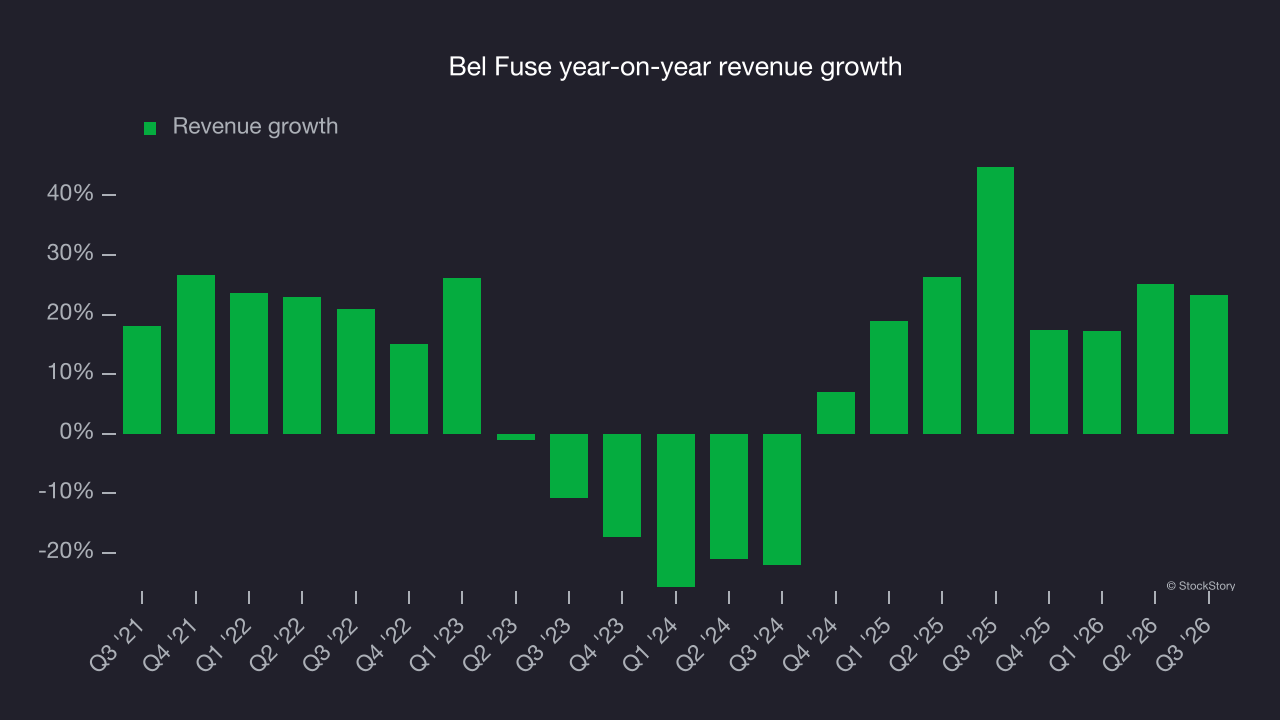
This quarter, Bel Fuse reported strong year-on-year revenue growth of 23.2%, and its $220.5 million of revenue topped Wall Street’s consensus estimates by 1.6%. Management is currently guiding for a 30.7% year-on-year increase in revenue next quarter.
Looking further ahead, sell-side analysts expect revenue to grow 9.4% over the next 12 months, according to S&P, a deceleration versus the last two years. Despite the slowdown, this projection is solid and implies the market is forecasting success for its products and services.
Operating margin
Operating margin is an important measure of profitability as it shows the portion of revenue left after accounting for all core expenses, from the cost of goods sold to advertising and wages. It’s also useful for comparing profitability across companies with different levels of debt and tax rates because it excludes interest and taxes.
Bel Fuse has been an efficient company over the last five years. It was one of the more profitable businesses in the industrials sector, with an average operating margin of 13.5%. That outcome is unsurprising given its favorable gross margin baseline.
Bel Fuse’s operating margin rose by 7 percentage points over the last five years, as its revenue growth provided operating leverage.
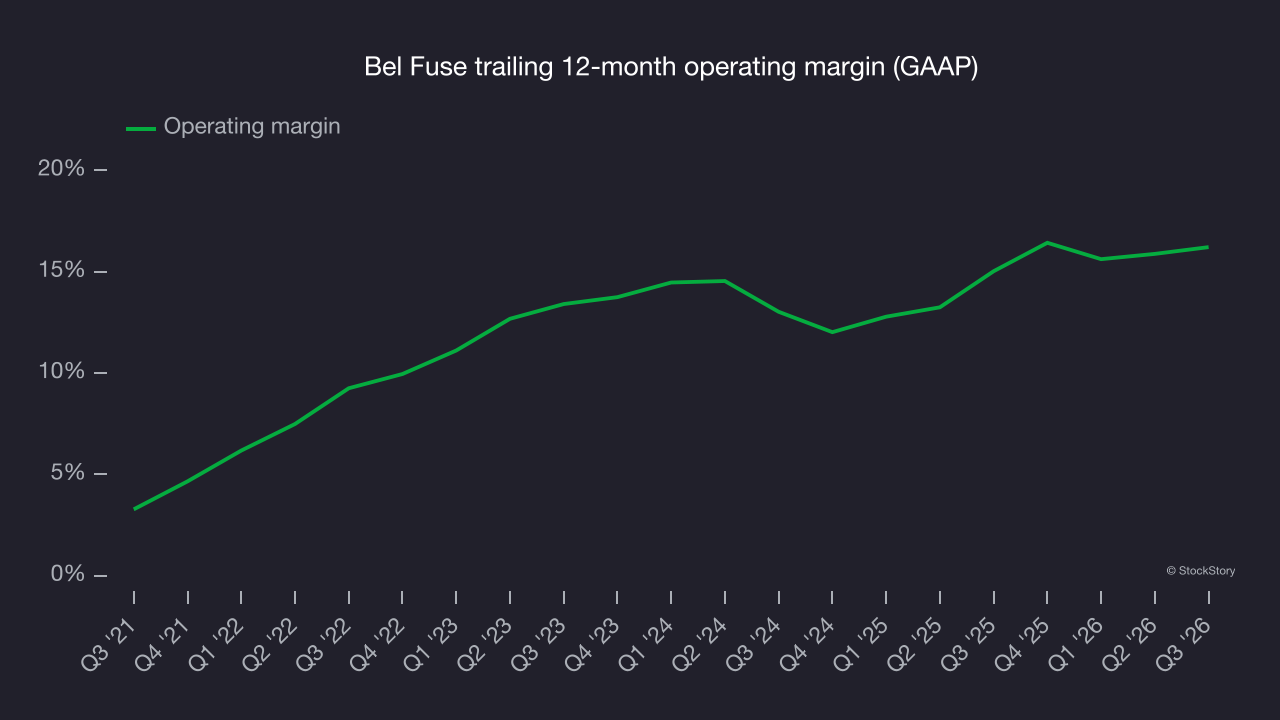
This quarter, Bel Fuse generated an operating margin of 17.9%, in line with the same quarter last year. This indicates the company’s cost structure has recently been stable.
Earnings per share
Revenue trends explain a company’s historical growth, but the long-term change in earnings per share (EPS) points to the profitability of that growth. For example, a company could inflate its revenue through excessive spending on advertising and promotions.
Bel Fuse’s EPS grew at a 54% compounded annual growth rate over the last five years, higher than its 8.9% annualized revenue growth. This indicates the company became more profitable on a per-share basis as it expanded.
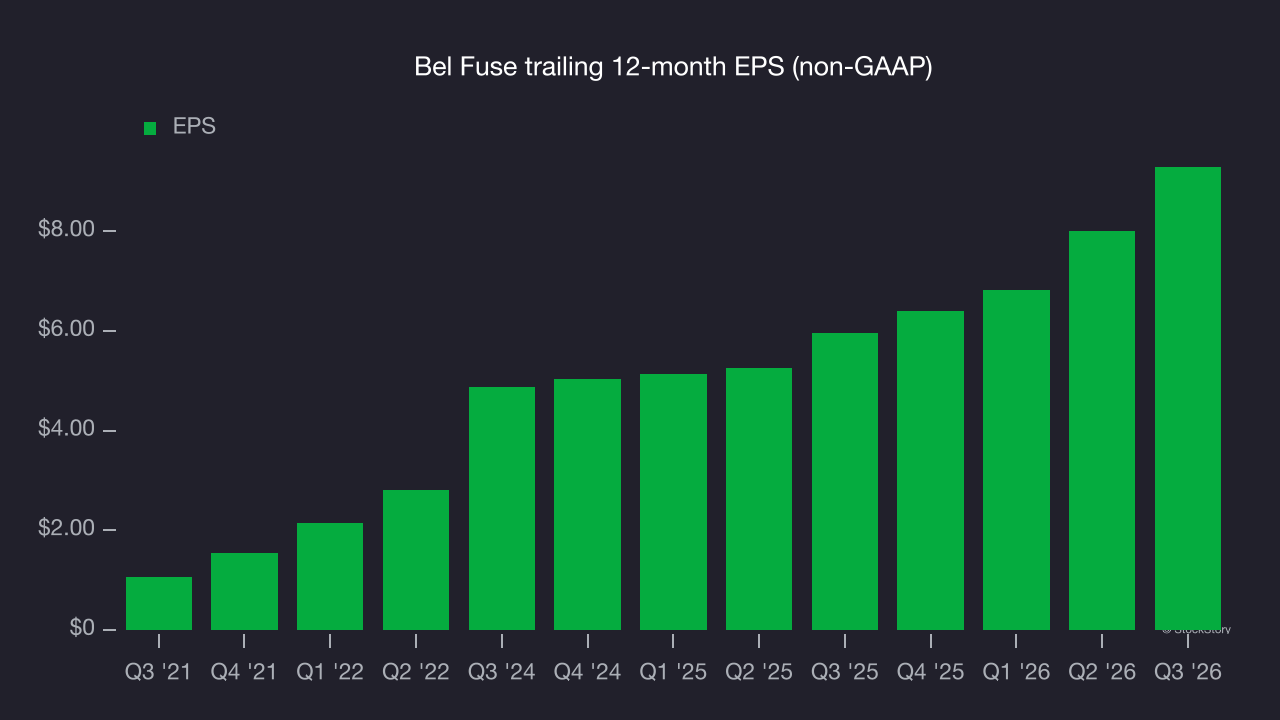
A closer look at Bel Fuse’s earnings helps explain the drivers of its performance. As mentioned earlier, Bel Fuse’s operating margin was flat this quarter but expanded by 7 percentage points over the last five years. This was the most relevant factor (aside from the revenue impact) behind its higher earnings; interest expenses and taxes can also affect EPS but don’t tell us as much about a company’s fundamentals.
As with revenue, EPS growth over a more recent period can provide insight into an emerging theme or development for the business.
Bel Fuse’s two-year annual EPS growth of 37.9% was lower than its five-year trend. That was still a good pace, but an acceleration would be welcome.
In Q3, Bel Fuse reported adjusted EPS of $2.92, up from $1.65 in the same quarter last year. This easily beat analysts’ consensus estimates, a positive result for shareholders. Over the next 12 months, Wall Street expects Bel Fuse’s full-year EPS to shrink by 15.4% from $9.28 to $7.86, according to S&P.
Key takeaways from Bel Fuse’s Q3 results
Bel Fuse delivered a solid quarter, beating analysts’ consensus EPS estimates and setting next-quarter revenue guidance above Wall Street’s consensus. Shares rose 4.7% to $188.64 immediately after the release.
Bel Fuse had a solid quarterly earnings result, but that alone does not determine whether the stock is a good investment. The latest quarter matters, but not as much as longer-term business quality and valuation when deciding whether to invest in the stock. For more on Bel Fuse, read our full research report here (it’s free).