Refrigerant services company Hudson Technologies (NASDAQ: HDSN) missed Wall Street’s revenue expectations in Q3 2026, with revenue falling 19.7% year on year to $59.42 million. Its GAAP profit of $0.05 per share was 58.3% below analysts’ consensus estimates.
For more on Hudson Technologies, read our free full research report.
Hudson Technologies (HDSN) Q3 2026 highlights:
- Revenue $59.42 million vs S&P analysts’ consensus estimates of $77.96 million (19.7% year-on-year decline, 23.8% miss)
- EPS (GAAP) $0.05 vs analysts’ consensus estimates of $0.12 (58.3% miss)
- Operating margin 5.5%, down from 18.9% in the same quarter last year
- Free cash flow margin 16.4%, up from 9.1% in the same quarter last year
- Market capitalization $221.4 million
“We further strengthened our debt-free balance sheet during the quarter, ending with $35 million in cash. As we move through the fourth quarter and prepare for 2027, we remain focused on our core refrigerant sales, recovery and reclamation activities while strategically positioning the Company in our evolving industry. Our longstanding relationships, technical expertise and financial flexibility provide a strong foundation to expand our service offerings, enhance our competitive positioning and reduce our exposure to fluctuations in refrigerant pricing,” Mr. Gaglione concluded.
Revenue growth
Reviewing a company’s long-term revenue performance reveals insights into its quality. Any business can have short-term success, but a top-tier one grows for years. Hudson Technologies’s revenue grew at a mediocre 6.5% compounded annual growth rate over the last five years, falling short of our benchmark for the industrials sector.
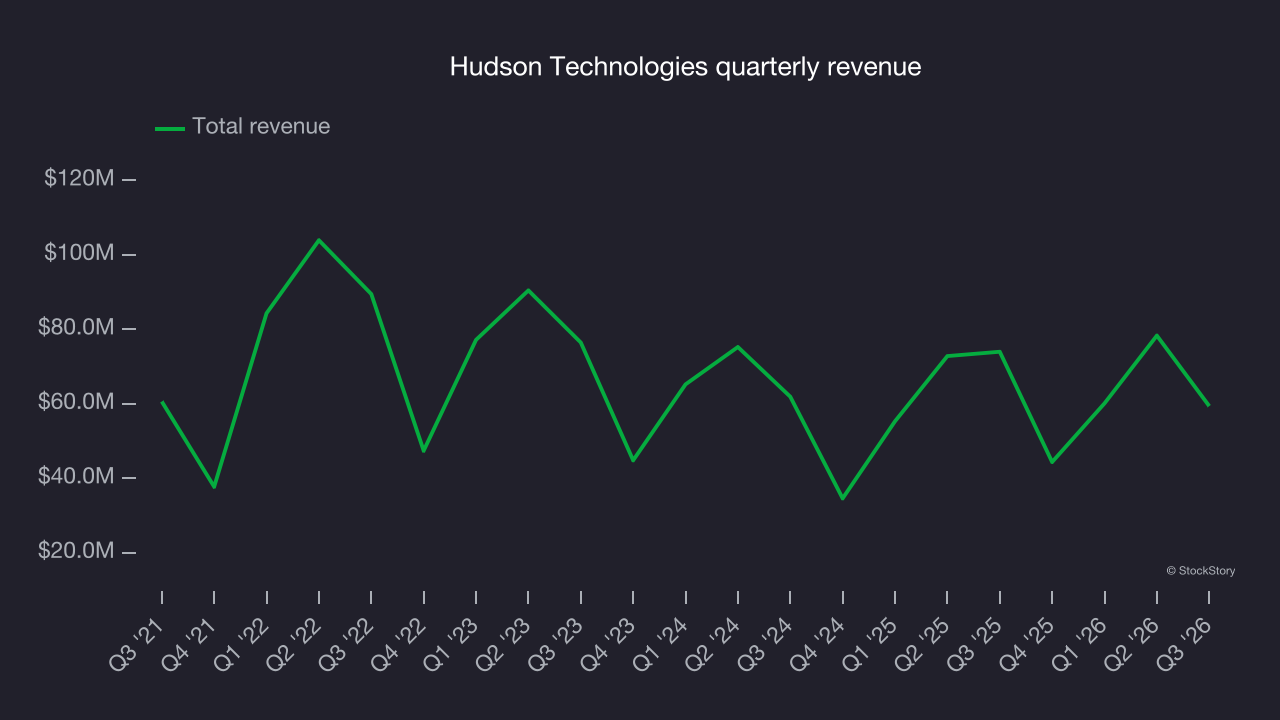
Long-term growth is the most important, but within industrials, a half-decade historical view may miss new industry trends or demand cycles. Hudson Technologies’s performance shows it grew in the past but relinquished its gains over the last two years, as its revenue fell by 1% annually. 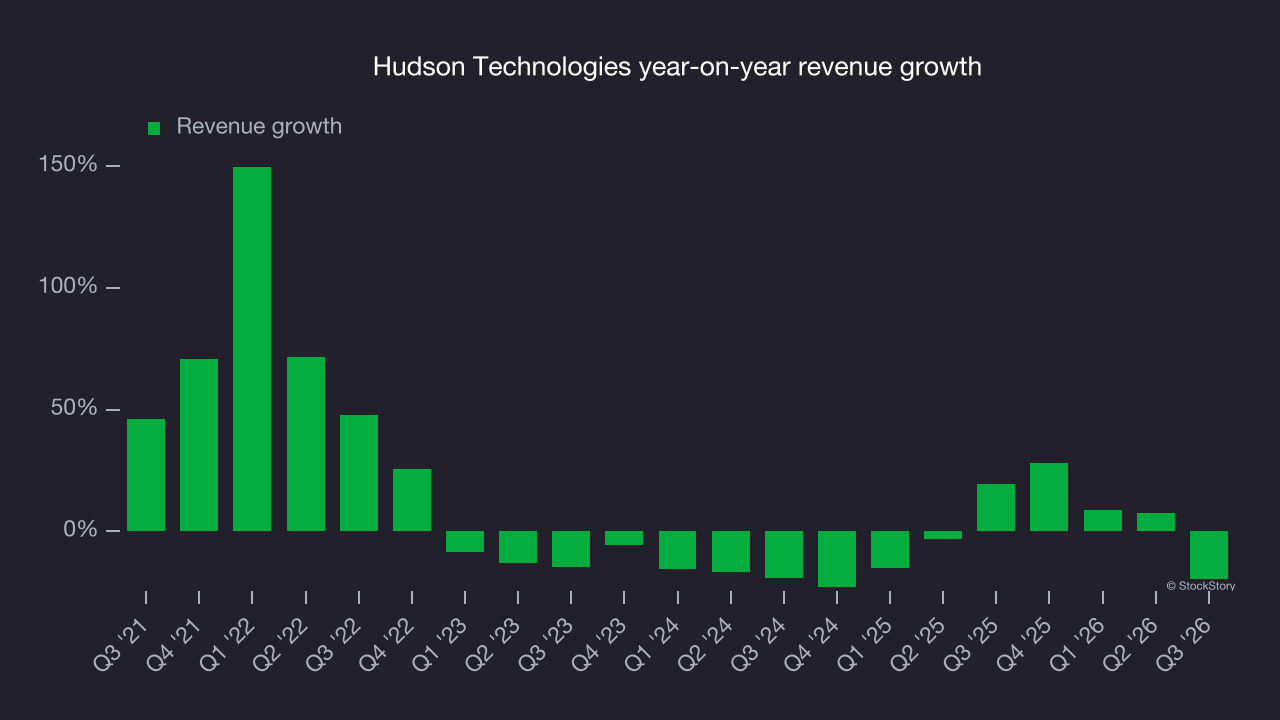
This quarter, Hudson Technologies missed Wall Street’s consensus estimates and reported an uninspiring 19.7% year-on-year revenue decline, generating $59.42 million of revenue.
Looking ahead, sell-side analysts expect revenue to grow 10.9% over the next 12 months, according to S&P, an improvement versus the last two years. This strong projection indicates its newer products and services will fuel better top-line performance.
Operating margin
Operating margin is a key measure of profitability. Think of it as net income, the bottom line, excluding the impact of taxes and interest on debt, which are less connected to business fundamentals.
Hudson Technologies has performed well over the last five years. It demonstrated strong profitability for an industrials business, with an average operating margin of 21.2%. That outcome is unsurprising given its favorable gross margin baseline.
Looking at the trend in its profitability, Hudson Technologies’s operating margin decreased by 40.4 percentage points over the last five years. This raises questions about the company’s expense base because its revenue growth should have given it leverage on its fixed costs, resulting in better economies of scale and profitability.
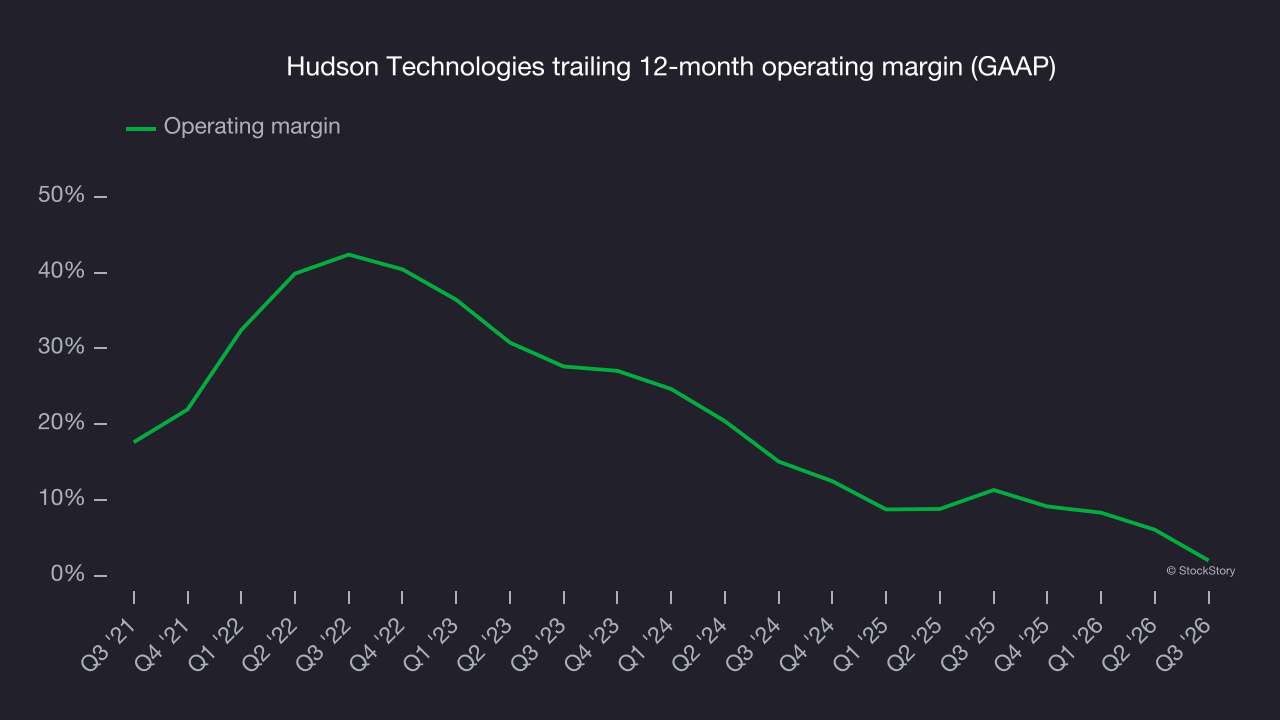
This quarter, Hudson Technologies generated an operating margin of 5.5%, down 13.4 percentage points year on year. Its operating margin declined more than its gross margin, suggesting lower efficiency as expenses such as marketing, R&D and administrative overhead increased.
Earnings per share
Revenue trends explain a company’s historical growth, but the long-term change in earnings per share (EPS) points to the profitability of that growth. For example, a company could inflate its revenue through excessive spending on advertising and promotions.
Hudson Technologies’s EPS declined by 15.4% annually over the last five years while its revenue grew by 6.5%. This tells us the company became less profitable on a per-share basis as it expanded due to non-fundamental factors such as interest expenses and taxes.
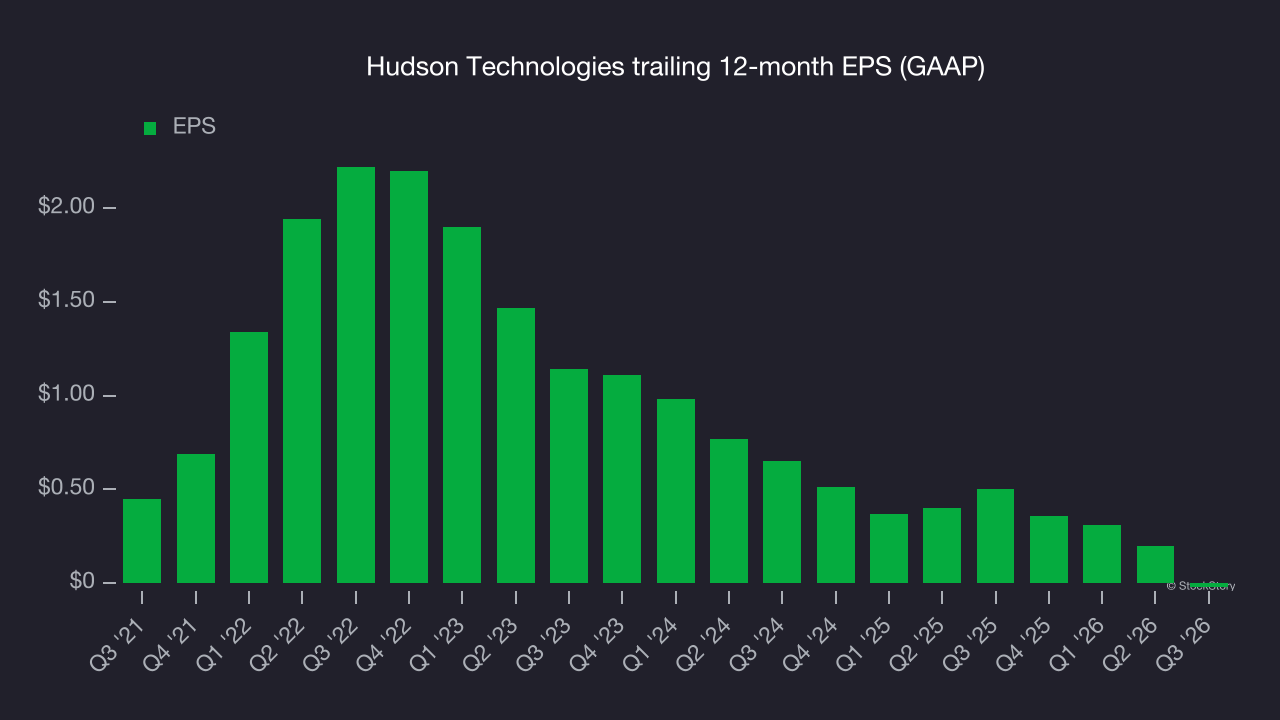
A closer look at Hudson Technologies’s earnings helps explain its performance. As we mentioned earlier, Hudson Technologies’s operating margin declined by 40.4 percentage points over the last five years. This was the most relevant factor (aside from the revenue impact) behind its lower earnings; interest expenses and taxes can also affect EPS but don’t tell us as much about a company’s fundamentals.
Like with revenue, we analyze EPS over a more recent period because it can provide insight into an emerging theme or development for the business.
Hudson Technologies’s two-year annual EPS declines of 42.5% show it has continued to underperform, a poor result by any measure.
In Q3, Hudson Technologies reported EPS of $0.05, down from $0.27 in the same quarter last year. This result missed analysts’ consensus estimates. Over the next 12 months, Wall Street expects a return to profitability. Analysts forecast Hudson Technologies’s full-year EPS will turn from negative $0.02 to positive $0.33, according to S&P.
Key takeaways from Hudson Technologies’s Q3 results
Hudson Technologies delivered a weaker quarter with few positives: Revenue missed Wall Street’s consensus estimates, and EPS fell short as well. Shares plunged 13.2% to $4.55 immediately after the report.
Hudson Technologies’s latest quarter was underwhelming. One earnings report doesn’t define a company’s quality, though, so assessing whether the stock is a buy at the current price requires a broader view. The latest quarter is only one part of the longer-term business quality picture. Quality, when combined with valuation, can help determine if the stock is a buy. For more on those factors, read the full research report here (it’s free).