
Since February 2026, Truist Financial has been in a holding pattern, posting a small return of 0.9% while floating around $52.67. The stock also fell short of the S&P 500’s 13.1% gain during that period.
Is there a buying opportunity in Truist Financial, or does it present a risk to your portfolio? Get the full stock story straight from our expert analysts, it’s free.
Why Do We Think Truist Financial Will Underperform?
We’re sitting this one out for now. Here are three reasons we avoid TFC, plus one stock we’d rather own.
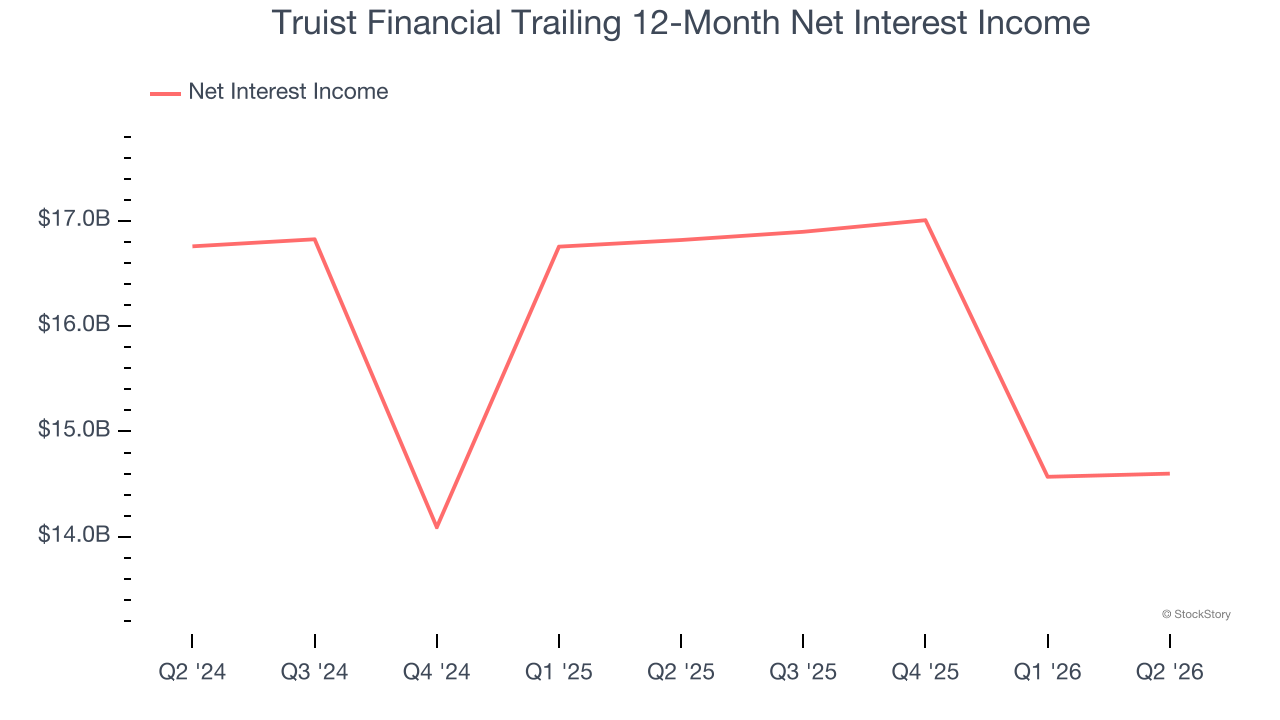
1. Net Interest Income Points to Soft Demand
Our experience and research show the market cares primarily about a bank’s net interest income growth as one-time fees are considered a lower-quality and non-recurring revenue source.
Truist Financial’s net interest income has grown at a 1.9% annualized rate over the last five years, much worse than the broader banking industry. Its growth was driven by an increase in its outstanding loans as its net interest margin, which represents how much a bank earns in relation to its outstanding loan book, was flat throughout that period.
2. Projected Net Interest Income Growth Is Slim
Forecasted net interest income by Wall Street analysts signals a company’s potential. Predictions may not always be accurate, but accelerating growth typically boosts valuation multiples and stock prices while slowing growth does the opposite.
Over the next 12 months, sell-side analysts expect Truist Financial’s net interest income to rise by 1.7%.
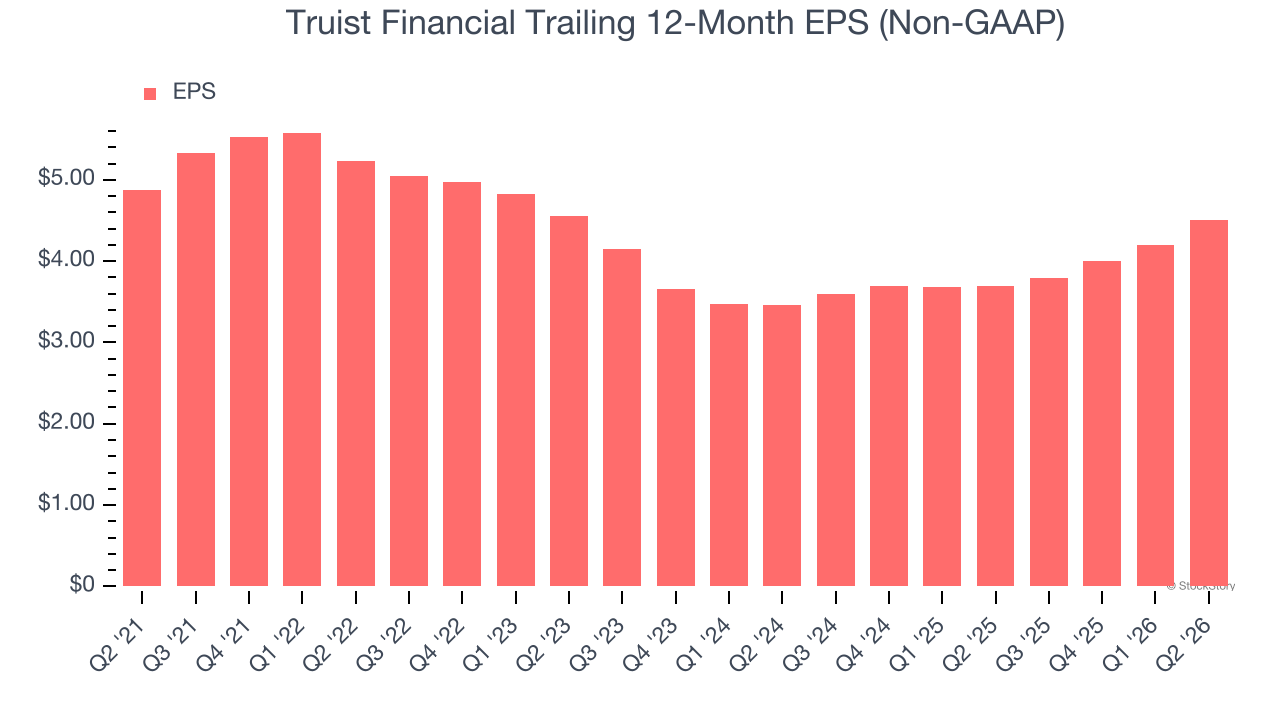
3. EPS Trending Down
We track the long-term change in earnings per share (EPS) because it highlights whether a company’s growth is profitable.
Sadly for Truist Financial, its EPS and revenue declined by 1.6% and 1.2% annually over the last five years. We tend to steer our readers away from companies with falling revenue and EPS, where diminishing earnings could imply changing secular trends and preferences. If the tide turns unexpectedly, Truist Financial’s low margin of safety could leave its stock price susceptible to large downswings.
Final Judgment
We cheer for all companies supporting the economy, but in the case of Truist Financial, we’ll be cheering from the sidelines. With its shares underperforming the market lately, the stock trades at 1.1× forward P/B (or $52.67 per share). This valuation tells us a lot of optimism is priced in - we think there are better opportunities elsewhere. We’d recommend looking at a top digital advertising platform riding the creator economy.
Stocks We Would Buy Instead of Truist Financial
WHILE YOU’RE HERE: Top 9 Market-Beating Stocks. The best stocks don’t just beat the market once. They do it again. And again. Robust revenue growth, rising free cash flow, returns on capital that leave their competition in the dust. The market has already rewarded these businesses.
But our AI platform says the party isn’t over. Find out which 9 stocks made the cut this week — FREE. Get Our Top 9 Market-Beating Stocks for Free HERE.
Stocks that have made our list include now familiar names such as Nvidia (+1,460% between June 2020 and June 2025) as well as under-the-radar businesses like the once-micro-cap company Kadant (+214% between June 2020 and June 2025). Find your next big winner with StockStory today.