Vacuum Pump Stations Market Gains Momentum as Centralized Systems, Energy Efficiency, and Smart Manufacturing Drive Industrial Transformation
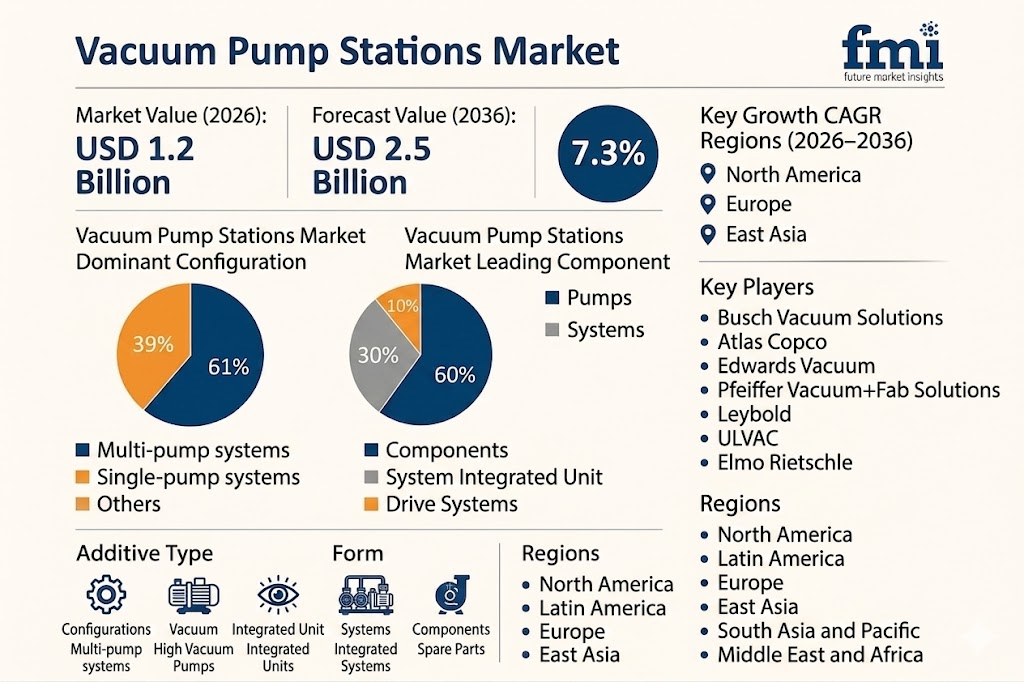
NEWARK, DE / ACCESS Newswire / April 22, 2026 / According to the latest analysis by Future Market Insights, the global industrial ecosystem is undergoing a fundamental transformation in how vacuum systems are designed, deployed, and optimized. As manufacturers prioritize energy efficiency, process stability, and lifecycle cost reduction, the Vacuum Pump Stations Market valued at USD 1.2 billion in 2026 is projected to reach USD 2.5 billion by 2036, expanding at a robust CAGR of 7.3%.
According to the latest industry analysis by Future Market Insights (FMI), growth is being driven by a decisive transition away from decentralized, point-of-use vacuum units toward centralized vacuum stations that deliver superior operational control, reduced maintenance complexity, and improved energy utilization across industrial facilities.
Get detailed market forecasts, competitive benchmarking, and pricing trends:
https://www.futuremarketinsights.com/reports/sample/rep-gb-32778
Quick Facts & Market Snapshot
Market Value (2026): USD 1.2 Billion
Forecast Value (2036): USD 2.5 Billion
Projected CAGR (2026-2036): 7.3%
Incremental Opportunity: USD 1.3 Billion
Dominant Configuration: Multi-pump systems (61% share)
Key Growth Driver: Industrial shift to centralized vacuum systems
The Centralization Shift: Redefining Industrial Efficiency
Traditional vacuum setups-comprised of multiple standalone units operating under partial load-are increasingly being replaced by centralized vacuum stations. These integrated systems combine pumps, controls, and piping networks to provide a continuous and optimized vacuum supply across production lines.
"Manufacturers are recognizing that decentralized systems inherently create inefficiencies in energy use and maintenance," notes an industry expert. "Centralized vacuum stations enable better load balancing, lower operational noise, and improved system-wide control."
Facilities adopting centralized systems benefit from:
Reduced energy consumption through optimized load distribution
Lower heat and noise levels on production floors
Simplified maintenance via consolidated system architecture
Enhanced uptime with coordinated multi-pump operation
Technology Evolution: Rise of Dry Vacuum Systems
A key technological shift shaping the market is the increasing adoption of dry vacuum systems, which are expected to account for 34% of the pump segment in 2026.
Unlike traditional liquid ring systems, dry vacuum technologies:
Operate without oil or sealing fluids
Reduce contamination risks in sensitive applications
Lower downstream treatment and maintenance requirements
This makes them particularly attractive in industries such as electronics, pharmaceuticals, and food processing, where purity and process integrity are critical.
Multi-Pump Configurations: The Backbone of Modern Systems
Multi-pump configurations dominate the market with a 61% share in 2026, driven by their ability to deliver staged capacity and operational redundancy.
These systems allow facilities to:
Adjust vacuum output dynamically based on demand
Maintain performance during maintenance or unexpected downtime
Avoid single-point failures in high-throughput environments
While single-pump systems remain relevant in smaller setups, large-scale industrial facilities increasingly prefer multi-pump architectures for their scalability and resilience.
End-Use Insights: Process Vacuum Leads Adoption
Process vacuum applications are projected to hold 31% market share in 2026, reflecting the growing need for stable and continuous suction across multiple production stages.
Industries are leveraging centralized vacuum systems to:
Improve process consistency and product quality
Support continuous manufacturing operations
Reduce operational complexity across interconnected production lines
The general industry segment, accounting for 41% share, remains the largest adopter due to widespread applicability across manufacturing environments.
Access the Complete Report in PDF Format: https://www.futuremarketinsights.com/reports/brochure/rep-gb-32778
Regional Outlook: India and Asia Drive Momentum
While demand is global, growth dynamics vary significantly across regions:
India (7.9% CAGR): Leading growth driven by industrial park expansion and centralized utility planning
China (7.0% CAGR): Strong demand from electronics and semiconductor manufacturing
United States (6.3% CAGR): Growth fueled by retrofit projects in processing and packaging facilities
South Korea (5.8% CAGR): Expansion linked to battery manufacturing and controlled environments
Germany (5.6% CAGR) & UK (5.2% CAGR): Adoption driven by precision manufacturing and energy efficiency mandates
Japan (4.8% CAGR): Demand supported by compact, high-efficiency system requirements
OEM Dominance: Integration Drives Channel Leadership
OEM channels are expected to lead with a 54% market share in 2026, as direct supplier involvement remains critical in designing and integrating complex vacuum systems.
Manufacturers prefer OEM partnerships for:
Custom system engineering and configuration
Guaranteed compatibility with plant infrastructure
Access to advanced diagnostics and predictive maintenance tools
Navigating Challenges: Cost, Complexity, and Lifecycle Constraints
Despite strong growth prospects, the market faces several structural challenges:
High upfront investment: Installation costs extend beyond equipment to include piping, controls, and commissioning
Long equipment lifespan: Slows replacement cycles in mature markets
Operational complexity: Managing variable vacuum demand across multiple production lines requires advanced control systems
Additionally, centralized systems introduce balancing challenges, requiring precise coordination to maintain consistent performance across diverse applications.
Opportunities: Smart Systems and Predictive Intelligence
Innovation is rapidly reshaping the competitive landscape, with key opportunities emerging in:
Predictive maintenance integration: AI-driven monitoring enhances uptime and reduces unplanned downtime
Automated load balancing: Intelligent control systems optimize energy use in real time
Modular system design: Enables scalability and flexibility across dynamic production environments
These advancements are transforming vacuum pump stations from static infrastructure into intelligent, adaptive systems.
Competitive Landscape: Engineering Excellence Meets Digital Innovation
The market remains competitive, with leading players focusing on system integration, energy efficiency, and software-driven optimization. Key companies include:
Busch Vacuum Solutions
Atlas Copco
Edwards Vacuum
Pfeiffer Vacuum+Fab Solutions
Leybold
ULVAC
Elmo Rietschle
Suppliers are increasingly differentiating themselves through:
Advanced control software and automation capabilities
Global service networks and lifecycle support
Open communication protocols for seamless plant integration
The Outlook: From Utility System to Strategic Asset
By 2036, vacuum pump stations are expected to evolve from a supporting utility into a strategic pillar of industrial efficiency and sustainability. As industries push toward smarter manufacturing, centralized vacuum systems will play a critical role in enabling energy optimization, process reliability, and operational scalability.
The transition is clear: facilities that embrace centralized, intelligent vacuum infrastructure today are positioning themselves for long-term competitive advantage in the next generation of industrial manufacturing.
Buy Report: Unlock 360° insights for strategic decision making and investment planning:
https://www.futuremarketinsights.com/checkout/32778
Related Reports:
Dry Vacuum Pumps Market - https://www.futuremarketinsights.com/reports/dry-vacuum-pumps-market
Compressors and Vacuum Pumps Market - https://www.futuremarketinsights.com/reports/compressors-and-vacuum-pumps-market
Pump Jack Market - https://www.futuremarketinsights.com/reports/pump-jack-market
About Future Market Insights (FMI)
Future Market Insights (FMI) is a leading provider of market intelligence and consulting services, serving clients in over 150 countries. Headquartered in Delaware, USA, with a global delivery center in India and offices in the UK and UAE, FMI delivers actionable insights to businesses across industries including automotive, technology, consumer products, manufacturing, energy, and chemicals.
An ESOMAR-certified research organization, FMI provides custom and syndicated market reports and consulting services, supporting both Fortune 1,000 companies and SMEs. Its team of 300+ experienced analysts ensures credible, data-driven insights to help clients navigate global markets and identify growth opportunities.
For Press & Corporate Inquiries
Rahul Singh
AVP - Marketing and Growth Strategy
Future Market Insights, Inc.
+91 8600020075
For Sales - sales@futuremarketinsights.com
For Media - Rahul.singh@futuremarketinsights.com
For web - https://www.futuremarketinsights.com/
SOURCE: Future Market Insights, Inc.
View the original press release on ACCESS Newswire