
Crypto trading in July 2026 is no longer about chasing isolated momentum or reacting to single catalysts. The market is now shaped by liquidity compression, derivatives dominance, and a steady rotation of capital between narratives rather than a broad expansion of risk appetite.
Prices still move quickly, but the drivers behind those moves are increasingly structural. Bitcoin sets the baseline, liquidity determines speed, and altcoins only move when positioning aligns with narrative strength.
The broader crypto market capitalization sits near $2.07 trillion, with 24-hour trading volume around $43.04 billion. Bitcoin dominance remains elevated at approximately 58.04%, confirming that liquidity is still heavily concentrated in the largest asset rather than distributed across altcoins.
In this structure, altcoin performance becomes selective rather than synchronized, with only a small group of assets able to sustain relative strength.
Bitcoin trades near $59,818, down 1.47% over 24 hours, 6.72% over seven days, and 18.87% over 30 days. Ethereum trades near $1,578, also under pressure across multiple timeframes. The altcoin market cap sits near $866.95 billion, while DeFi activity has weakened in the short term, reflecting reduced conviction rather than a full withdrawal of liquidity.
ETF flows continue to show divergence, with Bitcoin products seeing outflows while selected altcoin exposure still attracts attention, reinforcing a rotation-driven rather than exit-driven market.
Liquidity defines market structure
The key story in July is not direction but structure. Total crypto market capitalization is approximately $2.06 trillion, while spot trading volume remains relatively modest at around $43.34 billion over 24 hours. In contrast, derivatives activity is estimated at roughly $419.77 billion, nearly 9.7 times higher than spot volume.
Stablecoin supply is also elevated at around $285.51 billion, but this liquidity is not translating evenly into sustained spot demand. Instead, it is increasingly absorbed into leveraged positioning, amplifying both upside acceleration and downside liquidation risk. This imbalance creates a reflexive market where price movement is driven more by positioning than by organic inflows.
In this environment, execution quality becomes just as important as directional bias. Moves are faster, reversals are sharper, and liquidity gaps often matter more than narrative strength alone.
Solana as a liquidity signal
Solana (Solana) trades near $72.73, up 2.61% over the past 24 hours, down 2.64% over seven days and 13.59% over 30 days. Its market capitalization sits around $41.49 billion, with 24-hour trading volume near $1.71 billion.
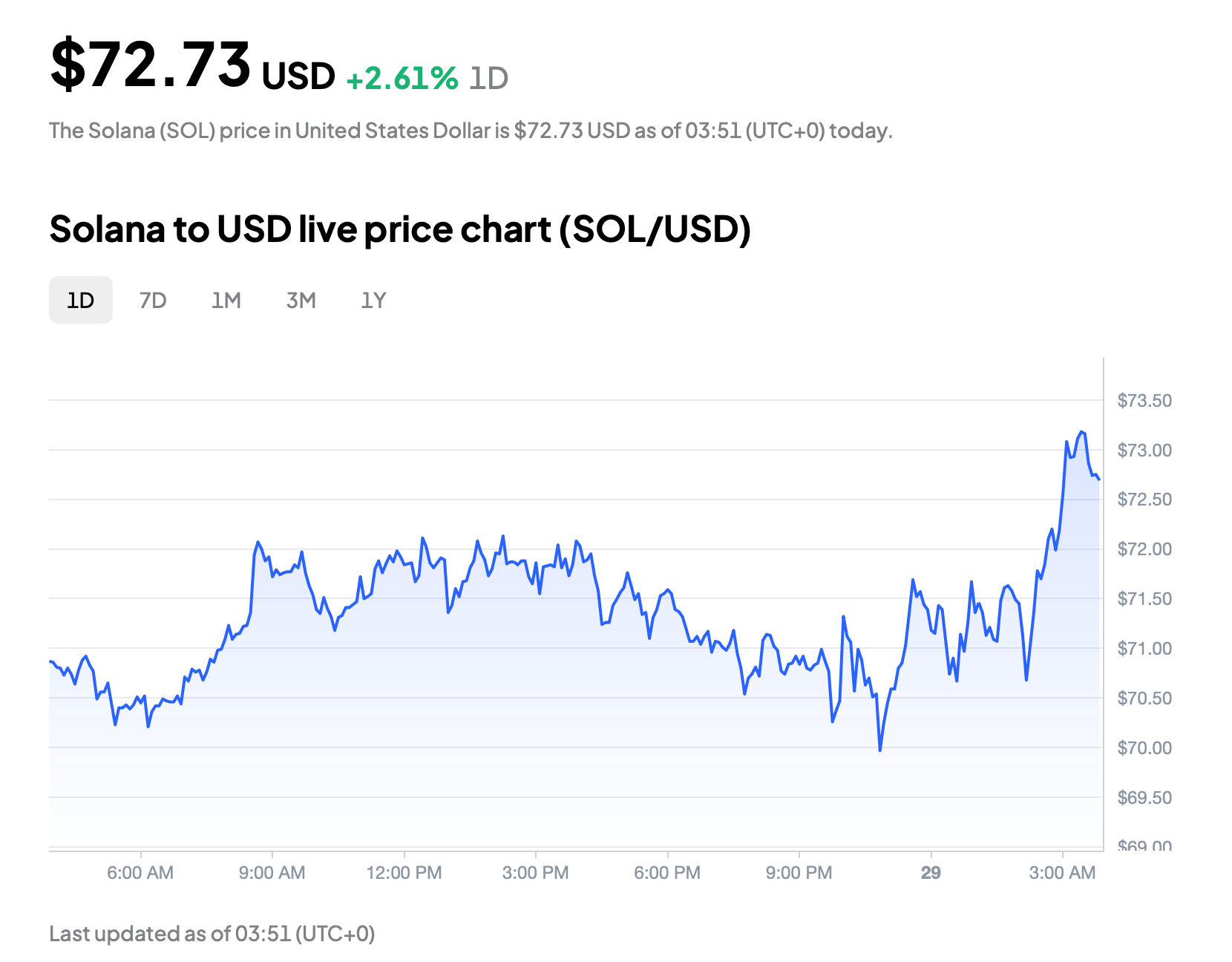
SOL/USD price chart on Toobit
Solana remains one of the most important liquidity indicators in the altcoin market. Even during weak market phases, it continues to attract consistent trading activity, which shows that participation in its ecosystem has not structurally disappeared.
The key signal in July is relative behavior. If SOL continues to hold downside better than Ethereum and other large caps, it becomes an early indicator that risk appetite is stabilizing beneath the surface. The distance from its prior cycle high near $294.33 still defines long term compression, but short term resilience is more important in the current phase.
Solana also benefits from continued ecosystem throughput. High retail engagement, meme-driven activity, and active on chain participation help sustain baseline liquidity. This prevents a full structural breakdown and keeps SOL positioned as a core sentiment barometer for high beta market behavior.
XRP as a macro compression asset
XRP (XRP) trades near $1.050, up 0.07% over 24 hours, down 8.36% over seven days and 20.87% over 30 days. Its market capitalization sits near $65.13 billion, with 24-hour volume around $1 billion.
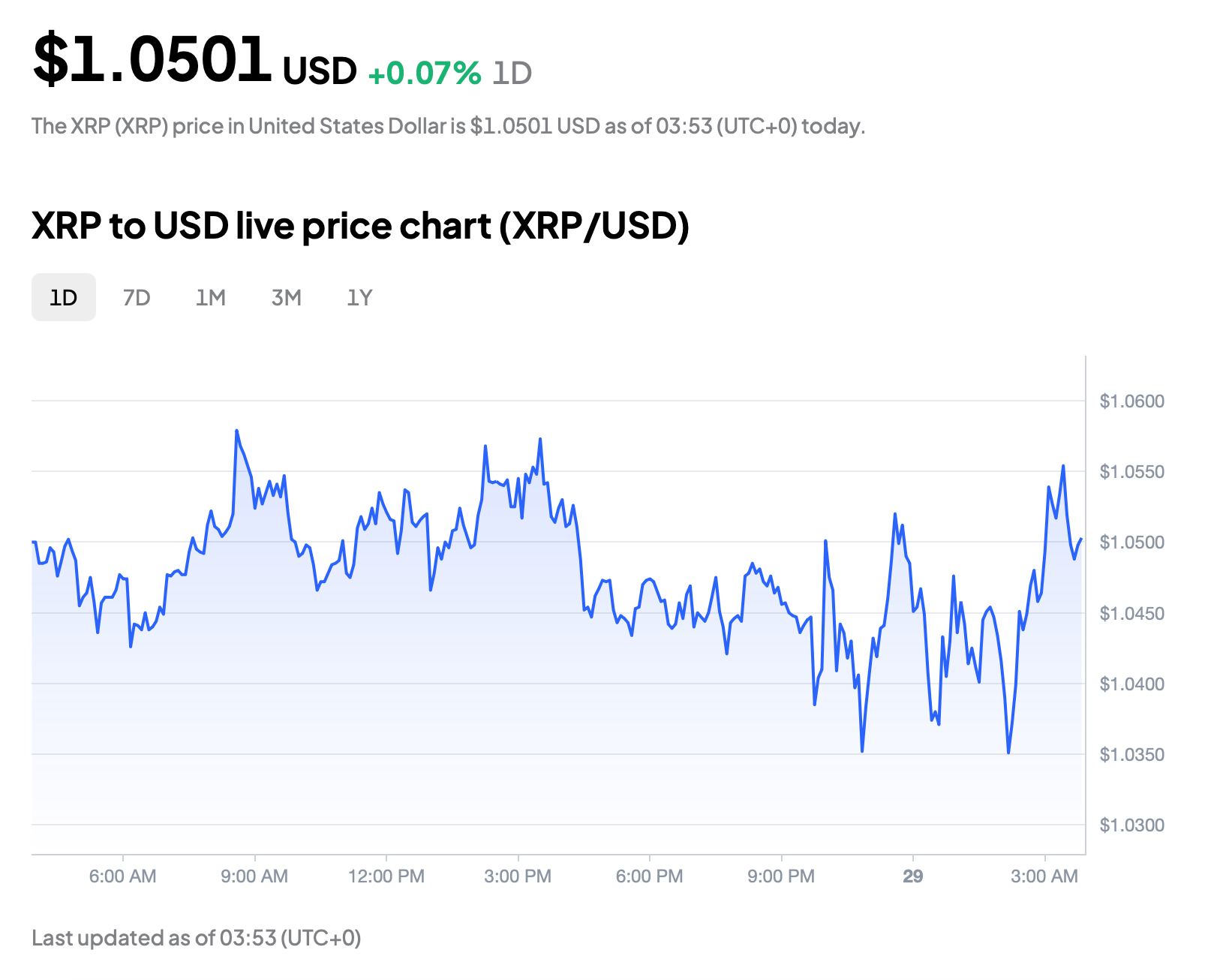
XRP/USD price chart on Toobit
XRP is currently in a compression phase rather than a directional trend phase. Price action is not driven by internal momentum but by macro liquidity conditions and regulatory sentiment shifts. This creates long periods of stagnation followed by sharp repricing when conditions change.
The key level in July is the $1 zone. If XRP maintains this region while broader market pressure continues, it signals structural stability rather than breakdown. That stability becomes important when liquidity eventually returns to large caps, because XRP tends to reprice quickly once sentiment shifts.
Unlike many altcoins, XRP does not move gradually through trends. It often transitions from inactivity to sharp expansion in short time windows. This makes it less useful as a continuous momentum asset and more relevant as a rotation candidate when macro conditions align.
Chainlink and infrastructure positioning
Chainlink (Chainlink) trades near $7.326, up 0.33% over 24 hours, down 8.38% over seven days and 19.97% over 30 days. Its market capitalization sits near $5.28 billion, with 24-hour volume around $173.9 million.
Chainlink continues to behave as infrastructure rather than speculation. Its role in oracle services positions it at the center of DeFi data systems, but this does not translate into immediate price strength during risk-off phases.
LINK typically lags early in cycles because liquidity flows first into higher beta assets. However, its relevance increases when markets shift toward infrastructure rebuilding and tokenization themes. These transitions take time, which is why Chainlink often underperforms in early consolidation but becomes more responsive in later phases.
Its current weakness reflects timing rather than structural decline. The underlying thesis remains intact, but capital has not yet rotated into infrastructure exposure at scale.
Avalanche and compressed volatility
Avalanche (Avalanche) trades near $6.596, up 2.89% over 24 hours, down 29.42% over 30 days, with a market capitalization near $2.72 billion and 24-hour volume around $193.1 million.
AVAX is in a compressed volatility regime where price sensitivity increases significantly. Under these conditions, even small shifts in sentiment or liquidity can produce outsized moves in either direction.
Avalanche is no longer functioning as a trend-driven asset. It behaves more like a reflexive instrument where catalysts matter more than accumulation. This creates conditions where price can remain flat for extended periods and then suddenly expand when narrative or liquidity returns.
The key risk in this structure is timing. Without sustained inflows, volatility alone does not guarantee direction. However, when catalysts do appear, AVAX tends to react quickly due to its compressed base.
ONDO and the real-world asset narrative
ONDO (Ondo Finance) trades near $0.311, up 0.35% over 24 hours, down 9.48% over seven days, while still holding a 60-day gain of approximately 17.95%.
ONDO is structurally different from most altcoins in this watchlist. Its price behavior is closely tied to the real world asset narrative, which continues to be one of the most persistent structural trends in crypto markets.
Tokenized U.S. Treasuries alone represent roughly $14.6 billion in outstanding value, forming a growing bridge between traditional yield systems and blockchain infrastructure. This creates a foundation where capital flows are influenced not only by speculation but also by yield migration.
Within this structure, Ondo Finance acts as a direct liquid representation of tokenized yield exposure. Its multi billion dollar TVL reflects sustained adoption of structured yield products, which makes ONDO less dependent on short term market cycles and more tied to long term capital reallocation.
This explains why ONDO can maintain relative strength even during weak altcoin conditions. Its demand profile is partially structural rather than purely speculative.
Fragmentation and execution dominate
The most important characteristic of July is fragmentation. Crypto is no longer a unified market. Bitcoin defines macro structure, Ethereum reflects secondary liquidity, Solana and XRP respond to rotation dynamics, Chainlink reflects infrastructure positioning, Avalanche reacts to volatility compression, and ONDO tracks structural adoption.
Correlation has weakened across assets and dispersion has increased. Capital does not move broadly anymore. It rotates selectively based on liquidity depth, narrative maturity, and sensitivity to macro conditions.
At the same time, the dominance of derivatives over spot trading reinforces this fragmented structure. With over $400 billion in daily derivatives activity compared to roughly $43 billion in spot volume, price movement is increasingly driven by leverage rather than organic demand.
This creates a market that is separated in narrative but amplified in execution. Moves accelerate faster, reversals are sharper, and liquidation driven distortions often override traditional technical structure. Execution therefore becomes a primary edge.
Entries require confirmation rather than anticipation, and position sizing must reflect volatility rather than conviction. The difference between strong analysis and effective trading is no longer direction, but timing and positioning within a highly leveraged flow-driven system.
Trading the watchlist on Toobit
The best altcoins to watch in July 2026 are not defined by how far they have fallen, but by how they behave under pressure.
On Toobit, these assets can be tracked in real time through live price pages, allowing traders to compare relative strength against Bitcoin before making allocation decisions. This comparison becomes especially important in a market where Bitcoin dominance remains elevated and liquidity is unevenly distributed.
Execution discipline is critical. Traders using Toobit spot markets should pay close attention to spreads, order book depth, and 24 hour liquidity rather than reacting purely to price movement. In weak market breadth conditions, even strong narratives can fail to follow through if positioning is not aligned or if Bitcoin dominance continues to rise and suppress broader risk appetite.
A structured watchlist only becomes effective when paired with disciplined execution logic. The objective is not to anticipate every move, but to ensure that entries are supported by liquidity conditions, confirmation signals, and alignment with the broader rotation cycle.
Final thoughts
July 2026 is defined by separation rather than direction. Liquidity exists but is unevenly distributed. Narratives are active but not synchronized. Price action is volatile but structurally fragmented.
Solana and ONDO currently show the clearest relative strength within this environment. XRP and Chainlink require stabilization before broader participation can return. Avalanche remains the highest sensitivity asset capable of sharp moves but heavily dependent on external catalysts.
Until Bitcoin dominance trends lower and spot liquidity expands meaningfully, the market is likely to remain selective rather than expansive, with rotation continuing to dominate over broad-based rallies.
In this structure, success is not about predicting every move. It is about understanding which assets are structurally positioned to survive the current phase of the cycle.