Federal ADA discrimination and race discrimination case against HD Supply advances after judge grants leave to amend, adding witness retaliation claims while keeping core employment discrimination allegations alive.
Case overview and procedural posture
A $50 million federal civil rights lawsuit filed by former warehouse worker Quinton J. Hall against HD Supply, Inc. is pending in the U.S. District Court for the Northern District of Georgia, with U.S. District Judge Sarah E. Geraghty presiding and Magistrate Judge Anna W. Howard managing pretrial matters. The case, docketed as 1:25‑cv‑06567 and classified as an Americans with Disabilities Act (ADA) employment civil‑rights action, arises from a June 27, 2024 forklift battery incident at HD Supply’s Forest Park, Georgia (GA02) distribution center.
Hall’s operative pleading—his Second Amended Complaint—asserts federal claims including disability discrimination under the ADA, ADA retaliation, failure to accommodate, race discrimination, and workplace retaliation theories, including a newly added witness‑retaliation claim. HD Supply denies liability, has filed an answer with defenses, and previously moved for partial dismissal of selected causes of action; the company’s partial motion was effectively mooted when the Court authorized Hall to file his amended complaint, resetting the pleadings.
The litigation has progressed beyond the initial pleading stage into structured discovery, with recent docket entries showing a June 16, 2026 discovery hearing and an order directing the parties to supplement discovery responses and submit a joint status report on remaining disputes. No ruling on summary judgment or final judgment has been reported in public materials, and the Court has not decided whether HD Supply is liable on any of Hall’s claims.
Judicial case management and amendment rulings
Public docket summaries indicate that Judge Geraghty and Magistrate Judge Howard have managed Hall v. HD Supply, Inc. through standard federal case‑management steps: directing the filing of a Certificate of Interested Persons, issuing scheduling and discovery orders, and holding status and discovery conferences. The Court has allowed Hall’s claims to proceed past initial administrative screening and has not dismissed the lawsuit in its entirety, instead permitting targeted motion practice such as HD Supply’s partial motion to dismiss and Hall’s motion for leave to amend.
The key recent procedural ruling is the order granting Hall leave to file a Second Amended Complaint, which is significant under Rule 15 of the Federal Rules of Civil Procedure because amendments can reshape the scope of litigation and affect which claims proceed to discovery and dispositive motions. Rule 15 generally provides that courts should “freely give leave when justice so requires,” but federal judges may deny amendments if they are unduly delayed, made in bad faith, futile under the governing legal standards, or prejudicial to the opposing party. By granting Hall’s motion and accepting his Second Amended Complaint, the Court exercised its discretion in favor of allowing additional allegations and a witness‑retaliation claim to be tested through discovery rather than foreclosed at the pleading stage.
This amendment ruling is procedural rather than substantive: it authorizes Hall to assert claims and theories but does not constitute a finding that the allegations are true or that HD Supply violated the ADA, Title VII, or any other statute. Subsequent orders, including the June 16, 2026 discovery order directing supplementation of discovery responses and a joint status report, continue to focus on case management—resolving discovery disputes and keeping the schedule on track—rather than adjudicating liability.
Plaintiff’s litigation strategy and claim development
Public summaries of the complaint and later filings suggest that Hall’s litigation strategy has involved gradually expanding and refining his claims through amendments while preserving core allegations of ADA discrimination, ADA retaliation, failure to accommodate, race discrimination, and workplace retaliation. The original complaint focused on a forklift battery incident on June 27, 2024, alleged back injury, and post‑incident disputes over accommodations and light‑duty work, as well as disciplinary actions culminating in his termination on July 25, 2024; subsequent amendments added more detail about alleged hostile work environment and retaliation for internal complaints and participation in protected activity.
Over time, Hall has referenced multiple witnesses in his filings, including current and former coworkers who reportedly observed events before, during, and after the forklift incident and who have provided statements about workplace safety, accommodations, and management’s response to his complaints. The Second Amended Complaint’s witness‑retaliation allegations, permitted by the Court, reflect a strategic effort to protect witnesses and incorporate alleged retaliatory acts aimed at individuals associated with his case, thereby broadening the retaliation theory beyond his own employment actions.
Hall’s docketed activity includes responding to HD Supply’s partial motion to dismiss, opposing efforts to narrow his claims, and seeking leave to amend rather than abandoning contested causes of action. The procedural record, as reported in public materials, shows him engaging in discovery, participating in a June 16, 2026 discovery hearing, and working through structured disputes about document production and interrogatory responses, which are common features of federal employment discrimination litigation. None of these filings or strategic choices establish the truth of his allegations; they reflect the plaintiff’s efforts to preserve as many ADA, race discrimination, and retaliation claims as possible for eventual summary judgment or trial.
HD Supply’s litigation strategy and motion practice
HD Supply’s litigation posture, as described in publicly available docket trackers, reflects a large corporate defendant’s typical strategy of narrowing exposure at the pleading stage and contesting the scope of discovery. The company has appeared in the case, filed an answer and defenses contesting Hall’s description of the forklift incident and subsequent employment actions, and asserted legal defenses under the ADA and Title VII, although the specific content of those defenses is not fully detailed in public summaries.
Rather than immediately moving to dismiss the entire lawsuit, HD Supply filed a Memorandum of Law in Support of a Partial Motion to Dismiss, seeking dismissal of certain claims—likely those it contends are legally insufficient or barred—while leaving other claims to be addressed later through discovery and summary judgment. This partial dismissal strategy allows corporate defendants to focus on narrowing high‑stakes claims such as hostile work environment or punitive damages allegations, while avoiding the higher threshold associated with seeking dismissal of an entire civil rights complaint.
Public entries also show HD Supply participating in discovery and responding to Hall’s requests, with disputes over the sufficiency of its responses prompting judicial intervention and the June 16, 2026 discovery order. The company has raised procedural objections and contested certain discovery demands, behavior that aligns with common defense tactics in federal employment discrimination litigation where defendants aim to limit burdensome discovery while contesting the factual basis for plaintiffs’ claims.
Current claims and the impact of the witness‑retaliation amendment
Based on public descriptions of the docket, the operative Second Amended Complaint in Hall v. HD Supply, Inc. currently includes multiple active federal claims: disability discrimination under the ADA, failure to accommodate, ADA retaliation, race discrimination likely brought under Title VII or 42 U.S.C. § 1981, and workplace retaliation theories. Some accounts reference a hostile work environment component, indicating that Hall has pled ongoing discriminatory or harassing conditions at the GA02 Forest Park distribution center, though the precise contours of that claim depend on the operative complaint’s language.
The newly authorized witness‑retaliation claim is procedurally significant because it adds a distinct category of alleged retaliatory conduct—adverse actions toward individuals believed to be supporting or testifying for Hall—on top of the alleged retaliation directed at Hall himself. Under federal employment‑retaliation law, allegations that an employer retaliates against witnesses can expand potential liability and raise additional discovery issues, including third‑party personnel files, communication records, and internal investigations regarding those individuals.
The Court’s decision to allow the Second Amended Complaint does not resolve whether any witness‑retaliation or underlying discrimination occurred; it merely permits the claims to proceed so that the parties can gather evidence. At this stage, all allegations in the complaint remain unproven assertions by the plaintiff, and HD Supply’s denials and defenses remain equally untested by summary judgment or trial.
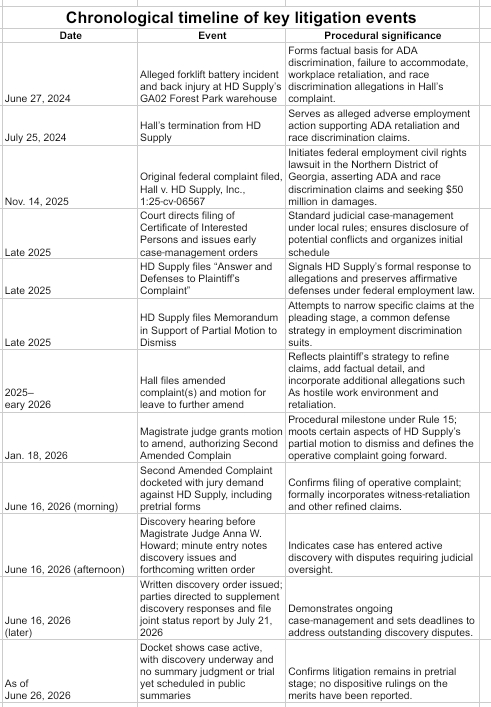
Each step marks the case’s progression from initial allegations through responsive pleadings and motion practice into fact‑gathering, without any judicial determination that either party’s version of events is correct.
Why Rule 15 leave to amend matters
Under Rule 15(a) of the Federal Rules of Civil Procedure, a plaintiff may amend a complaint with the opposing party’s consent or the Court’s leave, and “the court should freely give leave when justice so requires.” Courts assess factors such as undue delay, bad faith, repeated failure to cure deficiencies, undue prejudice to the opposing party, and futility of amendment when deciding whether to grant leave.
In Hall v. HD Supply, the magistrate judge’s decision to grant Hall leave to file his Second Amended Complaint is important because it defines the universe of claims that will be evaluated in discovery and later dispositive motions. The amendment adds allegations and the witness‑retaliation claim, which may expand the scope of relevant evidence and require HD Supply to respond to broader interrogatories, document requests, and deposition topics.
Judges sometimes deny amendments when the case is far advanced—for example, on the eve of trial—or when additional claims would require major schedule changes or repeat discovery; by contrast, courts often permit amendments early in litigation to ensure that the factual record and legal issues are fully developed. Here, the timing of the amendment early in the discovery phase, combined with the Court’s directive for both sides to supplement discovery responses, suggests the judge is prioritizing a complete factual record over strict limitations on pleadings.
Crucially, granting leave to amend is not a ruling on the merits: the Court is not endorsing Hall’s witness‑retaliation narrative or determining that HD Supply engaged in discrimination or retaliation; it is simply allowing those allegations to be tested through the adversarial process.
What happens next under the Federal Rules
With the Second Amended Complaint on file and discovery underway, the ordinary federal civil procedure path in an ADA employment discrimination and race discrimination lawsuit typically includes several phases. First, the parties will continue written discovery—interrogatories, requests for production, and requests for admission—followed by depositions of Hall, HD Supply managers, HR personnel, and identified witnesses to the forklift incident and alleged retaliatory acts.
Depending on the complexity of Hall’s claimed injuries and alleged disabilities, the parties may exchange expert disclosures under Rule 26, including medical experts and vocational or damages experts, though public sources do not yet describe specific expert activity in this case. After discovery closes, HD Supply and possibly Hall are expected to file dispositive motions such as motions for summary judgment under Rule 56, asking the Court to rule as a matter of law on some or all claims based on the developed record.
Courts sometimes refer employment discrimination cases to mediation or settlement conferences, either through court‑annexed ADR programs or private mediation, especially once discovery clarifies the strengths and weaknesses of each side’s position; public materials about Hall v. HD Supply do not yet report a scheduled mediation, but such steps are common. If one or more claims survive summary judgment, the case would proceed to pretrial motions, final witness and exhibit lists, and ultimately trial, where a jury or the Court would determine whether HD Supply is liable and, if so, what remedies should be awarded.
At present, the litigation remains in an intermediate phase: past the earliest pleading and case‑opening requirements, involved in contested discovery, and structurally positioned for later summary judgment briefing, but still far from a final merits determination.
Balanced analysis of the litigation’s trajectory
The procedural history of Hall v. HD Supply shows that the lawsuit has evolved from a single forklift‑incident narrative into a broader ADA discrimination, race discrimination, failure‑to‑accommodate, and retaliation case with multiple witnesses and an additional witness‑retaliation claim. The Court’s rulings to date—including allowing amendment and issuing discovery orders—indicate that the judge is managing the case according to standard federal civil practice, ensuring that both parties have an opportunity to develop the factual record.
However, these rulings are not findings of liability: they do not establish that HD Supply ignored safety alarms, denied accommodations, retaliated against Hall or witnesses, or created a hostile work environment; nor do they validate HD Supply’s defenses. Allegations in Hall’s complaint remain allegations unless and until they are proven at summary judgment or trial, and HD Supply’s denials and legal arguments remain contested positions in an ongoing case.
Discovery exists precisely so that both sides can test their claims and defenses through documents, testimony, and expert analysis, and the current docket activity reflects that process unfolding in real time. For researchers, journalists, attorneys, and members of the public, the key takeaway from the procedural record is that Hall v. HD Supply has moved into active discovery with an expanded set of claims, but the ultimate questions of ADA discrimination, race discrimination, failure to accommodate, and witness retaliation remain unresolved.
Would you like a shorter version of this article tailored specifically for a Google News press release format, focusing on the most SEO‑valuable phrases?