Health coverage company Centene (NYSE: CNC) reported Q3 2026 results topping the market’s revenue expectations, with revenue rising 1.9% year on year to $50.65 billion. The company’s full-year revenue guidance of $198.5 billion at the midpoint came in 1.3% above analysts’ consensus estimates. Its non-GAAP profit of $0.58 per share was significantly above analysts’ consensus estimates.
For more on Centene, read our full research report for free.
Centene (CNC) Q3 2026 highlights:
- Revenue $50.65 billion vs S&P analysts’ consensus estimates of $46.81 billion (1.9% year-on-year growth, 8.2% beat)
- Adjusted EPS $0.58 vs S&P analysts’ consensus estimates of $0.10 (significant beat)
- Revenue guidance The company lifted its revenue guidance for the full year to $198.5 billion at the midpoint from $195.5 billion, a 1.5% increase
- Adjusted EPS guidance Management raised its full-year adjusted EPS guidance to $5.20 at the midpoint, an 8.3% increase
- Operating margin -0.6%, up from -14% in the same quarter last year
- Free cash flow -$3.86 billion, down from $1.15 billion in the same quarter last year
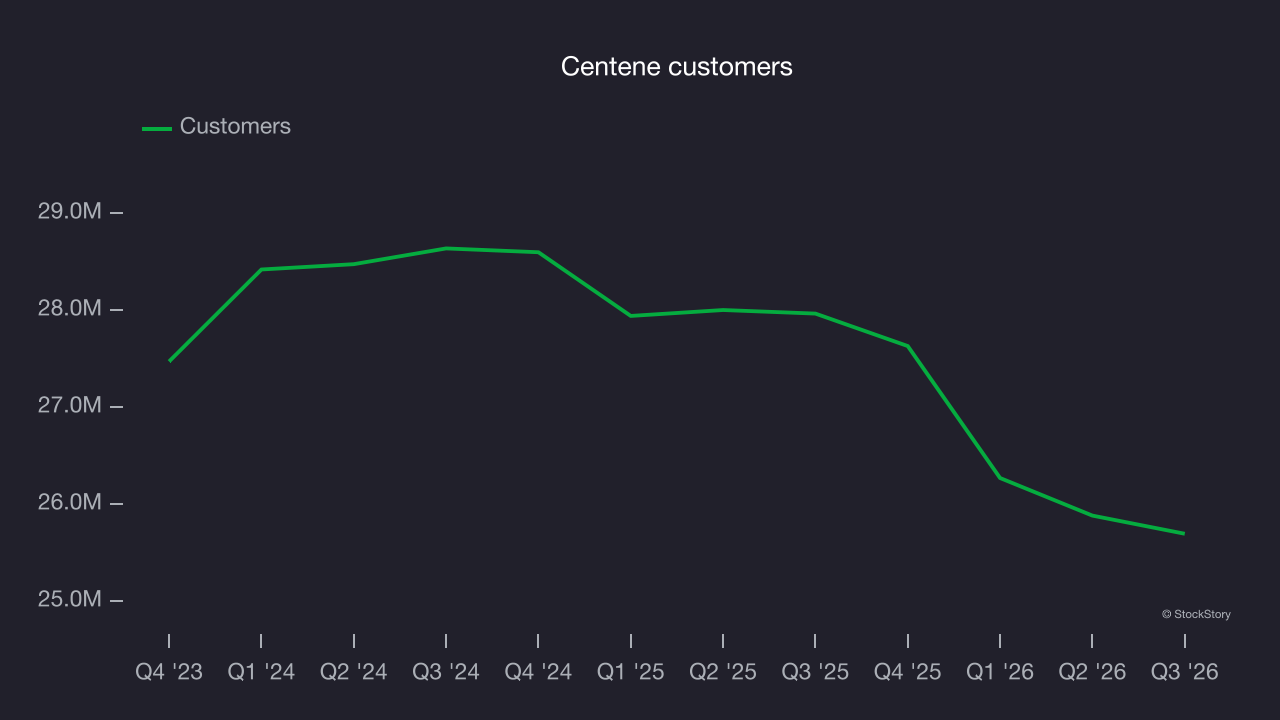
- Customers 25.7 million, down from 25.89 million in the previous quarter
- Market capitalization $33.61 billion
Revenue growth
A company’s long-term revenue performance can indicate its overall quality. Any business can put up a good quarter or two, but the best consistently grow over the long haul. Centene’s 10.9% annualized revenue growth over the last five years was decent. Its growth was slightly above the average healthcare company and shows its offerings resonate with customers.
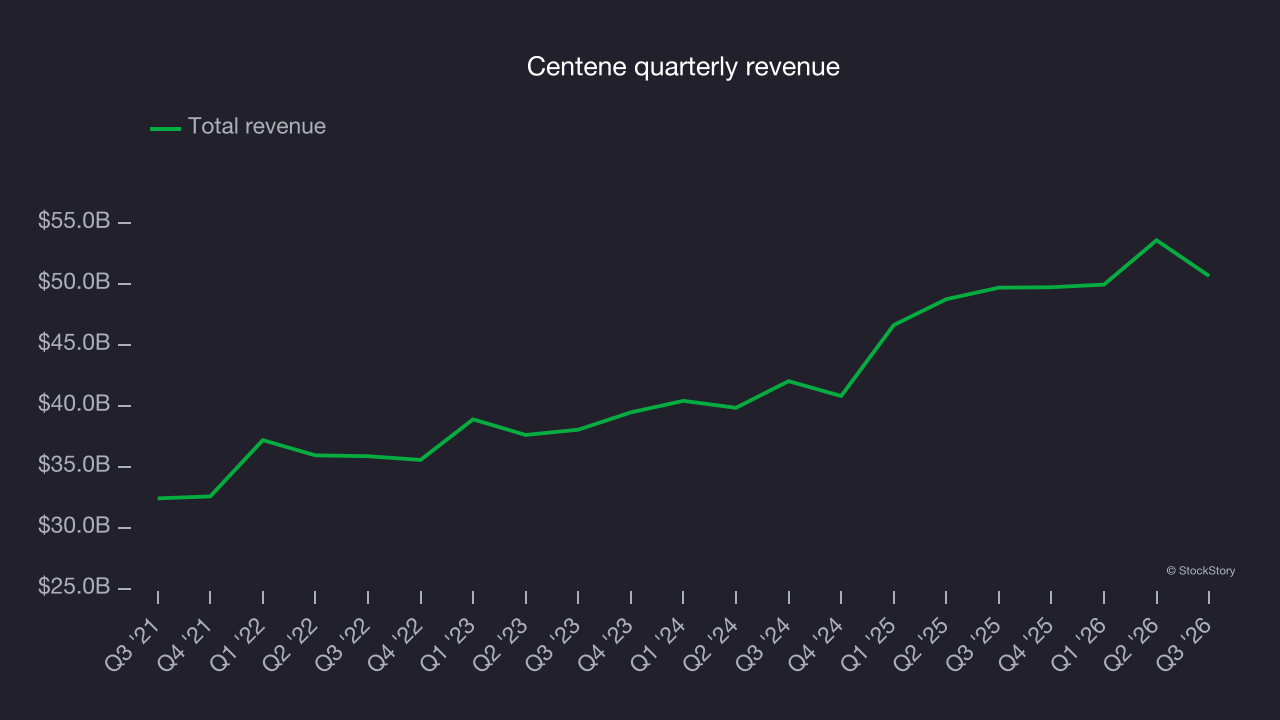
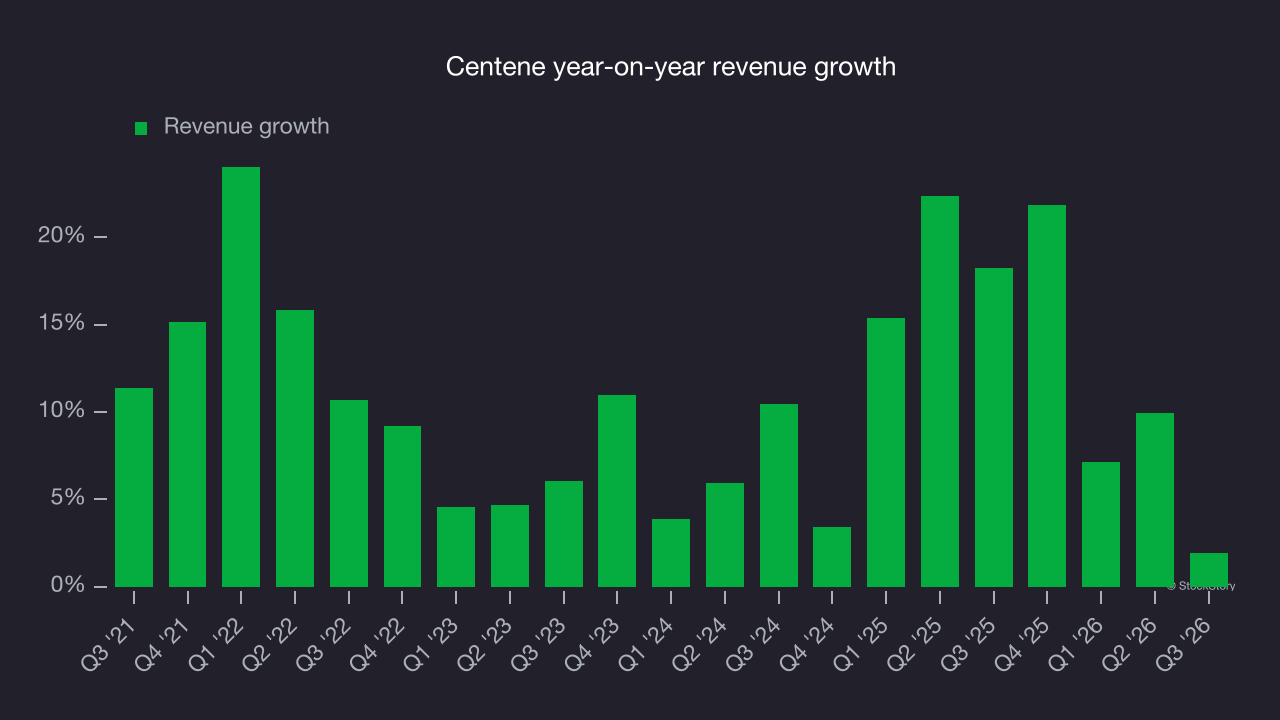
This quarter, Centene reported modest year-on-year revenue growth of 1.9% but beat Wall Street’s consensus estimates by 8.2%.
Looking ahead, sell-side analysts expect revenue to decline by 6.2% over the next 12 months, according to S&P, a deceleration versus the last two years. This underwhelming projection suggests its products and services will face some demand headwinds.
Adjusted operating margin
Adjusted operating margin is one of the best measures of profitability because it shows how much a company earns after subtracting all core expenses, like marketing and R&D. It also removes various one-time costs to give a clearer picture of normalized profits.
Centene was profitable over the last five years but held back by its large cost base. Its average adjusted operating margin of 2.1% was weak for a healthcare business.
Analyzing the trend in its profitability, Centene’s adjusted operating margin decreased by 2.4 percentage points over the last five years. The company’s two-year trajectory also shows it failed to get its profitability back to the peak as its margin fell by 1.2 percentage points. This poor performance shows its expenses were rising and it couldn’t pass those costs on to its customers.
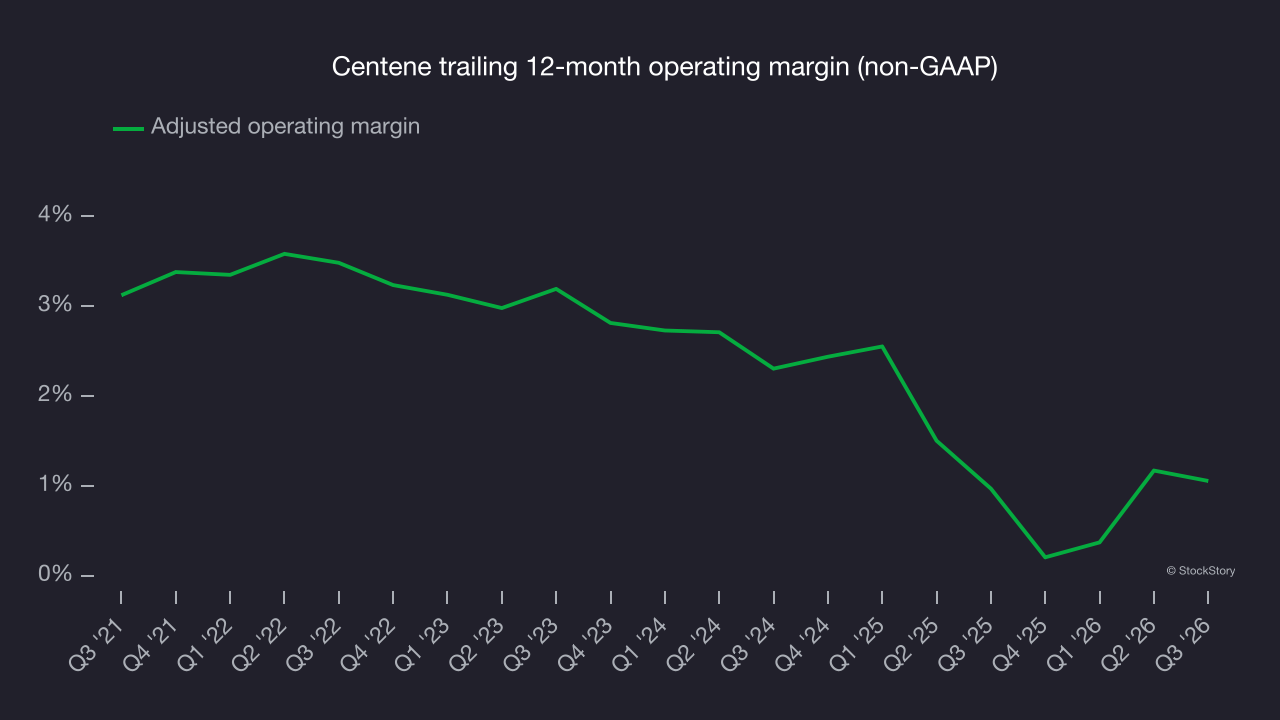
In Q3, Centene’s breakeven margin was -0.5%, in line with the same quarter last year. This indicates the company’s overall cost structure has been relatively stable.
Earnings per share
We track the long-term change in earnings per share (EPS) for the same reason as long-term revenue growth. Compared to revenue, however, EPS highlights whether a company’s growth is profitable.
Centene’s EPS grew at an unimpressive 2.8% compounded annual growth rate over the last five years, lower than its 10.9% annualized revenue growth. This indicates the company became less profitable on a per-share basis as it expanded due to non-fundamental factors such as interest expenses and taxes.
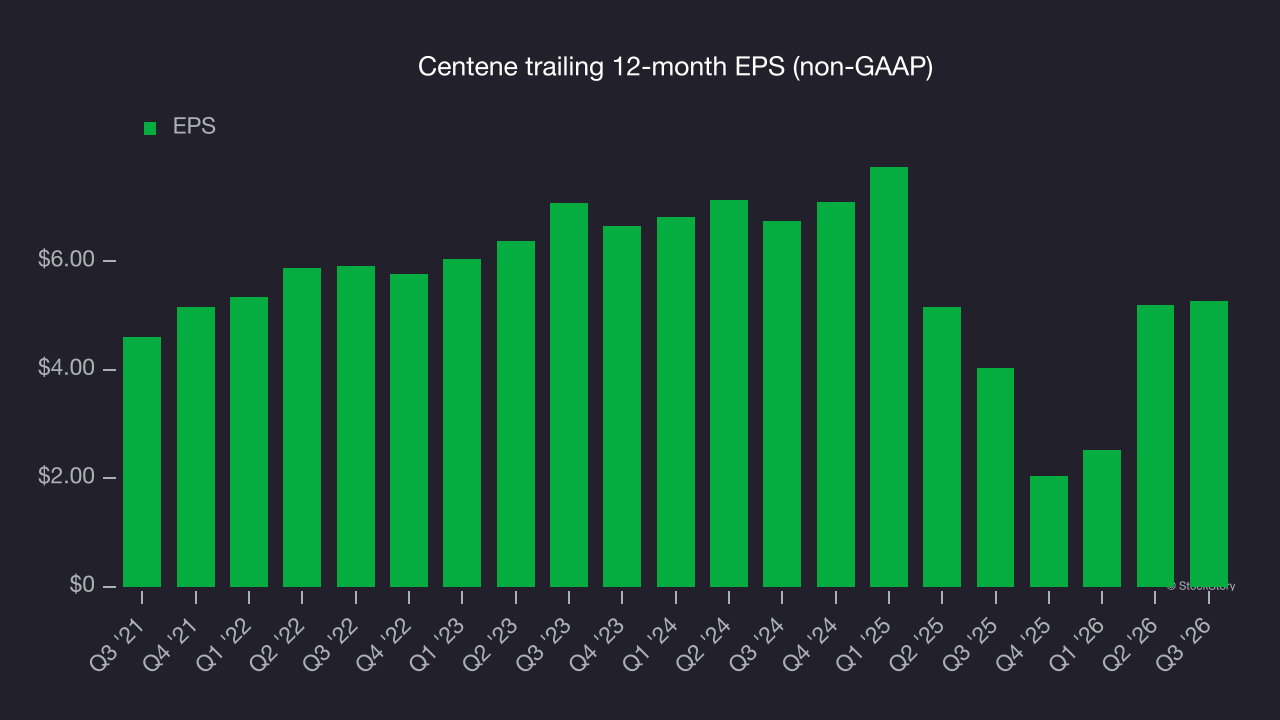
A closer look at Centene’s earnings helps explain the drivers of its performance. As mentioned earlier, Centene’s adjusted operating margin was flat this quarter but declined by 2.4 percentage points over the last five years. This was the most relevant factor (aside from the revenue impact) behind its lower earnings; interest expenses and taxes can also affect EPS but don’t tell us as much about a company’s fundamentals.
In Q3, Centene reported adjusted EPS of $0.58, up from $0.50 in the same quarter last year. This result easily cleared analysts’ consensus estimates. Over the next 12 months, Wall Street expects Centene’s full-year EPS to shrink by 3.6% from $5.27 to $5.08, according to S&P.
Key takeaways from Centene’s Q3 results
Centene delivered a solid quarter, with revenue topping Wall Street’s consensus estimates by a wide margin and EPS also beating analysts’ consensus estimates. However, investors were likely hoping for more: Shares fell 2.3% to $66.44 immediately after the results.
When deciding whether to invest in Centene at its current price, the latest quarter matters, but not as much as longer-term business quality and valuation. For more on these factors, read the full research report here (it’s free).