
Personal care and home fragrance retailer Bath & Body Works (NYSE: BBWI) beat Wall Street’s revenue expectations in Q1 CY2026, but sales fell by 3.2% year on year to $1.38 billion. The company expects next quarter’s revenue to be around $1.49 billion, close to analysts’ estimates. Its GAAP profit of $0.90 per share was significantly above analysts’ consensus estimates.
Is now the time to buy Bath and Body Works? Find out by accessing our full research report, it’s free.
Bath and Body Works (BBWI) Q1 CY2026 Highlights:
- Revenue: $1.38 billion vs analyst estimates of $1.36 billion (3.2% year-on-year decline, 1.2% beat)
- EPS (GAAP): $0.90 vs analyst estimates of $0.29 (significant beat)
- Adjusted EBITDA: $300 million vs analyst estimates of $204.6 million (21.8% margin, 46.6% beat)
- Revenue Guidance for Q2 CY2026 is $1.49 billion at the midpoint, roughly in line with what analysts were expecting
- EPS (GAAP) guidance for the full year is $3.13 at the midpoint, beating analyst estimates by 20.9%
- Operating Margin: 16.8%, up from 14.7% in the same quarter last year
- Free Cash Flow Margin: 14.2%, up from 10.6% in the same quarter last year
- Locations: 2,502 at quarter end, up from 2,424 in the same quarter last year
- Market Capitalization: $3.57 billion
Daniel Heaf, chief executive officer of Bath & Body Works, commented, “Our first-quarter results exceeded guidance, but remain below the standard our brand is capable of delivering. That reality reinforces the urgency with which we are executing the Consumer First Formula. Our efforts to strengthen our hero categories, modernize the brand, and expand our reach are beginning to resonate with consumers, and we are encouraged by the early proof points we are seeing.”
Company Overview
Spun off from L Brands in 2020, Bath & Body Works (NYSE: BBWI) is a personal care and home fragrance retailer where consumers can find specialty shower gels, scented candles for the home, and lotions.
Revenue Growth
A company’s long-term performance is an indicator of its overall quality. Any business can experience short-term success, but top-performing ones enjoy sustained growth for years.
With $7.25 billion in revenue over the past 12 months, Bath and Body Works is a mid-sized retailer, which sometimes brings disadvantages compared to larger competitors benefiting from better economies of scale.
As you can see below, Bath and Body Works’s revenue declined by 1.2% per year over the last three years despite opening new stores. This implies its underperformance was driven by lower sales at existing, established locations.
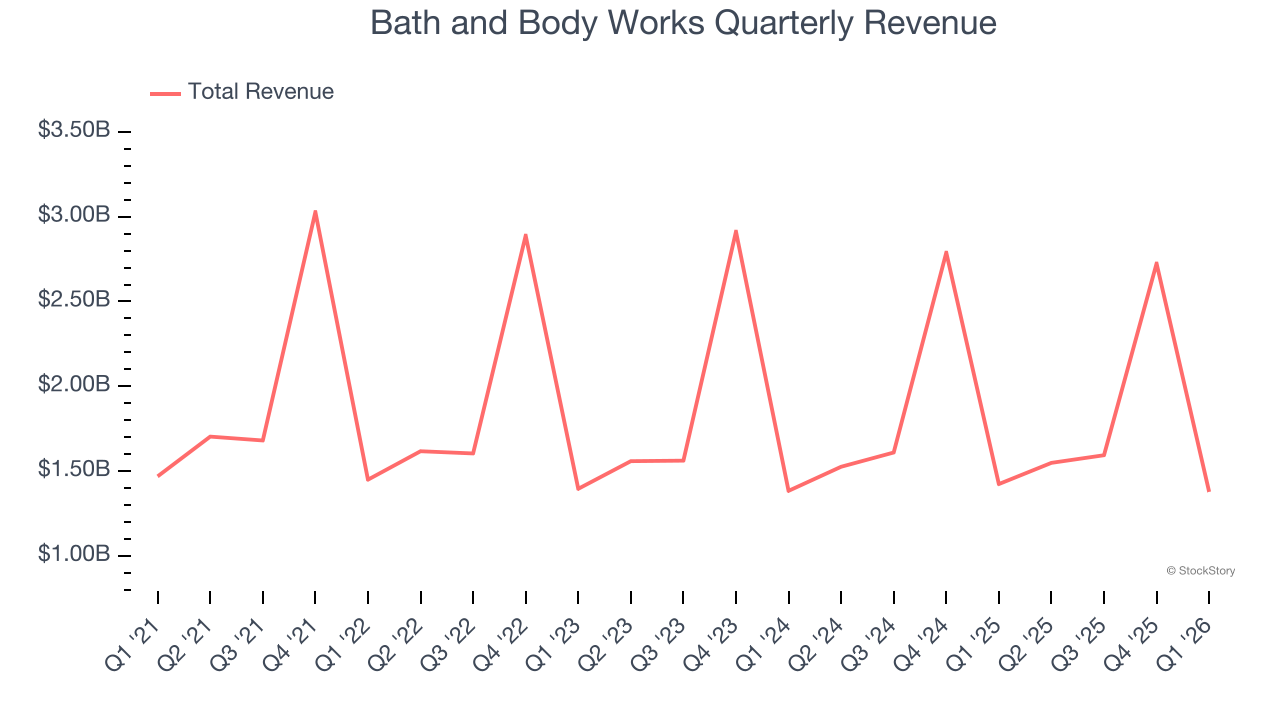
This quarter, Bath and Body Works’s revenue fell by 3.2% year on year to $1.38 billion but beat Wall Street’s estimates by 1.2%. Company management is currently guiding for a 4% year-on-year decline in sales next quarter.
Looking further ahead, sell-side analysts expect revenue to decline by 1.8% over the next 12 months, similar to its three-year rate. This projection is underwhelming and suggests its newer products will not accelerate its top-line performance yet.
WHILE YOU’RE HERE: The Next Palantir? One satellite company captures images of every point on Earth. Every single day. The Pentagon wants it. Hedge funds are using it to beat earnings. You’ve probably never heard of it.
This is what the early days of Palantir looked like before it became a $437 billion giant. Same playbook. Different technology. If you missed Palantir, you need to see this. Claim The Stock Ticker for Free HERE.
Store Performance
Number of Stores
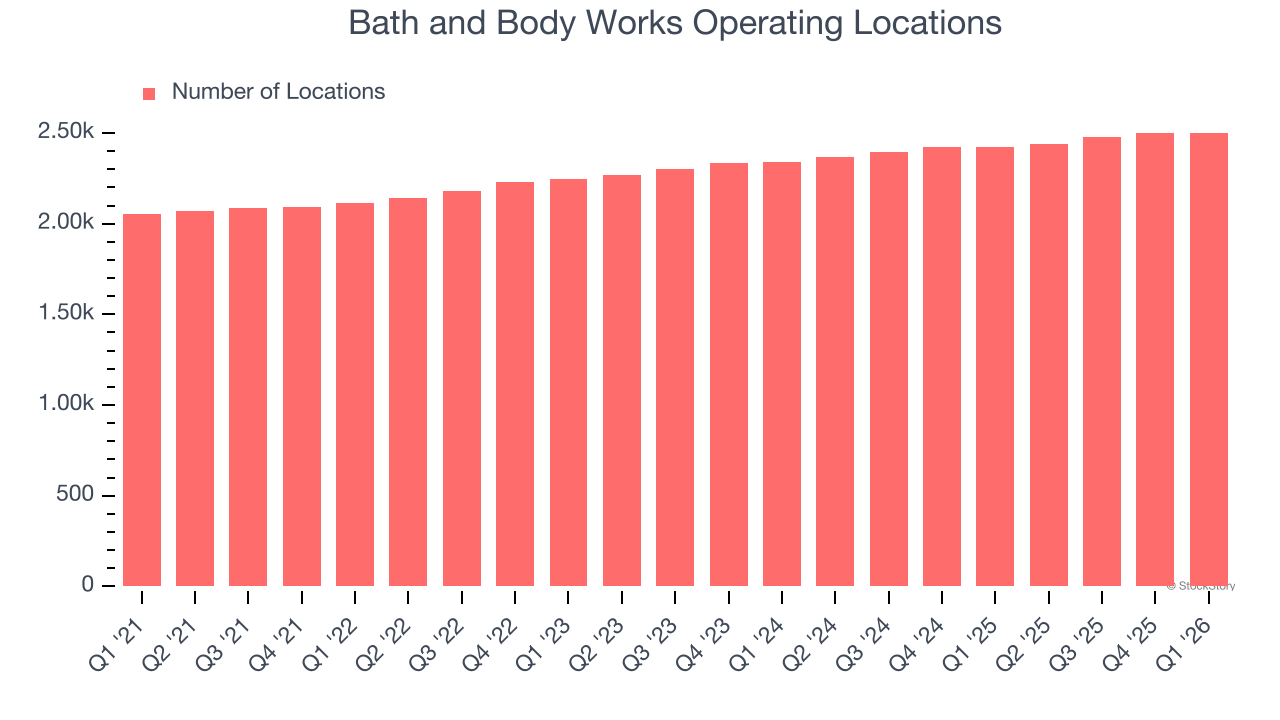
Bath and Body Works operated 2,502 locations in the latest quarter. It has opened new stores quickly over the last two years, averaging 3.6% annual growth, faster than the broader consumer retail sector.
When a retailer opens new stores, it usually means it’s investing for growth because demand is greater than supply, especially in areas where consumers may not have a store within reasonable driving distance.
Same-Store Sales
A company's store base only paints one part of the picture. When demand is high, it makes sense to open more. But when demand is low, it’s prudent to close some locations and use the money in other ways. Same-store sales is an industry measure of whether revenue is growing at those existing stores and is driven by customer visits (often called traffic) and the average spending per customer (ticket).
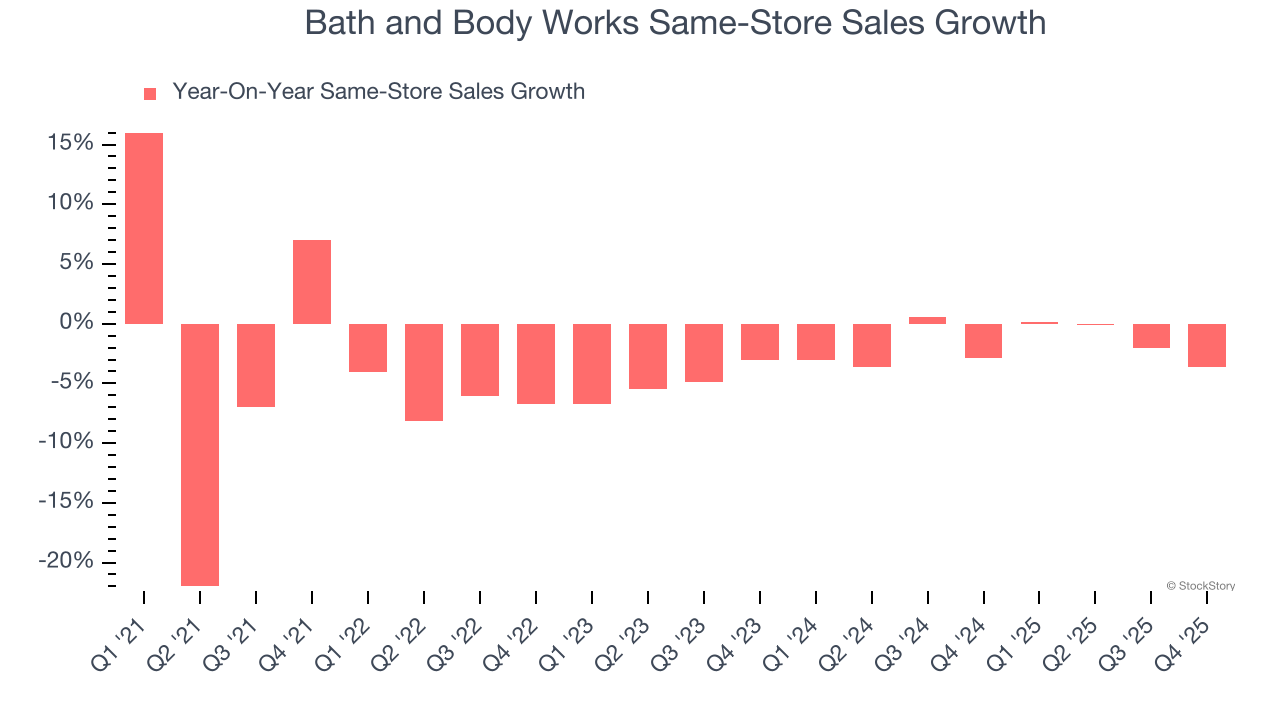
Bath and Body Works’s demand has been shrinking over the last two years as its same-store sales have averaged 1.6% annual declines. This performance is concerning - it shows Bath and Body Works artificially boosts its revenue by building new stores. We’d like to see a company’s same-store sales rise before it takes on the costly, capital-intensive endeavor of expanding its store base.
Note that Bath and Body Works reports its same-store sales intermittently, so some data points are missing in the chart below.
Key Takeaways from Bath and Body Works’s Q1 Results
We were impressed by Bath and Body Works’s optimistic EPS guidance for next quarter, which blew past analysts’ expectations. We were also glad its EPS outperformed Wall Street’s estimates. Zooming out, we think this was a solid print. The stock traded up 17.2% to $20.78 immediately following the results.
Bath and Body Works may have had a good quarter, but does that mean you should invest right now? We think that the latest quarter is only one piece of the longer-term business quality puzzle. Quality, when combined with valuation, can help determine if the stock is a buy. We cover that in our actionable full research report which you can read here (it’s free).