There’s a moment every successful brand reaches where nothing looks obviously broken, yet everything underneath has already started to shift. The numbers still hold. The narrative still lingers. But the behavior changes first. Usually, and sadly, value investors seem to like it most at this point.
That’s where Nike is today.
The discussion around (NKE) has been framed the wrong way. Investors are focused on distribution strategy, wholesale relationships, inventory levels, and margins. Those are visible. They are measurable. But they are not the cause of what’s happening. They are the consequence.
The real issue is simpler and far more difficult to quantify. Nike is losing its shine.
This is the part of the cycle most investors miss. Brand deterioration doesn’t arrive as a collapse. It doesn’t show up as a sudden break. It drifts. Quietly. Gradually. Almost invisibly at first. A product release that doesn’t quite land. A cultural moment that belongs to someone else. A subtle shift in what consumers reach for without thinking.
At the peak, a brand dictates demand. It sets pricing. It leads culture. Consumers follow. When that position weakens, even slightly, the entire system reverses. The brand starts responding rather than leading. Promotions increase. Product cycles become less certain. Distribution becomes a lever rather than an advantage.
This isn’t unique to (NKE) . It’s a pattern that repeats across consumer markets with remarkable consistency.
(UA) didn’t collapse overnight. It lost relevance slowly, almost imperceptibly, before the numbers followed. (ADS.D.DX) has gone through multiple cycles where product momentum, not strategy, dictated performance. Gap once dominated cultural relevance, only to drift into discount-driven survival. Each of these companies looked stable until they didn’t.
The sequence is always the same. Cultural relevance peaks. Product momentum fades. Consumers shift their attention. Financial performance lags way behind the change. In my experience, this is where the value investors get really caught out. By the time investors react, the opportunity has already passed.
(NKE) is sitting in that transition phase right now. Not broken. Not collapsing. However, the market is no longer clearly leading the way. That distinction matters more than most investors appreciate.
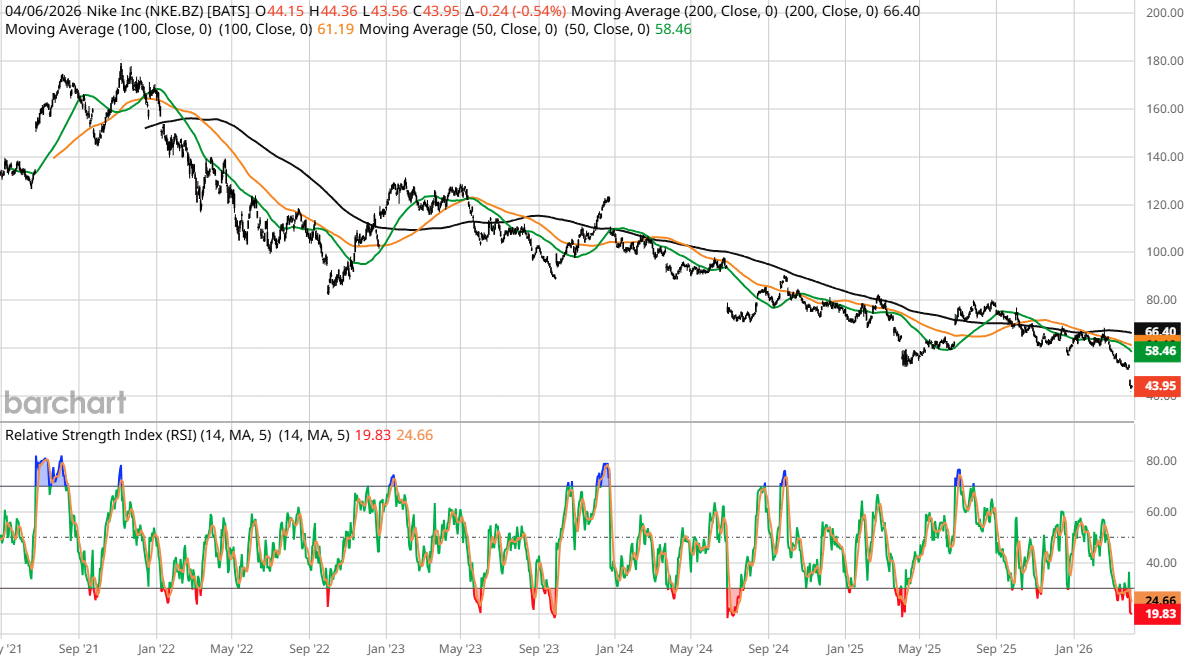
Markets are conditioned to react to data. Revenue, margins, guidance. But consumer brands don’t turn on spreadsheets. They turn on perception. And perception doesn’t announce itself. It shows up in behavior. What people wear. What they talk about. What they stop buying without noticing. By the time the data confirms the shift, the market has already begun to reprice the business.
What makes this cycle more dangerous today is speed. Trends move faster. Product cycles compress. Social media accelerates shifts in attention. What once took years can now unfold in quarters. That shortens the window between early signals and financial impact, leaving less time for investors to adjust.
This is why so many get caught leaning the wrong way. They wait for confirmation. They look for stabilization in earnings. They try to model a recovery before understanding whether the brand is still leading or simply reacting.
The better question isn’t whether (NKE) will recover. It’s whether the brand is still setting the agenda.
If organic demand drives the market, pricing power and product resonance reveal the answer. Promotions and distribution adjustments support demand, leading to a different answer. One reflects leadership. The other reflects adaptation. And markets price those two realities very differently.
This area is also where a broader investing mistake comes into focus. Too many investors search for opportunity in stability. They want predictable earnings, steady growth, and clean narratives. But those situations rarely produce outsized returns because they are already understood. The real edge comes from recognizing change before it becomes consensus.
That’s why structural situations, spinoffs, breakups, forced selling, and capital allocation shifts continue to outperform. They create movement. They force the market to re-evaluate. They introduce new information that must be priced.
Brand deterioration, on the other hand, is slower. It doesn’t force action immediately. It creates a lag between perception and price. That lag is where most investors misjudge risk.
(NKE) isn’t a story about failure. It’s a story about transition. And transitions are where markets make mistakes.
Because the hardest thing for investors to accept is that a company is not broken. It’s that something great has simply become… less great.
That shift doesn’t come with a headline. It doesn’t come with a warning. It shows up quietly, in behavior first, and only later in numbers. And by the time the numbers confirm it, the market has already moved. Markets don’t reward you for identifying great brands. They reward you for recognizing when those brands change.
In my experience, the biggest losses don’t come from buying bad companies. They come from holding onto excellent ones for too long, long after something has quietly changed. Investors wait for confirmation in the numbers, but by then the market has already moved. The edge isn’t in predicting recovery. It’s in recognizing when leadership has already shifted.
That’s the nuance most investors miss. Paging (PYPL) …
On the date of publication, Jim Osman did not have (either directly or indirectly) positions in any of the securities mentioned in this article. All information and data in this article is solely for informational purposes. For more information please view the Barchart Disclosure Policy here.
More news from Barchart
- Dell Announced Major AI-Driven Layoffs in March 2026. What Comes Next for Dividend-Paying DELL Stock?
- Nike’s Real Problem Isn’t Sales: It’s Relevance
- Plug Power Just Scored a New Deal in Canada. Should You Buy PLUG Stock Here?
- Seagate Technology Just Hit a New All-Time High. Should You Buy STX Stock Here?