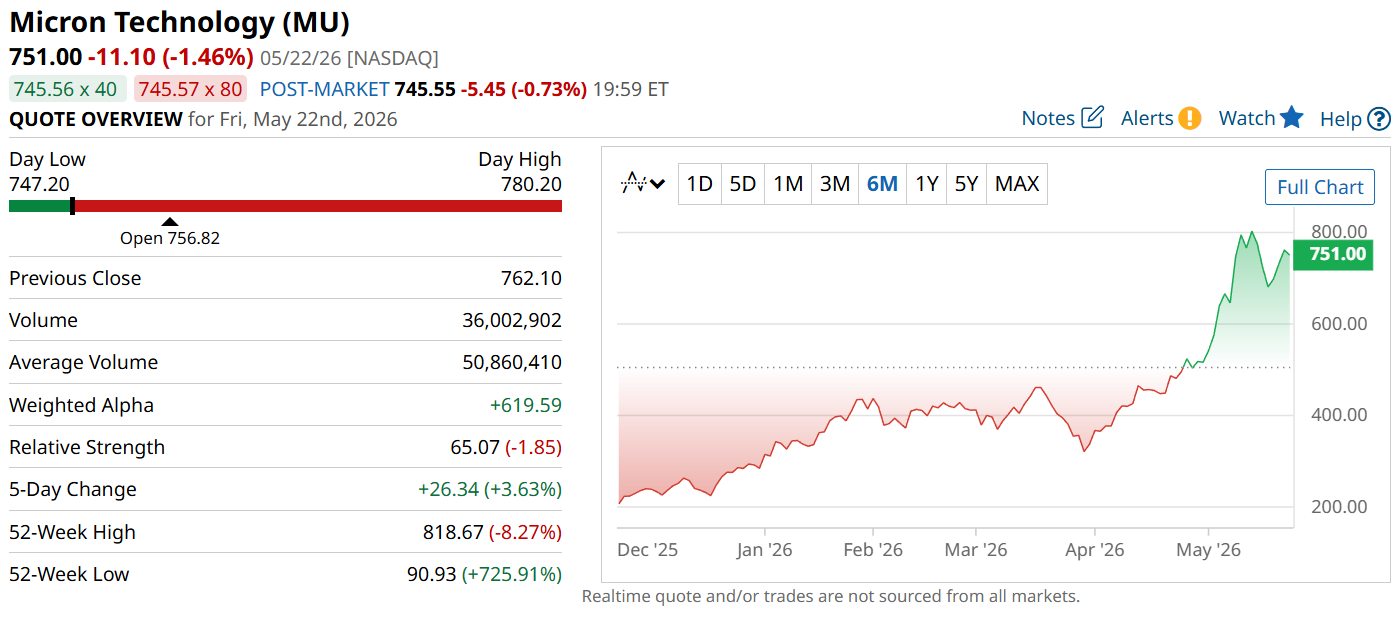
Micron is seeing an extraordinary bull run, driven by massive demand for memory from the AI sector. Trading at $751, the stock is up 726% from its 52-week low, and despite short-term weakness, Wall Street still rates it a Strong Buy.
Now, there are two simple facts here.
One, many investors are bullish on Micron, which means some will be looking for prime entry points likely below its current trading price.
Two, increased trading activity usually leads to higher volatility.
Now, in my experience, the best way to capitalize on this opportunity is to sell a cash-secured put. That higher volatility will likely translate into higher premiums, but it also comes with a higher chance of assignment.
That’s not necessarily a bad thing in itself, but if you’re going for income, then you can turn that cash-secured put assignment into a wheel strategy. Let me show you how.
What is a cash-secured put?
Cash-secured puts are an options trading strategy where you collect premium by selling a put option on a stock. A put option is a contract that gives the buyer the right, but not the obligation, to sell an asset at a set price, on or before the expiration date.
Now, since you’re selling a put, you’re obligated to buy 100 shares of the underlying, per contract, if you do get assigned. This happens when the stock price is below the strike by expiration, and by extension, the put is in the money. When that happens, the buyer exercises the put and sells the shares to you at the strike price.
But if the stock trades above the strike price, the put option expires worthless, and you are now free from any further obligation. You pocket the premium and can do it again.
Keep in mind that for cash-secured puts, you need to have enough cash so that if you do get assigned, you have enough money on hand to buy the stock.
How does the cash-secured put fit into the wheel strategy?
If your cash-secured put gets assigned, you will buy and own 100 shares of the underlying asset- for every contract you sold. Once you have the shares, you can then sell a covered call against them.
A call is the opposite of a put: it gives the buyer the right, but not the obligation, to buy an underlying asset at a specified strike price on or before the expiration date. A covered call involves selling a call option against 100 shares of a stock that you own. If the call is assigned, you sell your shares at the strike price.
And here we have the full wheel in action: sell a cash-secured put, collect the premium as many times as you can, get assigned; sell a covered call, collect the premium, get assigned; repeat. The goal is to earn a premium while buying and selling a quality stock at pre-determined prices.
It’s important to choose an underlying asset that you’d actually want to own because if the stock falls well below your purchase price, you could be left holding shares at a loss, and the premiums collected may not fully offset that decline.
Real-world example: Micron
Speaking of quality stocks, Micron has performed well over the past year. So let’s use that as the underlying asset for this wheel strategy.
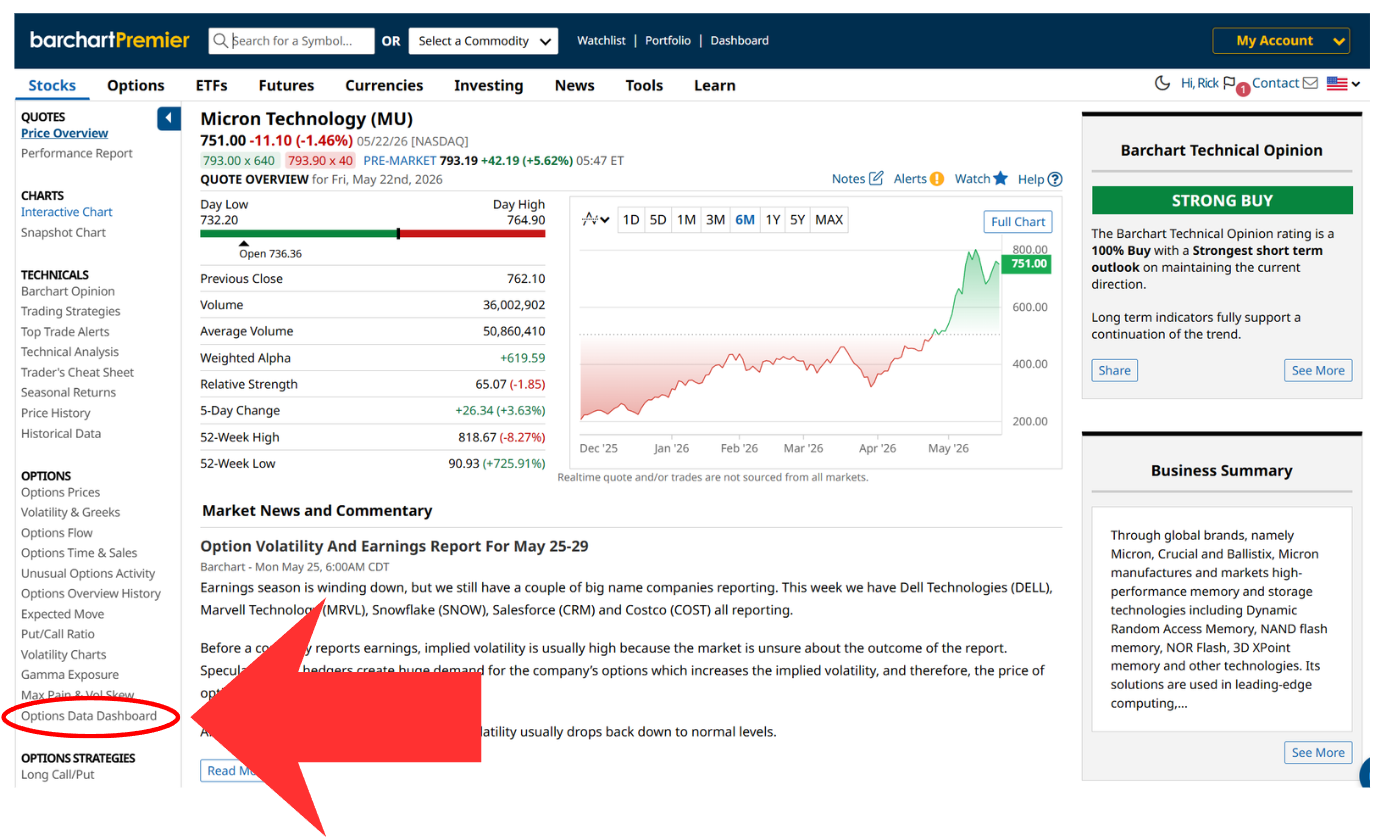
But before we proceed, you can go to the stock profile page, then click the new Options Data Dashboard on the left side of the screen.
This new page gives you a snapshot of the underlying asset’s volatility, trend, expected move, and put/call ratios - basically, everything you need to know before entering any options trade.
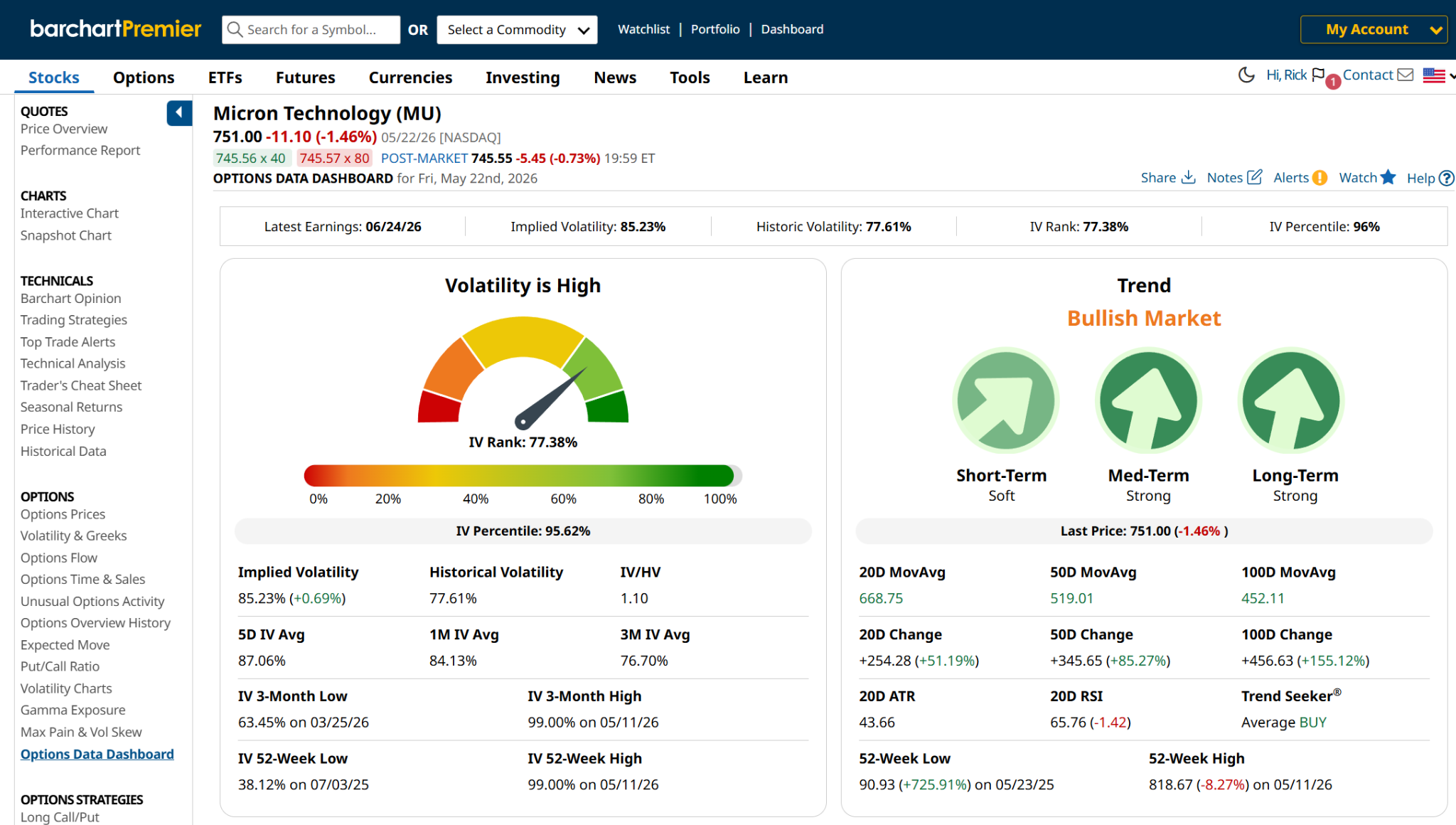
So, the first thing I like to look at is volatility and trend. As you can see, Micron' volatility is high, which means premiums will be higher. It is also bullish on all monitored periods.
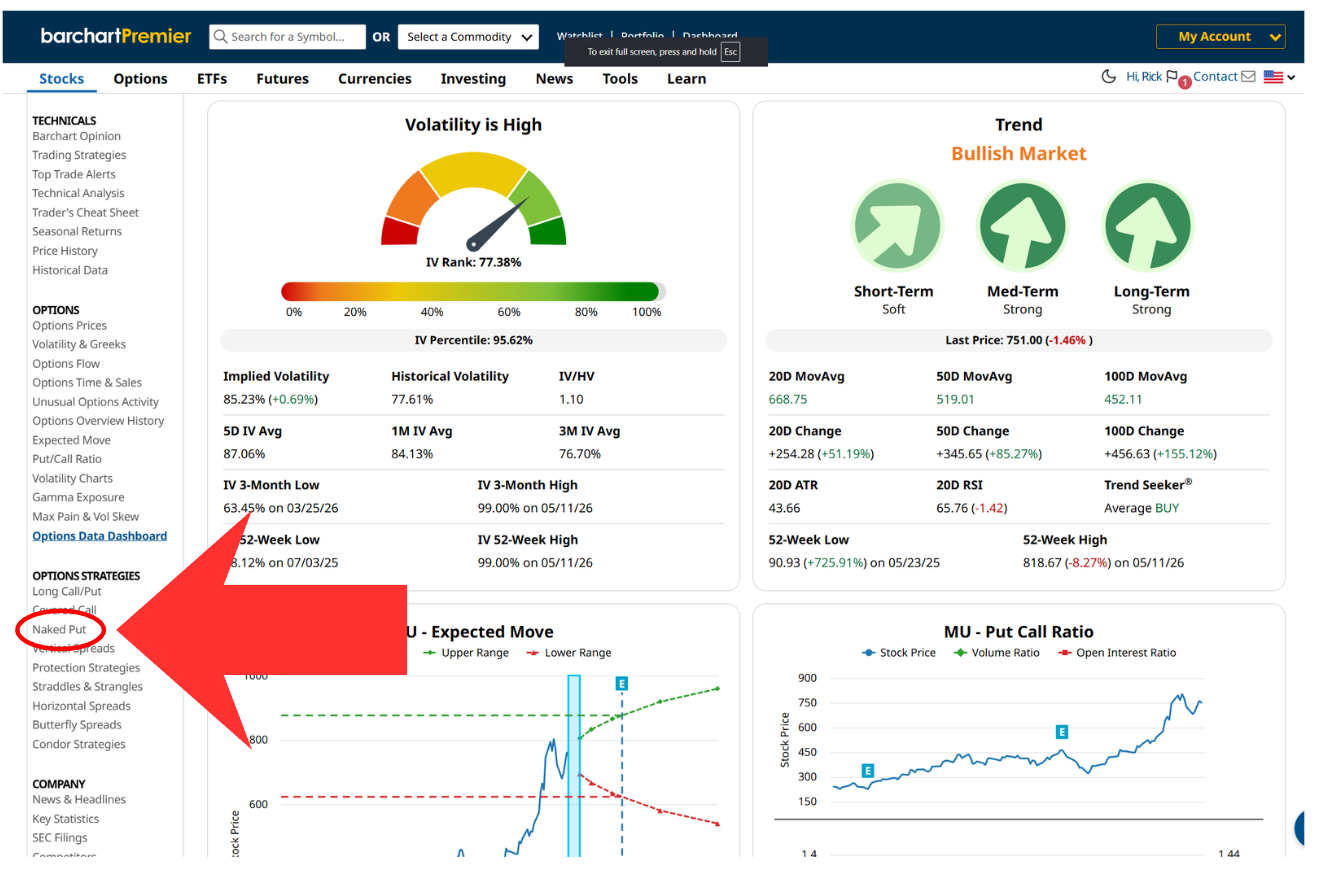
After that, I’ll scroll down and click on the Naked Put screener, which is the same as a cash-secured put screener.
Once there, I’ll change the expiration date to somewhere between the sweet spot of 30 to 45 days. I’ll pick July 2, which is 40 days from now.
Then, I’ll pull up the P/L window to the side, then click Expected Move, which gives us the market’s estimate of how far a stock is likely to move by a specific expiration date
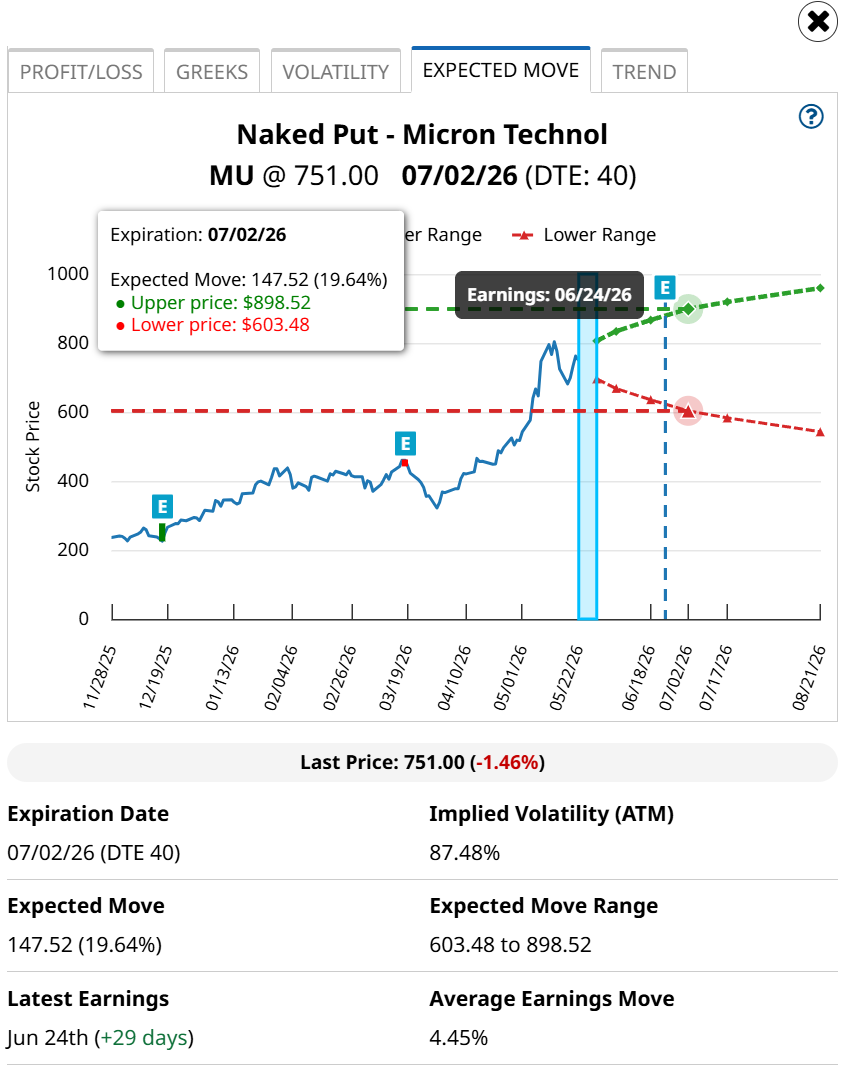
According to Expected Move, Micron is expected to trade as high as $898 and as low as $603 at expiration.
Since you want your cash-secured put to expire out of the money, i.e., for the underlying stock to trade above your strike price, you can set the strike price below the lower end of that expected move range.
In this case, it’s $603, but let’s be safer and say $600.
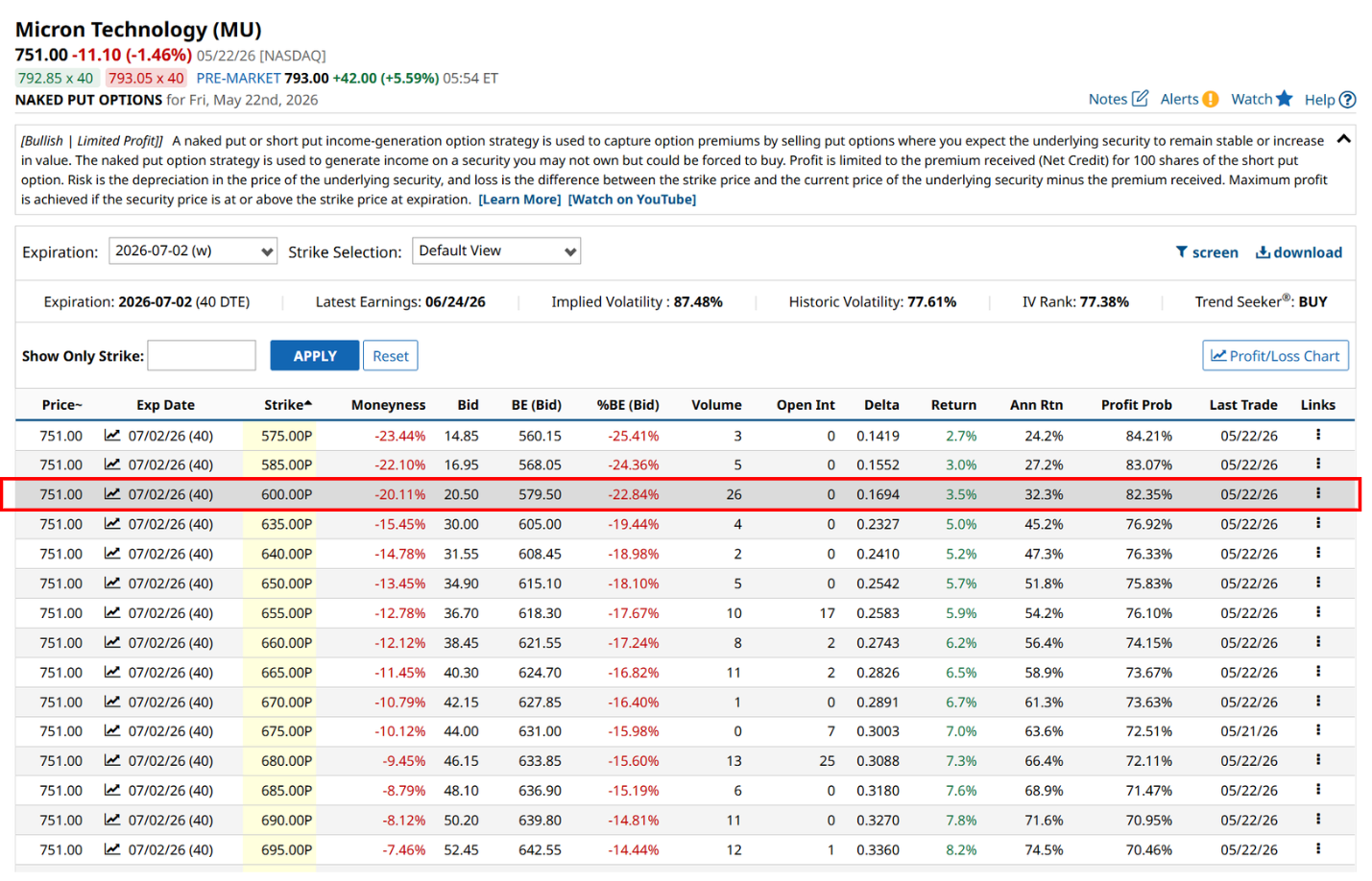
According to the screener, you can sell a 600-strike put on Micron and receive $20.50 per share or $2,050 total per contract, since every options contract is 100 shares. This trade has an 82.35% chance of expiring at a profit, even if it's just 1 cent.
What happens when the option expires?
Fast forward to the expiration date, and the stock trades above or below the $600 put strike.
If Micron stays above the strike price, the option expires worthless, and you are now free to sell another cash-secured put. Again, you can repeat the process as long as you possibly can.
But if Micron trades below $600 at assignment, you'll buy 100 shares for $600 each. Now you own the stock, and you can start the covered call phase.
How will you trade the new covered call?
Now, let’s say that Micron is trading at $590 by expiration, but you bought it at $600 each. This time, you can sell a call against those shares and set the strike price that’s higher than your purchase price. Otherwise, you’ll be selling at a loss if you get assigned.
So, maybe you want at least $20 per share profit on the stock sale, if it happens, so you set your strike price at $620 per share. Let’s say 620-strike covered calls cost $10.50 per share, and the option expires in 30 days.
This brings your total collected premium to $31 per share.
Now, if you don’t get assigned, you can repeat the covered call sale.
If you do get assigned, you sell 100 Micron shares at $620, then start the whole process all over again
| Trade | Per Share | Per Contract |
| Cash-secured put premium | $20.50 | $2,050 |
| Covered call premium | $10.50 | $1,050 |
| Stock sale profit, bought at $600 and sold at $620 | $20.00 | $2,000 |
| Total profit | $51.00 | $5,100 |
And if we tally up everything in this scenario - premium received and stock sale included - you get $5,100 in total profit.
Final Thoughts
Of course, this example is simplified. Stock prices don't move in straight lines, implied volatility changes constantly, and there is always the possibility that Micron falls far below your strike price after assignment. Still, when volatility is elevated and you have a bullish long-term outlook, the wheel can be an effective way to generate income while potentially entering positions at lower prices than where the stock is currently trading.
On the date of publication, Rick Orford did not have (either directly or indirectly) positions in any of the securities mentioned in this article. All information and data in this article is solely for informational purposes. For more information please view the Barchart Disclosure Policy here.
More news from Barchart
- Institutional Investors Love Ford Stock - Buying Huge, Unusual Volume of Long-Term Call Options
- How to Trade Lockheed Martin Stock Now Amid Escalating U.S.-Iran Tensions
- Micron Stock Is Up 726%. This Options Strategy Pays You to Buy the Dip
- Lowe's Delivers Strong Free Cash Flow, But the Stock Fell - Time to Buy LOW?