There is a moment every growing consumer brand dreads. Orders start pouring in faster than ever, the sales team is celebrating, and then — the production line grinds to a halt. A team of four people filling bottles by hand simply cannot keep up with what the market is now demanding. Products ship late. Fill volumes are inconsistent. Customers complain. And a brand that spent years building its reputation suddenly finds itself fighting fires instead of fulfilling orders.
This is not a rare story. It plays out in food and beverage companies, cosmetics brands, pharmaceutical producers, cleaning product manufacturers, and personal care labels every single day. The difference between brands that break through this ceiling and those that stay stuck behind it often comes down to one decision: investing in the right liquid filling machine.
1. The Demand Problem No One Warns You About
Scaling a consumer brand is deceptively difficult. The moment a product takes off lands a major retail listing, goes viral on social media, or wins a contract with a large distributor the entire operation is stress-tested overnight.
Why Volume Alone Is Not the Problem
The challenge is not just volume. It is consistency. When customers pick up a bottle of sauce, a tube of lotion, or a supplement, they expect it to be filled to exactly the same level every single time. They expect the packaging to look professional and the product to be safe, sealed, and free from contamination. Manual filling cannot guarantee any of that at scale, no matter how careful or experienced the team is.
What the Market Data Tells Us
The numbers confirm the shift. The global liquid filling machine market is now valued at over $5.55 billion in 2025 and is forecast to reach $7.19 billion by 2030. Brands across every consumer category are waking up to the fact that automation is not a luxury reserved for large corporations. It is a survival tool for any business serious about growth.
2. What a Liquid Filling Machine Actually Does
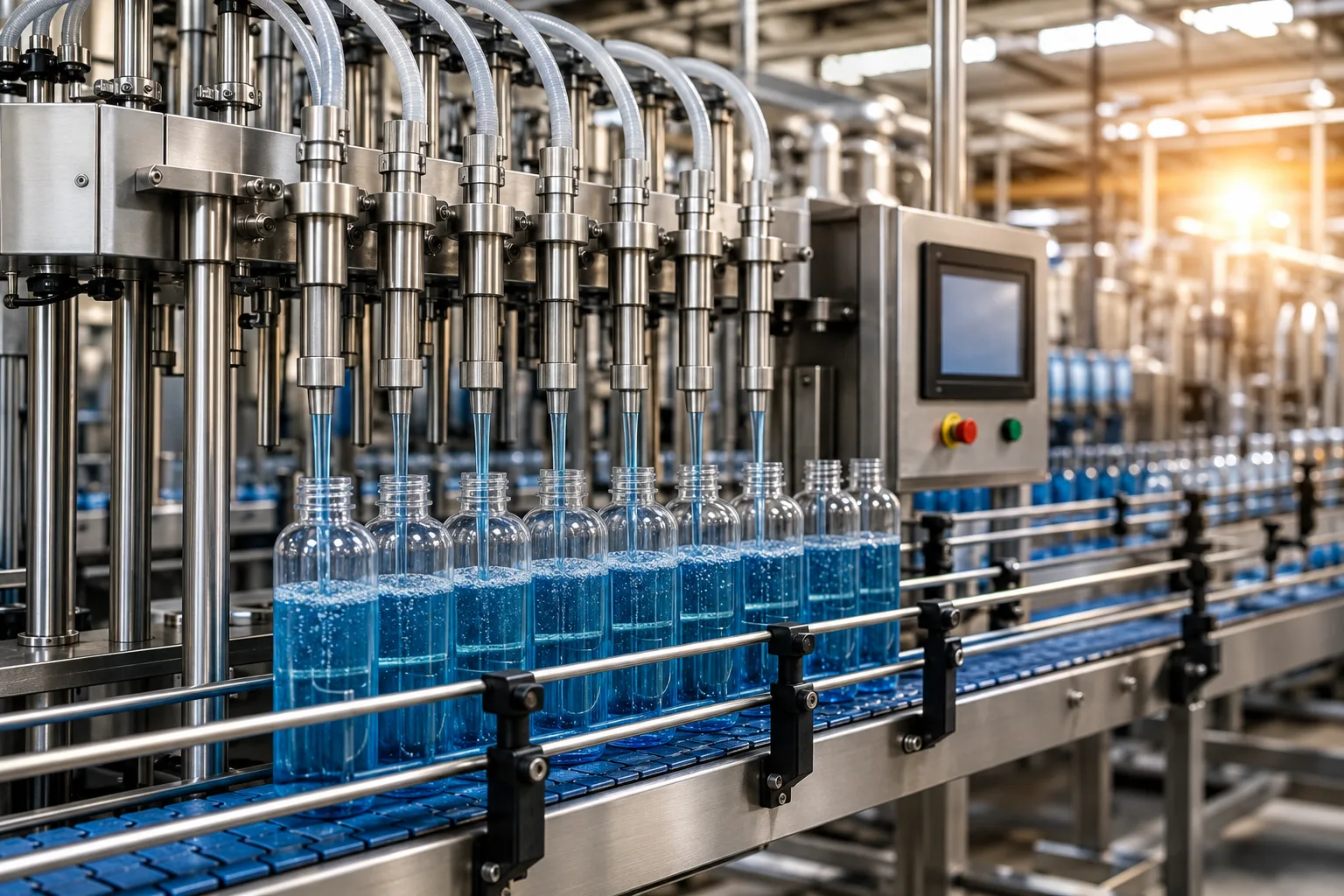
At its core, a liquid filling machine dispenses a precise, repeatable volume of liquid into a container every single time, at speed, without human error. But within that simple description lies considerable sophistication.
The Four Main Filling Technologies
Modern machines use different technologies depending on the product being filled:
- Piston fillers are ideal for thick, viscous products such as creams, sauces, gels, and pastes
- Gravity fillers work perfectly for free-flowing liquids like water, spirits, and juices
- Overflow fillers are used for products like shampoos and cleaning liquids where a consistent visual fill level matters for retail presentation
- Pump fillers offer the most versatility, handling everything from thin liquids to medium-viscosity products across multiple industries
Matching the Machine to the Application
The right machine matches not just the product viscosity, but the container type, required fill volume, production speed, and compliance standards of the industry. A pharmaceutical brand filling vials has entirely different requirements from a craft gin distillery filling 700ml bottles. Choosing the right machine for the right application is what separates a smooth-running production line from a costly mistake.
3. How Smart Brands Are Using Automation to Stay Ahead
The most competitive consumer brands in food, beverage, cosmetics, and personal care are not waiting until their manual operations fail before they automate. They are getting ahead of demand and using that head start to lock in retail contracts, meet compliance requirements, and protect their reputation before it comes under pressure.
Speed and Accuracy at Scale
A fully automatic liquid filling machine can fill hundreds of containers per minute with sub-millilitre accuracy. It does not get tired, does not have an off day, and does not introduce the contamination risk that comes with constant manual handling. For brands in regulated industries like pharmaceuticals or food, this level of precision is not optional; it is a legal requirement.
Flexibility Across Products and Containers
Beyond accuracy, modern machines are built for flexibility. Multi-head fillers allow a single machine to fill multiple containers simultaneously. Adjustable volume settings mean one machine can handle a 100ml travel-size bottle and a 5-litre bulk container within the same production run. PLC-controlled systems with touchscreen interfaces make changeovers fast, reducing the downtime that kills throughput on high-volume production days.
4. The Real Cost of Staying Manual
Many brands delay the move to automated filling because the upfront investment feels daunting. But the real cost of staying manual is almost always higher than the cost of automating, it is just less visible on a balance sheet.
Hidden Costs That Add Up Fast
Manual filling is slow. It relies on human consistency that cannot be sustained across a full shift. It creates spillage, waste, and measurable product loss every single day. It requires more staff to produce the same output, driving up labour costs month after month. And critically, it creates liability inconsistent fills in regulated categories like food and pharmaceuticals can trigger compliance failures, product recalls, and brand damage that takes years to recover from.
Calculating the Real ROI
When you account for the cost of product waste, additional labour, delayed orders, and the reputational cost of inconsistent quality, the return on investment for a liquid filling machine becomes not just clear, it becomes urgent. Most businesses that make the switch report recovering their investment within the first year of operation.
5. Flexible Purchase Options for Every Stage of Growth
One of the barriers that has historically kept smaller brands away from automated filling is the assumption that purchasing a machine requires a massive capital outlay with no flexibility. That assumption is no longer accurate.
How Packserv Makes Automation Accessible
Packserv, one of the most trusted names in packaging machinery, has built its entire business model around removing that barrier. Packserv offers businesses the flexibility to buy, rent, rent-to-buy, or finance their machinery — meaning a brand at any stage of growth can access professional-grade automation without draining its working capital.
Rent-to-Buy, Trade-In, and Buy for Life
The rent-to-buy model in particular has become popular with fast-scaling brands that want to test a machine in their real production environment before committing to full ownership. Packserv also offers a guaranteed trade-in program and a unique Buy for Life option, giving manufacturers long-term confidence in their investment rather than locking them into equipment they may outgrow. With machines designed and manufactured in-house and technical support teams across multiple locations, Packserv ensures every machine keeps running when it matters most.
6. Maintaining Product Integrity at Scale
As production volumes increase, so does the pressure on product integrity. A single contaminated batch, an incorrect fill weight, or a labelling error at scale can affect thousands of units rather than dozens. The financial and reputational consequences are exponentially larger.
Engineering Quality That Protects the Product
This is where the build quality of the machine matters enormously. High-grade stainless steel contact parts, food-safe and pharmaceutical-grade materials, no-drip nozzle technology, and bottom-up fill options for foaming products are not just features — they are the difference between a brand that consistently delivers and one that consistently apologises.
Precision, Hygiene, and Repeatability
The best liquid filling machines are engineered to protect the product just as much as they are designed to move it efficiently. Precision, hygiene, and repeatability are built into the design at every level, because for the brands that rely on them, there is simply no margin for error.
7. The Competitive Advantage Nobody Talks About
There is a less obvious benefit to automated liquid filling that rarely gets discussed: the commercial credibility it gives a brand when pitching to major retailers, distributors, and contract partners.
Meeting Retailer and Distributor Standards
Supermarket chains, online marketplaces, and large-scale distributors have strict supplier requirements. Fill accuracy, labelling compliance, batch traceability, and consistent presentation are all assessed before a listing is approved. Brands that can demonstrate a fully automated, controlled production process immediately earn greater credibility at the negotiating table.
Automation as a Commercial Credential
An automated packaging line is not just an operational asset — it is a commercial credential. It signals to every partner, buyer, and investor that the brand is built to scale, built to last, and built to deliver without compromise.
8. The Bottom Line
The brands winning in today’s consumer market are not necessarily the ones with the best product formulas. They are the ones that can manufacture reliably, fill accurately, pack consistently, and ship on time — every single time, at whatever volume the market demands.
Explosive Demand Is an Opportunity, Not a Threat
With the right equipment in place, explosive demand is not a problem to fear. It is the opportunity every brand has been building toward. The question is simply whether the production line is ready to meet it or whether it will be the reason a brand cannot capitalise on its own success.
Start With the Right Machine
For consumer brands ready to make that leap, the journey starts with understanding which liquid filling machine is right for the product, the container, and the growth stage the business is in. The right choice today is the foundation of everything the brand builds tomorrow.