Note: This article reflects market conditions and data as of April 9, 2026.
Introduction
Intel Corporation (NASDAQ: INTC) stands today at the most critical juncture in its 58-year history. After a tumultuous period between 2022 and 2024 that saw the Silicon Valley icon lose nearly two-thirds of its market value, the "Blue Giant" has emerged in 2026 as a leaner, split-entity powerhouse. The narrative has shifted from one of existential crisis to a story of a dual-track recovery: the high-stakes gamble on Intel Foundry and the aggressive capture of the AI PC market.
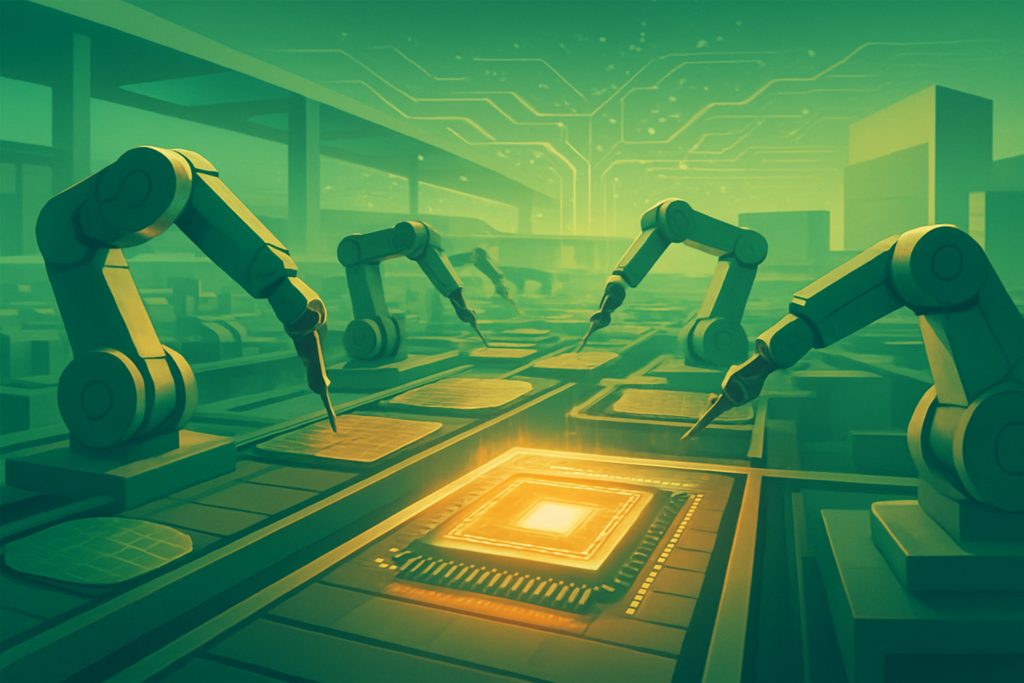
Once the undisputed king of semiconductors, Intel spent the last decade fighting off a revitalized AMD and the manufacturing prowess of TSMC. Today, the focus is squarely on its "18A" (1.8nm) process node—the technological linchpin that promises to restore Intel’s transistor leadership—and its dominant 56% share in the burgeoning AI PC segment. As investors look toward the second half of 2026, the question is no longer whether Intel can survive, but how high its new ceiling can reach.
Historical Background
Founded in 1968 by Robert Noyce and Gordon Moore, Intel was the architect of the microprocessor revolution. From the 4004 to the ubiquitous x86 architecture, the company defined personal computing for decades. Under Andy Grove, Intel’s "Only the Paranoid Survive" mantra led it to a dominant position in the 1990s and early 2000s.
However, the 2010s were marked by complacency. Intel missed the mobile revolution, lost its manufacturing edge to Taiwan Semiconductor Manufacturing Co. (NYSE: TSM), and saw its data center monopoly challenged by Nvidia (NASDAQ: NVDA). By 2021, when Pat Gelsinger returned as CEO, the company was lagging by multiple process nodes. Gelsinger’s "IDM 2.0" strategy was a radical plan to open Intel’s factories to outsiders, effectively competing with TSMC while simultaneously designing its own chips. The bridge to today’s 2026 reality was built on the "five nodes in four years" (5N4Y) roadmap, a feat many analysts initially deemed impossible.
Business Model
Intel’s business model in 2026 is structurally different than it was two years ago. The company now operates via two distinct, reporting-independent arms:
- Intel Products: This remains the primary revenue driver, comprising the Client Computing Group (CCG), Data Center and AI (DCAI), and Network and Edge (NEX). CCG focuses on the "AI PC" ecosystem, while DCAI competes in the server and AI accelerator space.
- Intel Foundry: This is the manufacturing "shop" that builds chips for both Intel Products and external "fabless" customers like Microsoft and Amazon. By separating the P&L for the foundry, Intel has sought to gain the trust of competitors who might otherwise hesitate to have their designs manufactured by a rival.
This "Foundry First" model allows Intel to maximize fab utilization and participate in the AI infrastructure boom even when its own chip designs are not the primary choice.
Stock Performance Overview
Intel’s stock performance over the last decade is a tale of two halves.
- 10-Year View: On a 10-year horizon, INTC has significantly underperformed the PHLX Semiconductor Index (SOX). While the index surged on the back of the AI revolution, Intel traded in a wide, volatile range, eventually crashing to a multi-decade low of roughly $17 in late 2024.
- 5-Year View: The 5-year chart shows a "U-shaped" recovery. The 2021–2024 period was a painful decline as the company's dividend was suspended and capital expenditures ballooned.
- 1-Year View: The last 12 months have been a period of redemption. From April 2025 to April 2026, INTC shares have rallied approximately 85%, climbing from the low $20s to current levels near $46. This rally was fueled by the successful HVM (High Volume Manufacturing) of the 18A node and a massive $15 billion foundry backlog.
Financial Performance
Intel’s latest financials reflect the "cost of catching up."
- Revenue: For FY 2025, Intel reported revenue of $52.9 billion. While flat year-over-year, the internal mix shifted significantly toward higher-margin AI PC chips and foundry services.
- Profitability: After a staggering $18.8 billion loss in 2024 (largely due to write-downs and restructuring), Intel reached near-breakeven in 2025. Q1 2026 guidance suggests a return to consistent non-GAAP profitability.
- Margins: Gross margins remain the primary concern for analysts, hovering around 35%. The high depreciation of new EUV (Extreme Ultraviolet) lithography equipment and the ramp-up costs of the 1.8nm node are keeping margins compressed relative to Intel's historical 60% peak.
- Balance Sheet: With a heavy debt load, Intel has leaned on CHIPS Act funding and private equity partnerships (like the Brookfield and Apollo deals) to fund its multi-billion dollar "Silicon Heartland" fabs in Ohio and Arizona.
Leadership and Management
The current leadership reflects a shift from visionary architectural planning to brutal operational execution. Following Pat Gelsinger’s retirement in late 2024, Lip-Bu Tan—the former CEO of Cadence Design Systems—took the helm as CEO in March 2025.
Tan has been credited with "right-sizing" the ship. His tenure has focused on:
- Financial Discipline: Terminating non-core projects and reducing headcount by 15,000 to save $10 billion annually.
- Foundry Independence: Hardening the "Chinese Wall" between the design and manufacturing teams to attract external foundry customers.
- Customer-Centricity: Bringing a "fabless mentality" to the manufacturing side, ensuring that Intel Foundry treats external clients with the same priority as internal ones.
Products, Services, and Innovations
Intel's 2026 product portfolio is defined by the AI PC and 18A Fabrication.
- Panther Lake: Launched in early 2026, this is the first consumer processor built on the 18A node. It features a next-generation NPU (Neural Processing Unit) capable of over 180 TOPS (Trillions of Operations Per Second), positioning Intel to lead the "Local AI" revolution where LLMs run directly on laptops rather than the cloud.
- Clearwater Forest: The 18A-based server CPU designed for massive efficiency in data centers, utilizing Intel’s Foveros Direct 3D packaging.
- Intel 18A Node: This is Intel's "holy grail." It introduces PowerVia (backside power delivery) and RibbonFET (Gate-All-Around) transistors. PowerVia, in particular, is a technology where Intel currently leads TSMC, allowing for more efficient power routing and higher clock speeds.
Competitive Landscape
Intel faces a three-front war:
- Manufacturing: TSMC remains the "gold standard." While Intel's 18A is technically competitive with TSMC’s 2nm (N2), TSMC enjoys a more mature ecosystem and higher yields (~80% vs Intel’s estimated 65-75%).
- AI Data Center: Nvidia and Broadcom (NASDAQ: AVGO) dominate the AI accelerator and networking space. Intel’s Gaudi 3 and subsequent Falcon Shores chips are "value" alternatives but have yet to dethrone the H100/B200 hegemony.
- Client Computing: AMD (NASDAQ: AMD) continues to take share in high-end gaming and server, while Qualcomm (NASDAQ: QCOM) and Apple (NASDAQ: AAPL) lead in battery efficiency with ARM-based architectures. However, Intel’s "Lunar Lake" and "Panther Lake" have significantly closed the efficiency gap.
Industry and Market Trends
The semiconductor industry is currently defined by Sovereign AI and Edge Computing. Nations are subsidizing local chip production to ensure supply chain resilience, a trend that directly benefits Intel’s massive U.S. and European footprint.
Furthermore, the "AI PC" is the biggest hardware refresh cycle since the early internet era. By 2026, an estimated 60% of all new PCs shipped are "AI-capable." Intel’s scale—producing millions of chips—gives it a "volume advantage" that smaller rivals struggle to match, as software developers (ISVs) prioritize optimizing their AI tools for Intel hardware.
Risks and Challenges
The "New Intel" is not without significant risk:
- Execution Risk: Any delay in the 18A ramp or a significant yield issue would be catastrophic, as the company has no "Plan B."
- Capital Intensity: Intel is spending $25B+ per year on CAPEX. If the foundry business doesn't secure enough "anchor" customers beyond Microsoft and AWS, the cost of maintaining these empty fabs could lead to further financial distress.
- Margin Erosion: As Intel transitions to a foundry model, it may never see its 60% gross margins again. A "foundry" margin of 30-40% might be the new reality, necessitating a complete re-valuation of the stock by Wall Street.
Opportunities and Catalysts
- Foundry Customer Wins: Rumors of a Broadcom or MediaTek volume commitment for 18A in late 2026 could serve as a major stock catalyst.
- Altera IPO: The full divestment/IPO of the Altera FPGA unit provides a potential cash infusion to shore up the balance sheet.
- Windows 12/AI Refresh: A major OS update optimized for NPUs could accelerate the PC replacement cycle, benefiting Intel's Client Computing Group.
Investor Sentiment and Analyst Coverage
Sentiment has shifted from "Distressed" to "Show Me."
- Institutional Moves: Hedge funds that specialized in turnarounds began rotating back into INTC in mid-2025. Institutional ownership has stabilized after a flight to quality in 2024.
- Wall Street Consensus: The majority of analysts hold a "Buy" or "Strong Hold" rating. The average price target of $52 implies a modest 13% upside from current levels, reflecting a cautious optimism that the worst is over, but the full reward is still years away.
Regulatory, Policy, and Geopolitical Factors
Intel is the primary beneficiary of the U.S. CHIPS and Science Act. With nearly $20 billion in total incentives (grants and loans), the U.S. government has effectively "backstopped" Intel’s failure. Geopolitically, as tensions remain high in the Taiwan Strait, Intel serves as the world’s "Western Foundry" insurance policy. This "geographic alpha" is a major selling point for U.S. and European defense and government agencies who require domestic chip sourcing.
Conclusion
Intel in April 2026 is a company that has successfully stared into the abyss and stepped back. Under the operational rigors of Lip-Bu Tan and the technological foundations laid by the 5N4Y strategy, Intel has returned to the manufacturing "conversation."
The "turnaround" is no longer a promise; it is visible in the 18A silicon now shipping in Panther Lake laptops and Microsoft’s AI servers. However, for investors, Intel is a marathon, not a sprint. The company is trading at a premium to its recent lows but still carries the baggage of high capital costs and fierce competition. Watch the 18A yield rates and the Q3 foundry revenue—these will be the true indicators of whether Intel’s return to glory is a permanent fixture or a temporary reprieve.
This content is intended for informational purposes only and is not financial advice.