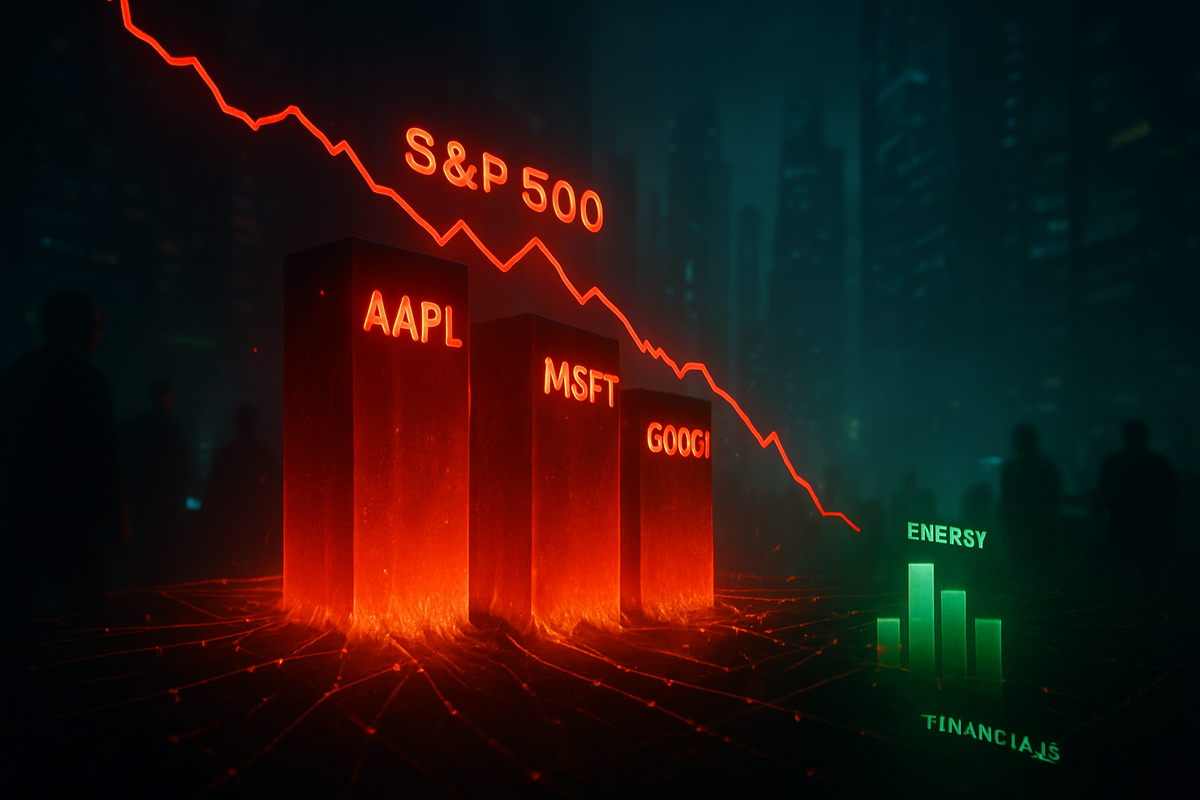
As the curtain closes on 2025, the U.S. stock market finds itself in a paradoxical position. While the S&P 500 is poised to finish the year with a robust gain of approximately 17%, the final weeks of December have been defined by a persistent downward pressure. This late-year slide is not a reflection of broad economic weakness, but rather a consequence of the "tech-led drag"—a phenomenon where a handful of trillion-dollar giants are disproportionately pulling the major indices lower even as the rest of the market shows resilience.
On this December 29, 2025, the S&P 500 sits near the 6,897 mark, retreating from its mid-month peak of 6,952.84. The retreat has been catalyzed by a sharp rotation out of the "Magnificent Seven" stocks, which now command a staggering 37% weight in the index. When these titans stumble, the impact is seismic; a 2% drop in a company like Nvidia Corp. (NASDAQ: NVDA) now carries more weight than the combined gains of hundreds of smaller companies, creating a "concentration crisis" that has left index investors vulnerable to localized volatility in the technology sector.
The Cracks in the AI Foundation
The current market malaise can be traced back to a series of mid-December shocks that shattered the "AI-at-any-price" narrative. The most significant blow came from Oracle Corp. (NYSE: ORCL), which saw its shares crater by 10% in a single session—wiping out $69 billion in market value—after its massive $10 billion Michigan data center project stalled. The withdrawal of a key financial backer, Blue Owl Capital (NYSE: OWL), signaled to the market that the bottomless pit of capital for AI infrastructure might finally be reaching its limit. This "seismic shock" was followed by a disappointing earnings report from Broadcom Inc. (NASDAQ: AVGO), which fell 11.4% in mid-December, further chilling sentiment across the semiconductor space.
The timeline of this downturn began in earnest during the fourth quarter, as "AI fatigue" transitioned from a theoretical concern into a tangible market force. Earlier in the year, the emergence of DeepSeek, a Chinese startup that demonstrated high-efficiency model training at a fraction of the cost of U.S. competitors, had already planted seeds of doubt regarding the long-term ROI of massive capital expenditures. By late December, these doubts coalesced into a "show-me-the-money" ultimatum from institutional investors. Nvidia, which had reached a historic $5 trillion market cap in October, has since pulled back to the $4.2 trillion range as "bubble anxiety" takes hold, dragging the cap-weighted S&P 500 down with it.
Winners of the Rotation and Losers of the Concentration
The primary losers in this current environment are the concentrated mega-cap funds and passive index trackers. Beyond Nvidia and Oracle, Tesla Inc. (NASDAQ: TSLA) has been a significant laggard, dropping 3.3% in the final week of the year as the EV market faces saturation and pricing pressures. Microsoft Corp. (NASDAQ: MSFT) and Apple Inc. (NASDAQ: AAPL) have also shown signs of "technical fatigue," with Microsoft struggling against a "double top" chart pattern and Apple viewed as losing its defensive luster due to slower-than-expected AI monetization compared to Alphabet Inc. (NASDAQ: GOOGL).
Conversely, the "Great Rotation" has created a new class of winners. As capital flees the overextended tech sector, it has found a home in "real-world" earnings. The S&P 500 Energy sector has surged, gaining roughly 13% in December alone, while Utilities and Financials have also seen significant inflows. Companies in the S&P 500 Equal Weight Index—which gives the same weight to a small utility company as it does to a tech giant—have actually outperformed the standard market-cap-weighted index during this period. This divergence highlights that while the "index" looks weak, the broader economy and many of its constituent companies remain on solid footing.
Broader Significance and Historical Precedents
The current market structure is a stark reminder of the risks inherent in extreme concentration. With the top five companies—Nvidia, Microsoft, Apple, Alphabet, and Amazon.com Inc. (NASDAQ: AMZN)—accounting for over 28% of the S&P 500, the index has become a proxy for a single industry. Analysts like Matt Maley, Chief Market Strategist at Miller Tabak + Co, have noted that 2025 is ending with a "whimper" for those hiding in mega-cap tech, even as the rest of the market thrives. This reminds many of the late-cycle behavior seen in the late 1990s, though today’s giants are backed by significantly more cash flow than their dot-com predecessors.
The regulatory and macro environment has added fuel to the fire. Ongoing trade tensions and selectively applied tariffs on global supply chains—specifically targeting the chips and electronics vital to Silicon Valley—have added a permanent "risk premium" to tech valuations. Furthermore, the 43-day government shutdown that ended in November left investors "flying blind" during the crucial holiday quarter, causing a pivot toward defensive, stable-earnings sectors over speculative growth stories that require precise economic data to justify their high multiples.
The Road to 2026: Strategic Pivots Ahead
Looking forward, the tech sector is facing a period of forced adaptation. The "AI infrastructure" trade is likely to shift toward "AI application" and efficiency. Companies will need to prove that their multi-billion dollar investments in GPUs and data centers can translate into bottom-line growth. In the short term, we may see a continued "window dressing" period where fund managers trim their tech holdings to lock in 2025 gains and rebalance into undervalued cyclical sectors like Industrials and Materials.
The Federal Reserve's recent 25-basis-point rate cut to the 3.5%–3.75% range has also sent a mixed signal. While lower rates typically favor growth stocks, the Fed’s cautious outlook for 2026 has prompted investors to favor "bond proxies" like Utilities. For the tech giants to regain their momentum, they will likely need to deliver "beat-and-raise" earnings reports in the first quarter of 2026 that specifically address the ROI concerns currently haunting the sector.
A Market in Transition
The end of 2025 marks a turning point for the modern market. The era of tech-driven "easy gains" for index investors is being challenged by the sheer weight of these companies' own success. The key takeaway for the final days of the year is that the S&P 500's performance is no longer a broad barometer of economic health, but rather a reflection of the sentiment surrounding a few dozen high-growth stocks.
As we move into 2026, investors should keep a close eye on the "S&P 493." If the broader market can continue its upward trajectory while the tech giants consolidate, it would signal a healthy, more sustainable market environment. However, if the "tech-led drag" intensifies, it could lead to a deeper correction that tests the resolve of passive investors. For now, the "Great Rotation" remains the dominant story, as the market seeks a more balanced and less concentrated path forward.
This content is intended for informational purposes only and is not financial advice