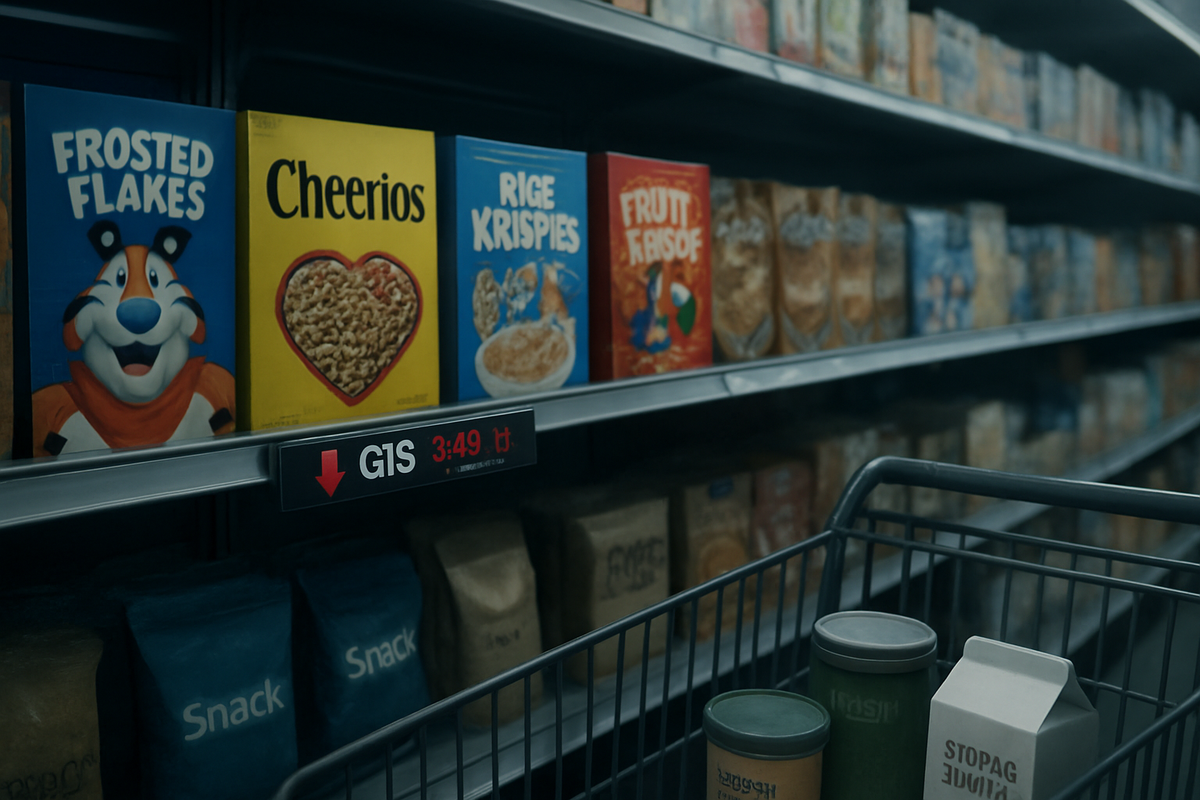
As the first week of 2026 unfolds, a chill has settled over the packaged food industry that has nothing to do with the winter weather. On January 5, 2026, shares of General Mills (NYSE: GIS) plummeted to a new 52-week low of $45.14, marking a staggering 26.5% decline over the previous twelve months. For a company long considered a "widow-and-orphan" stock—a safe haven for conservative investors—this collapse signals a profound shift in how Americans eat and how Wall Street values the companies that feed them.
The immediate implications are stark: the consumer staples sector, once the bedrock of defensive portfolios, is no longer the safe harbor it used to be. General Mills’ descent is not an isolated incident but a bellwether for a sector struggling to adapt to a "K-shaped" consumer recovery, the disruptive influence of weight-loss medications, and a resurgence of store-brand dominance. As investors flee traditional food giants, the question is no longer when these stocks will bottom out, but whether their fundamental business models can survive a decade of rapid biological and economic change.
The Descent to $45: A Timeline of Disruption
The slide to the 52-week low was precipitated by a series of strategic pivots and macroeconomic headwinds that came to a head in late 2025. In its Q2 fiscal 2026 earnings report, released on December 17, 2025, General Mills (NYSE: GIS) reported a 7% drop in net sales to $4.9 billion. While the company managed to beat earnings-per-share estimates—posting $1.10 against a $1.02 forecast—the "beat" was largely attributed to aggressive cost-cutting and the divestiture of its North American yogurt business rather than organic growth.
The timeline of this decline began in mid-2025, as "sticky" inflation, hovering between 3% and 4%, finally broke the consumer’s willingness to accept price hikes. For years, General Mills and its peers used inflation as a cover to raise prices, but by the third quarter of 2025, volume growth turned sharply negative. The situation was further complicated in late 2025 by the implementation of new import tariffs, which added an estimated 3% to the cost of goods sold (COGS). This forced General Mills into a difficult "resharing" initiative to move production back to the U.S., a move that protected the supply chain but hammered short-term margins.
Key stakeholders, including CEO Jeff Harmening, have attempted to soothe investors by pointing to the company's "Remarkable Experience" initiative—a focus on brand innovation. However, the market’s reaction has been one of skepticism. Institutional investors have increasingly rotated capital out of traditional staples and into high-growth tech or specialized healthcare, leaving GIS to trade at multiples not seen since the pre-pandemic era.
Winners and Losers in the New Pantry War
In this shifting landscape, the traditional hierarchy of the grocery aisle is being dismantled. The clear winners in early 2026 are the mega-retailers who have mastered the "private label revolution." Walmart Inc. (NYSE: WMT), The Kroger Co. (NYSE: KR), and Aldi have seen their store brands capture over 21% of the U.S. market. These retailers are no longer just offering "budget" alternatives; they are using AI-driven consumer insights to launch premium private labels that rival General Mills in quality while undercutting them on price.
Conversely, the "losers" are the legacy conglomerates that failed to diversify quickly enough. The Kraft Heinz Company (NASDAQ: KHC) continues to face bearish sentiment, with a consensus "Reduce" rating from analysts as it prepares for a massive corporate split scheduled for the second half of 2026. Meanwhile, Conagra Brands, Inc. (NYSE: CAG) is struggling with extreme price elasticity; its iconic brands like Duncan Hines have seen dramatic volume drops as consumers switch to lower-cost baking alternatives or forgo the category entirely.
One notable exception in the sector is Kellanova (NYSE: K), which was acquired by Mars, Inc. in late 2025 for approximately $36 billion. By integrating into the private Mars empire, Kellanova’s brands have been shielded from the public market’s volatility, trading near all-time highs before the deal closed. This has led to speculation that General Mills itself could eventually become a target for private equity or a larger global conglomerate looking to buy iconic American brands at a discount.
The Sensory Shift: GLP-1s and the Macro Picture
The broader significance of General Mills’ 52-week low lies in a factor that was barely on the radar three years ago: the "GLP-1 Sensory Shift." By January 2026, an estimated 1 in 10 Americans are using GLP-1 medications like Ozempic or Wegovy. Recent medical studies have confirmed that these drugs do more than just suppress appetite; they cause a "sensory shift" where users report a dulled taste for sweetness and an increased sensitivity to artificial smells.
This has created a crisis for companies like General Mills, whose portfolio is heavily weighted toward sugary cereals and processed snacks. The industry is now racing to reformulate products for "sensory payoff" rather than just high caloric density. This fits into a broader trend of "functional eating," where consumers demand that every calorie provide a specific health benefit.
Furthermore, the 2026 market is grappling with the "K-shaped" recovery. While high-income households continue to spend, the middle and lower-income tiers—General Mills' core demographic—are under immense pressure. The historical precedent of consumer staples being "recession-proof" is being tested; in 2026, consumers aren't just switching to cheaper brands, they are fundamentally changing their caloric intake, a move that could have permanent ripple effects on the entire food supply chain.
What Comes Next: Pet Food and Strategic Pivots
Looking ahead to the remainder of 2026, General Mills is betting its future on a different kind of consumer: the four-legged variety. A key catalyst for the company is the national expansion of Blue Buffalo into the "fresh" pet food category. As humans eat less, they are spending more on "human-grade" food for their pets, a high-growth segment that General Mills hopes will offset the decline in its cereal and snack divisions.
In the short term, investors should expect continued volatility as the company navigates the integration of its domestic manufacturing shifts. A strategic pivot toward "miniaturization"—smaller packaging sizes designed for GLP-1 users who eat less per sitting—is also expected to roll out by mid-2026. If General Mills can successfully transition from a volume-based business to a value-added, health-conscious enterprise, the current 52-week low may eventually be viewed as a generational buying opportunity. However, the path to $60 or $70 a share is blocked by significant structural hurdles that will require more than just clever marketing to overcome.
Summary and Investor Outlook
The fall of General Mills (NYSE: GIS) to a 52-week low on January 5, 2026, marks the end of the "easy era" for consumer staples. The key takeaways for the market are clear: brand loyalty is no longer a shield against price sensitivity, and biological shifts in the consumer base (via GLP-1s) are as potent a threat as any economic recession.
Moving forward, the market will likely reward companies that can prove "volume-driven growth" rather than just "price-driven revenue." Investors should closely watch General Mills’ pet food margins and any further divestitures of legacy brands that no longer fit the modern health profile. While the 5% dividend yield remains attractive for income seekers, the 2026 landscape suggests that the "staples" of the past are being replaced by a new, leaner, and more fragmented food economy.
This content is intended for informational purposes only and is not financial advice.