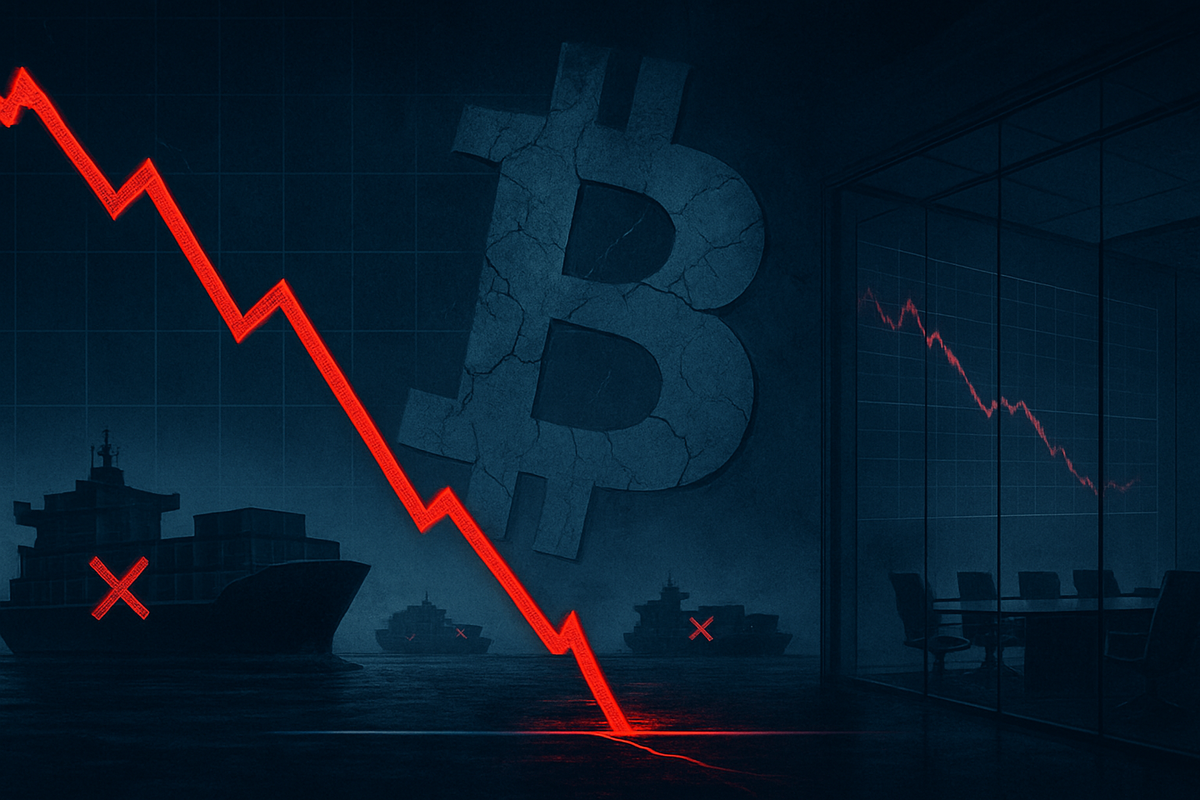
The cryptocurrency market faced a brutal reckoning on Tuesday as Bitcoin (BTC) slid to $63,067, marking its most significant monthly decline since the "crypto winter" of 2022. The digital asset, which had spent much of the previous year testing six-figure valuations, buckled under the weight of a sudden escalation in global trade tensions. As the U.S. administration moved to implement sweeping new tariffs, investors across the globe scrambled to exit speculative positions, sending shockwaves through both the crypto and equity markets.
The immediate implications of this slide are profound, as the "risk-off" sentiment has effectively dismantled the narrative of Bitcoin as a "digital gold" hedge against geopolitical instability. Instead, the asset has behaved as a high-beta proxy for the tech-heavy Nasdaq, falling in lockstep with growth stocks. For institutional holders and retail traders alike, the breach of the $63,000 support level signals a regime shift where liquidity—not scarcity—is the primary driver of price action in the current economic climate.
The Tariff Catalyst: A Timeline of the February Retraction
The catalyst for the current sell-off can be traced back to February 20, 2026, when a landmark Supreme Court ruling struck down previous emergency trade measures, prompting the administration to pivot to a more aggressive stance. On February 23, the invocation of Section 122 of the Trade Act of 1974 resulted in a 15% global tariff on a vast array of imported goods. This policy shift ignited immediate fears of a stagflationary spiral, where rising costs of goods meet slowing global growth, forcing a mass liquidation of risk assets.
Bitcoin’s reaction was swift and unforgiving. Within 48 hours of the announcement, the cryptocurrency tumbled from a weekly high of $67,600 to its current level of $63,067. This 6.7% drop contributed to a monthly loss that exceeds 25%, a level of volatility not seen since the collapse of major crypto exchanges four years ago. Market data indicates that over $500 million in leveraged long positions were liquidated in a single 24-hour window, further accelerating the downward momentum as automated margin calls hit the order books.
Key stakeholders, including institutional ETF providers and major corporate treasuries, have watched the correlation between Bitcoin and U.S. equities tighten to historic levels. While earlier in 2025 Bitcoin occasionally decoupled from the S&P 500 during periods of dollar weakness, the February 2026 "Tariff Reset" has seen it trade with a near-perfect positive correlation to the Nasdaq 100. As tech futures slid by 1.2% in pre-market trading, Bitcoin followed suit, proving that in a liquidity crunch, everything is sold to raise cash.
Corporate Fallout: MicroStrategy and the Leverage Trap
Perhaps no company is more exposed to this volatility than MicroStrategy (NASDAQ: MSTR), which has effectively transformed into a Bitcoin holding company over the last five years. As Bitcoin’s price cratered toward the $63,000 mark, MicroStrategy’s stock plummeted to approximately $122, a far cry from its 2025 highs of $542. The company, which recently rebranded its corporate identity to reflect its singular focus on "digital property," now faces a "valuation gravity" that is testing the resolve of its most ardent institutional backers.
Under the new FASB fair-value accounting rules, MicroStrategy is forced to mark its staggering 714,644 BTC holdings to market prices in real-time. The current slide has erased billions in paper gains, putting the spotlight on the company's $8.2 billion in senior convertible debt. While the company has maintained a $2.25 billion cash reserve to service its interest obligations through 2028, the "MSTR Premium"—the valuation gap between the stock price and the net asset value of its Bitcoin—has entirely collapsed. Investors who once paid a 2x premium for MSTR shares are now trading the stock at nearly a 1:1 ratio with its underlying BTC holdings.
Other industry players are also reeling. Crypto exchange Coinbase Global, Inc. (NASDAQ: COIN) saw its shares dip 8% as trading volumes shifted from speculative buying to panic selling, which typically yields lower long-term margins. Bitcoin miners like Marathon Digital Holdings (NASDAQ: MARA) are facing a "double whammy": the falling price of their primary output (BTC) combined with the rising cost of imported hardware components due to the very tariffs that triggered the market rout. For these companies, the path forward requires a drastic reduction in operational costs to survive a potentially prolonged period of suppressed prices.
A Wider Significance: The Death of the 'Digital Gold' Narrative?
This event marks a critical turning point in how the market views cryptocurrency within the broader financial ecosystem. For years, proponents argued that Bitcoin would serve as a "safe haven" during trade wars or currency devaluations. However, the February 2026 crash suggests that Bitcoin has been fully absorbed into the "macro collateral" bucket. When trade uncertainty triggers "equity stress," Bitcoin is now among the first assets to be liquidated by hedge funds and institutional desks to cover losses in traditional portfolios.
The ripple effects are likely to extend to regulatory and policy circles. The volatility sparked by the tariff announcements may give ammunition to regulators seeking stricter capital requirements for banks and fintech firms holding crypto assets. If Bitcoin continues to mirror the volatility of the tech sector rather than the stability of Gold (which rose 1.2% today as a defensive play), the argument for including BTC in conservative retirement portfolios may face renewed scrutiny from the Department of Labor and other oversight bodies.
Historically, this month’s performance mirrors the dark days of November 2022. However, the context is different: in 2022, the crash was driven by internal industry failures; in 2026, the crash is being driven by external macroeconomic policy. This suggests that the crypto market has matured to the point where it is no longer an "alternative" market, but a standard component of the global risk cycle—for better or for worse.
Looking Ahead: Strategic Pivots in a Protectionist Era
In the short term, the market will be looking for a floor. Technical analysts point to the $60,000 psychological level as the "line in the sand" for Bitcoin. If the 15% tariff remains in place or is expanded, the resulting inflationary pressure could force the Federal Reserve to maintain higher interest rates for longer, a scenario that historically bodes ill for non-yielding assets like Bitcoin. Investors should prepare for a period of "sideways-to-down" price action as the market digests the new trade reality.
Strategically, companies like MicroStrategy may need to pause their aggressive acquisition of Bitcoin to focus on balance sheet fortification. We may see a shift toward "yield-bearing" crypto strategies or a pivot toward infrastructure-based investments that are less sensitive to the daily spot price of BTC. For the broader market, the challenge will be to find a new value proposition that justifies Bitcoin's inclusion in a portfolio when it no longer offers the diversification benefits it once promised.
Wrap-Up: Navigating the New Macro Reality
The slide to $63,067 is more than just a price correction; it is a clear signal that the era of Bitcoin’s isolation from global trade policy is over. The "worst month since 2022" highlights the vulnerability of speculative assets in a world where protectionism and trade wars are returning to the forefront of economic strategy. The primary takeaway for investors is that Bitcoin’s correlation with risk assets is currently its most defining characteristic, overriding its "scarcity" narrative.
Moving forward, the market will likely remain highly sensitive to any rhetoric regarding trade negotiations or tariff exemptions. Investors should keep a close eye on the "MSTR Premium" and the performance of Gold relative to BTC as indicators of whether a decoupling is possible. For now, the "risk-off" sentiment dominates, and until the global trade picture clears, the path of least resistance for Bitcoin and related equities appears to be lower.
This content is intended for informational purposes only and is not financial advice.