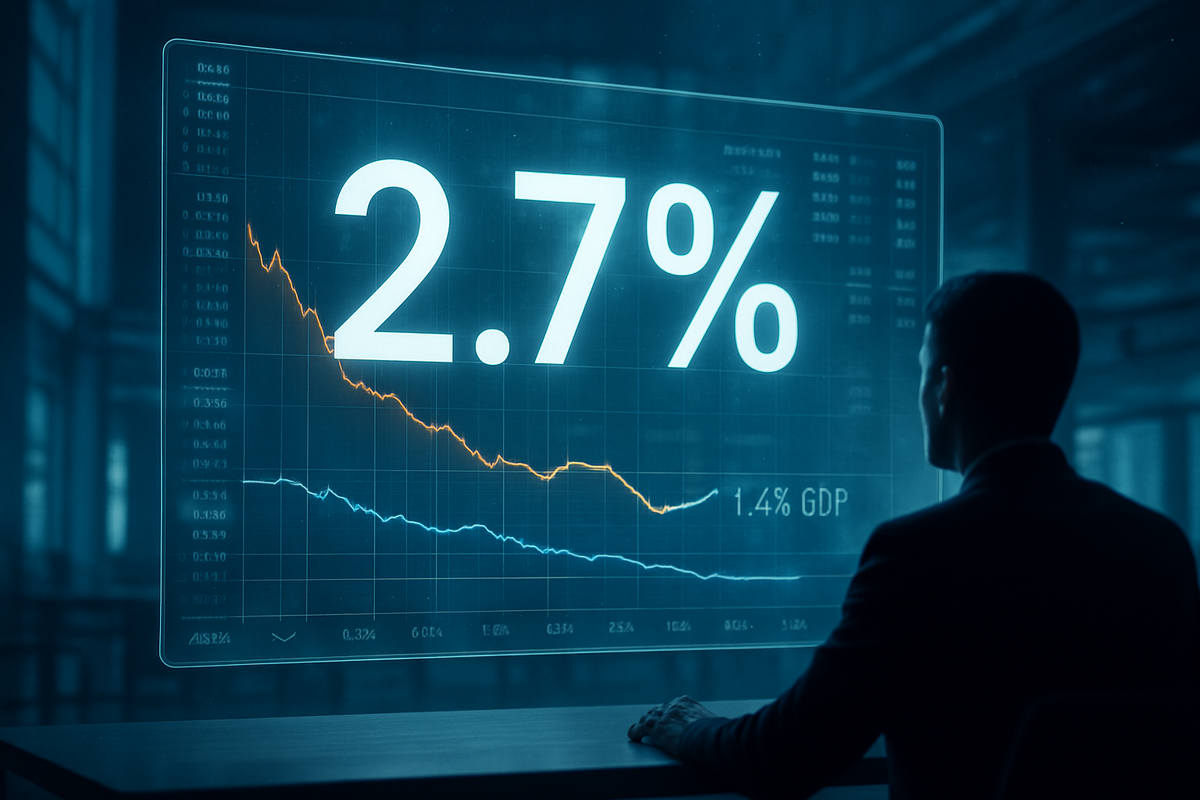
As of February 24, 2026, the global financial markets have entered a tense "wait-and-see" phase, caught between the cooling embers of 2025’s economic growth and a stubborn inflation floor that refuses to give way. Investors are currently navigating a landscape where the Federal Reserve’s preferred inflation gauge has stalled near 2.7%, well above the long-sought 2% target, creating a "hawkish hold" that has effectively neutralized expectations for near-term rate cuts.
The immediate implications are clear: the era of easy monetary pivots appears to be on an indefinite hiatus. With the second estimate of Q4 2025 GDP and the January 2026 Personal Consumption Expenditures (PCE) report both delayed until mid-March due to the administrative hangover of the late-2025 government shutdown, market participants are operating in a data vacuum. This uncertainty has spiked volatility in the bond market and left equity traders hesitant to commit to major positions, as the specter of "sticky" inflation threatens to keep interest rates in the 3.50% to 3.75% range for the foreseeable future.
The Resilience of the 2.7% Floor: A Timeline of Economic Friction
The current market paralysis is the culmination of a tumultuous six-month stretch. Following the resolution of the government shutdown in November 2025, the U.S. economy has struggled to find its footing. The "Advance Estimate" for Q4 2025 GDP, released just days ago on February 20, shocked analysts with a lackluster 1.4% annualized growth rate—significantly lower than the 2.8% consensus. This sluggishness, however, has not provided the traditional silver lining of lower prices. Instead, the "Liberation Day" tariffs implemented throughout 2025 have finally filtered through the supply chain, turning what was once a deflationary trend in goods into a persistent cost burden for consumers.
Key stakeholders, including Fed Chair Jerome Powell and Treasury officials, are now grappling with "Supercore" inflation—services excluding housing and energy—which saw a re-acceleration in early 2026. This resurgence was primarily fueled by soaring medical costs and airline fares, alongside a labor market that, while cooling to 50,000–60,000 new jobs per month, remains tight enough to keep the unemployment rate at a historically low 4.4%. The initial market reaction to this "stagflation-lite" environment has been a steady climb in the 10-year Treasury yield, as traders realize the Fed has little room to move until the March 13 "Super Friday" data dump.
Winners and Losers in the 'Higher-for-Longer' Equilibrium
In this climate of persistent rates and tepid growth, the financial sector finds itself in a position of relative strength. JPMorgan Chase & Co. (NYSE: JPM) and The Goldman Sachs Group, Inc. (NYSE: GS) have seen their net interest margins remain more resilient than previously forecasted, as the expected rate cuts for Q1 2026 have been priced out of the market. These institutions are benefiting from a yield curve that reflects a permanent structural shift in inflation expectations, allowing them to maintain higher lending rates even as loan demand softens slightly.
Conversely, the consumer discretionary and housing sectors are feeling the squeeze of the 2.7% inflation trap. Retail giants like Walmart Inc. (NYSE: WMT) are facing a dual threat: rising inventory costs due to the 2025 tariff regime and a consumer base whose real purchasing power is being eroded by sticky service costs. Similarly, homebuilders like D.R. Horton, Inc. (NYSE: DHI) are struggling to maintain sales momentum as mortgage rates refuse to retreat, locked in place by a Federal Reserve that cannot justify a cut while the "last mile" of disinflation remains elusive. Even high-growth tech firms like NVIDIA Corporation (NASDAQ: NVDA), while still buoyed by the AI revolution, are seeing their valuation multiples come under scrutiny as the "risk-free rate" remains stubbornly high, forcing investors to demand higher earnings yields to justify current prices.
Structural Shifts and the Ghost of '70s Inflation
The broader significance of the current 2.7% inflation reading lies in its structural nature. Unlike the transitory shocks of the early 2020s, the current "stickiness" is increasingly viewed as a byproduct of a deglobalizing economy. The transition from efficient, global supply chains to more localized, tariff-protected domestic production has created a permanent upward pressure on prices. This shift mirrors historical precedents from the late 1970s, where inflation became embedded in the service economy even as manufacturing struggled, leading to prolonged periods of restricted monetary policy.
Furthermore, the policy implications are reaching a boiling point. Regulatory bodies are now scrutinizing the "pass-through" effects of corporate price hikes, with some lawmakers calling for a re-evaluation of the Fed’s dual mandate. The Federal Reserve itself is in a "hawkish hold," with Governor Michael Barr and other officials signaling that the central bank is in no hurry to resume rate cuts. They view the current environment not as a temporary hurdle, but as a "new normal" where the 2% target might require significantly more economic pain—or a fundamental change in how "price stability" is defined in a post-tariff world.
The March 13 'Super Friday' and Beyond
As the market looks toward the end of the quarter, the focus is squarely on the rescheduled data release on March 13, 2026. This "Super Friday" will provide the definitive second estimate of Q4 GDP and the crucial January PCE figures. In the short term, if the PCE remains at or above 2.7%, we can expect a complete abandonment of rate-cut talk for the first half of the year. This would likely trigger a tactical rotation out of growth stocks and into defensive sectors such as utilities and consumer staples, as investors seek shelter from a potentially stagnant economy.
In the longer term, public companies will be forced to undergo strategic pivots. We are likely to see an increase in cost-cutting measures and a slowdown in capital expenditures as firms adapt to a high-cost-of-capital environment. Strategic adaptations, such as reshoring production to avoid tariffs or investing heavily in automation to offset wage-driven service inflation, will become the primary drivers of alpha for investors. The "wait-and-see" mode may end in March, but the challenges of a 2.7% inflation floor are likely to persist throughout the 2026 fiscal year.
Navigating the Stalled Recovery
The primary takeaway for investors on this February 24 is that the "last mile" of the inflation fight is proving to be the most difficult. The combination of a government-delayed data flow and a structural floor in prices has created a period of high uncertainty and low conviction. While the U.S. economy is not currently in a recession, the 1.4% GDP growth figure suggests that the margin for error is razor-thin, and any further hawkishness from the Fed could tip the scales toward a contraction.
Moving forward, the market will remain hyper-sensitive to any clues regarding the March 13 data release. Investors should watch the 10-year Treasury yield as a primary barometer of inflation expectations and pay close attention to management commentary from the upcoming earnings season regarding tariff impacts and wage pressures. The path to 2% is no longer a straight line; it is a grueling climb, and for now, the market is content to catch its breath and wait for the fog to clear.
This content is intended for informational purposes only and is not financial advice.