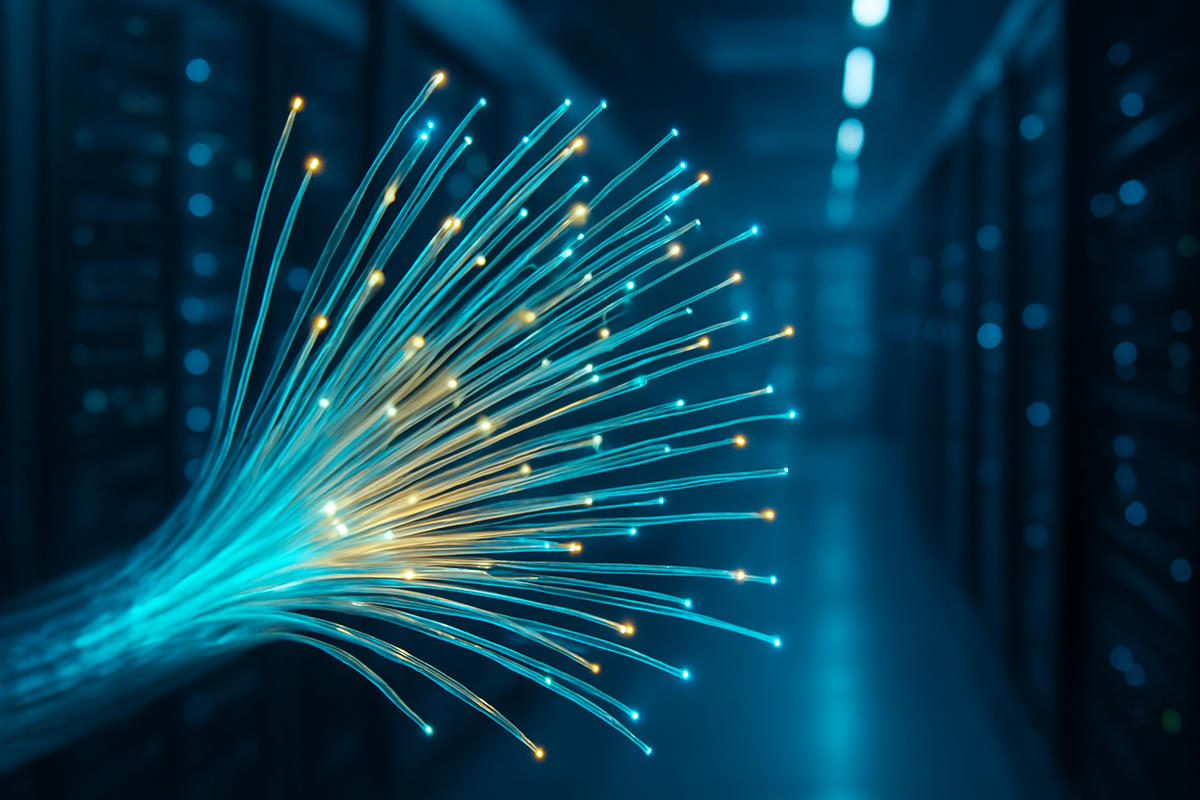
Shares of Corning Inc. (NYSE: GLW) surged over 7% in early trading today, February 24, 2026, reaching a new all-time high as investors recalibrate their valuation of the 175-year-old company. Long dismissed by Wall Street as a "boring glass manufacturer" tied to the cyclical whims of the smartphone and television markets, Corning has successfully reinvented itself as the indispensable "nervous system" of the artificial intelligence revolution. Today's rally follows a series of bullish analyst upgrades and the formalization of a landmark multi-year supply agreement with major hyperscale data center operators.
The immediate implication of this surge is a fundamental market re-rating. By crossing a critical technical resistance level, Corning has signaled that its "Springboard" strategic plan—once viewed with skepticism—is delivering far beyond initial projections. With operating margins hitting the 20% mark a full year ahead of schedule, the company is proving that the massive fiber density required for generative AI training is not just a temporary spike, but a structural shift in global infrastructure spending that favors Corning’s proprietary glass science.
The "Springboard" to AI Dominance
The catalyst for today’s movement can be traced back to the final execution phases of Corning’s "Springboard" framework. Originally launched to add $3 billion in annualized sales by the end of 2026, the plan was expanded multiple times throughout 2025 as the demand for AI-related connectivity far outpaced supply. In the fourth quarter of 2025, Corning reported that it had already integrated its latest high-density fiber solutions into several massive "AI Factories" being built across North America and Europe. This momentum culminated in early 2026 with a reported $6 billion deal with Meta Platforms (NASDAQ: META), which positioned Corning as the primary provider of optical connectivity for Meta's next-generation Llama-4 training clusters.
This transition was not an overnight success but the result of a multi-year pivot that began in mid-2024. During that period, Corning began securing long-term capacity reservations with telecommunications giants like Lumen Technologies (NYSE: LUMN), which famously reserved 10% of Corning’s global fiber capacity to support its own AI-focused backbone expansion. By early 2026, the timeline of events showed a clear pattern: Corning was moving away from selling bulk fiber and toward selling integrated optical "plugs and plays" that drastically reduce the labor required to build data centers, a move that significantly boosted their profit margins.
The key players in this shift extend beyond the C-suite in Corning’s New York headquarters. Collaborative engineering teams from Microsoft (NASDAQ: MSFT) and NVIDIA (NASDAQ: NVDA) have been working closely with Corning to develop "Hollow Core Fiber" and "Co-Packaged Optics." These technologies, which are just now reaching commercial scale in early 2026, address the "latency wall" that had threatened to slow down AI performance. Initial market reactions to these technical milestones have been overwhelmingly positive, with institutional investors shifting capital out of traditional hardware and into the connectivity layer where Corning holds a dominant intellectual property moat.
Winners and Losers in the Optical Arms Race
In the wake of Corning’s surge, the landscape of "AI winners" is being redrawn. While GPU manufacturers were the first to benefit from the AI boom, Corning’s success highlights that the connectivity layer is the next major frontier. Companies like Lumen Technologies (NYSE: LUMN) stand to win alongside Corning, as their massive investment in "dark fiber" routes becomes more valuable when equipped with Corning’s high-density cables. Similarly, Lumentum (NASDAQ: LITE) and Coherent (NYSE: COHR), which provide the lasers and transceivers that turn electrical signals into the light passing through Corning's glass, have seen their own shares buoyed by the "connectivity trade."
However, the shift creates potential losers among those who failed to innovate at the material science level. Traditional cable manufacturers who compete solely on price are being squeezed out of the high-margin AI data center market. These players lack the specialized "bend-insensitive" fiber technology that Corning (NYSE: GLW) uses to pack thousands of fibers into narrow conduits. Furthermore, international competitors like the Prysmian Group are finding it difficult to compete in the U.S. market due to the strict "Buy America" requirements of the federal BEAD (Broadband Equity, Access, and Deployment) program, which has reached peak funding distribution in 2026.
For investors, the distinction is becoming clear: companies that own the "physical layer" of the internet with high barriers to entry are the new defensive growth plays. The surge in GLW stock suggests that the market is finally penalizing companies that are stuck in the "commoditized" end of the hardware spectrum while rewarding those who, like Corning, have integrated their products directly into the proprietary architectures of the world’s largest tech companies.
A Structural Shift in Infrastructure Density
The significance of Corning’s 7% jump extends far beyond a single day’s trading; it represents a recognition of the "Fiber Multiplier" effect. Industry data from 2025 confirmed that AI-focused data center racks require between 10 to 36 times more fiber connectivity than traditional CPU-based servers. This exponential increase in density has forced a rethink of data center design. Corning’s ability to innovate at the chemical level—creating glass that can transmit data faster and in tighter spaces—has turned a 19th-century material into a 21st-century bottleneck-breaker.
This event fits into a broader industry trend where the "physicality" of the internet is reclaiming its importance. After decades of focus on software and "the cloud" as an abstract concept, the massive power and cooling requirements of AI have grounded the industry back in physical infrastructure. Regulatory and policy implications are also playing a role; the U.S. government's focus on domestic high-tech manufacturing has turned Corning’s expansive North Carolina facilities into strategic national assets, insulating the company from some of the geopolitical volatility affecting the semiconductor supply chain.
Historically, this pivot is reminiscent of the "Golden Age of Telecommunications" in the late 1990s, but with a crucial difference: profitability. Unlike the fiber build-out of the dot-com era, which was built on "if you build it, they will come" speculation, the current build-out is backed by the trillion-dollar balance sheets of hyperscalers with immediate, revenue-generating needs for AI compute. This makes the current surge in Corning (NYSE: GLW) appear more sustainable than the infrastructure booms of the past.
The Road to 2028: What’s Next for Corning?
Looking ahead, Corning is positioned to capitalize on two primary technological shifts: Hollow Core Fiber (HCF) and Co-Packaged Optics (CPO). In the short term, the rollout of HCF—where light travels through air rather than solid glass to reduce latency—will likely become the new standard for high-frequency AI training. As Microsoft and other partners begin full-scale deployment, Corning’s first-mover advantage in manufacturing this complex geometry will be a key metric for investors to watch throughout the remainder of 2026.
In the long term, the strategic pivot toward Co-Packaged Optics could redefine the server itself. By bringing the fiber connection directly onto the photonic chip, Corning and its partners are attempting to solve the massive power consumption issues currently plaguing the industry. If successful, Corning will move from being a provider of "cables between boxes" to a provider of "components inside the silicon," further increasing its content-per-server and expanding its total addressable market.
However, challenges remain. The rapid scaling of manufacturing capacity requires significant capital expenditure, and any slowdown in AI capital spending by the "Big Four" hyperscalers would pose a risk. Investors will be watching for potential "digestion periods" where the industry takes a breath after the current frantic build-out. Nonetheless, Corning’s upgraded target of $11 billion in incremental annualized sales by 2028 suggests that the company sees a long runway for this "glass-to-AI" transition.
Wrap-Up and Investor Outlook
Corning’s 7% surge on February 24, 2026, marks the definitive end of its era as a cyclical glass company. The key takeaway for the market is that connectivity is no longer a commodity; it is a specialized, high-margin component of the AI stack. By successfully executing the "Springboard" plan and hitting its 20% operating margin target ahead of schedule, Corning (NYSE: GLW) has proved that its material science expertise provides a durable competitive advantage that is difficult for competitors to replicate.
Moving forward, the market will likely view Corning as a structural AI play, potentially trading at multiples more in line with high-growth tech companies than traditional industrial manufacturers. Investors should keep a close eye on the progress of the BEAD program's domestic deployments and the quarterly sales growth in the Optical Communications segment, which is now the undisputed engine of the company. As the digital world demands more "bandwidth at the edge," Corning’s ability to manipulate light through glass has never been more valuable.
This content is intended for informational purposes only and is not financial advice.