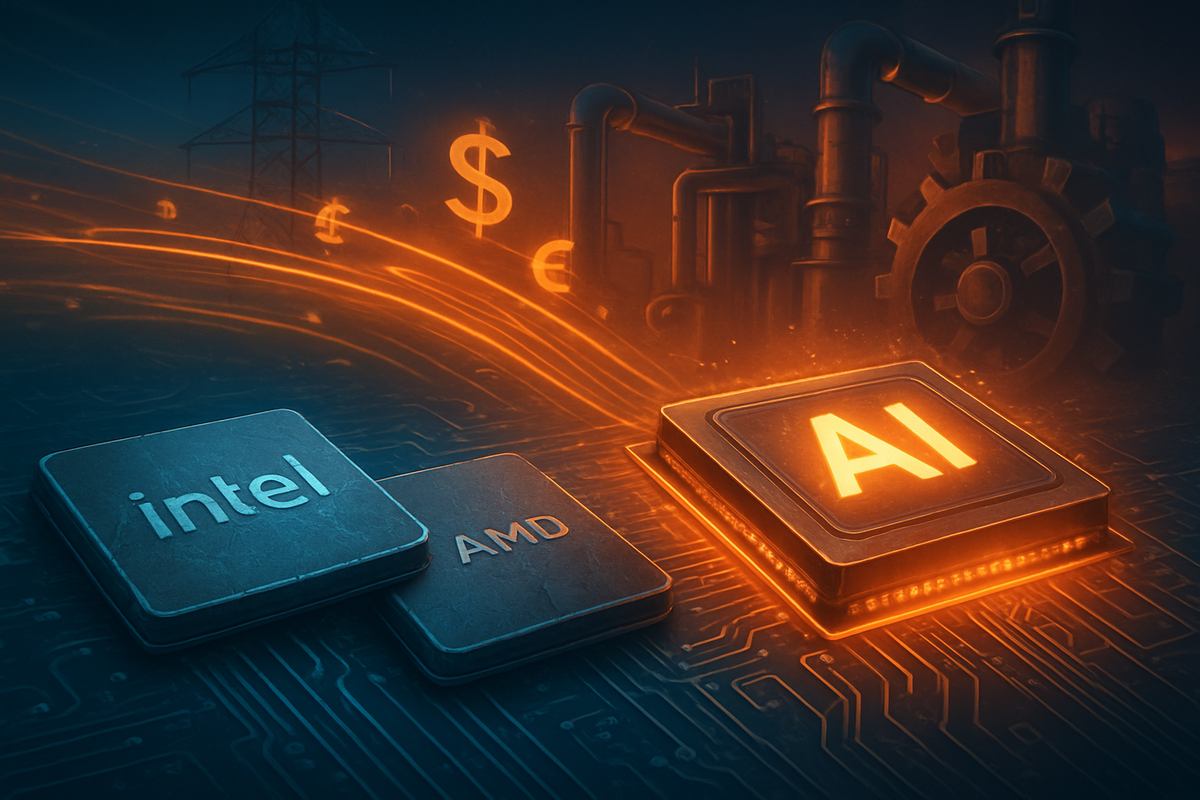
The semiconductor darlings of the AI era faced a harsh reality check on Friday, March 20, 2026, as Intel Corporation (NASDAQ: INTC) and Advanced Micro Devices, Inc. (NASDAQ: AMD) saw their stock prices tumble amid a perfect storm of rising competition and a massive shift in investor sentiment. Intel shares fell 5% to settle near the $44 mark, while AMD dipped 3%, slicing through the critical $200 support level that technical analysts had closely watched throughout the first quarter.
This downturn marks a pivotal moment for the chip sector, which has dominated Wall Street’s narrative for the past three years. The immediate catalyst appears to be a dual-pronged pressure: a "sector-wide rotation" away from pure-play digital technology toward physical infrastructure, and a relentless product offensive from NVIDIA Corporation (NASDAQ: NVDA) that has left traditional CPU giants scrambling to justify their lofty valuations. As the "AI gold rush" transitions from speculative growth to hardware deployment, the market is beginning to separate the structural winners from those struggling with manufacturing bottlenecks.
The volatility on March 20 was punctuated by a series of events that converged to rattle investor confidence. For Intel, the pressure mounted following a disappointing outlook for the first quarter of 2026. Despite the high-profile launch of its Clearwater Forest (Xeon 6+) server CPUs at the Mobile World Congress earlier this month—the first major product built on the ambitious 18A process node—the company’s foundry division continues to be a financial drag. Reports of a $2.51 billion operating loss in the foundry segment for the previous quarter have fueled fears that the "IDM 2.0" strategy is consuming more capital than it is currently generating.
AMD’s slide was triggered by a different set of challenges. While the company reported record data center revenue for the end of 2025, leaked reports in late February suggested that its highly anticipated Helios rack-scale AI platform, featuring the MI455X accelerator, might face mass production delays into the second half of 2026. This news hit just as hyperscale customers—the massive cloud providers that drive volume—began looking for alternatives to ensure their AI roadmaps remain on schedule.
Compounding the sector’s woes was a localized scandal involving Super Micro Computer, Inc. (NASDAQ: SMCI). News broke on the same day regarding a federal indictment of several employees for allegedly bypassing export sanctions to sell high-end AI servers to restricted markets. This sent a shiver through the entire AI supply chain, as investors feared a broader regulatory crackdown that could stifle international sales for all U.S.-based chip designers.
The current landscape suggests a widening gap between those who own the "Inference Era" and those fighting for general-purpose market share. NVIDIA Corporation (NASDAQ: NVDA) appears to be the primary beneficiary of the current turmoil. At its GTC 2026 conference this month, NVIDIA unveiled its Vera Rubin platform, which integrates an 88-core Vera CPU with its next-gen GPUs. This move directly invades the server CPU territory traditionally held by Intel and AMD, offering a unified architecture that appeals to data centers looking to minimize latency. Furthermore, NVIDIA’s acquisition of the startup Groq has allowed it to integrate the Groq 3 LPU (Language Processing Unit), which offers a 35x efficiency advantage for AI inference over traditional silicon.
Conversely, Intel and AMD find themselves in a precarious position. Intel’s pivot to becoming a global foundry is a high-stakes gamble that requires massive government subsidies and flawlessly executed manufacturing. While the "One Big Beautiful Bill Act" (OBBBA) passed in late 2025 provides significant domestic manufacturing tax credits, Intel has yet to prove it can compete on yield and cost with established giants like Taiwan Semiconductor Manufacturing Company (NYSE: TSM). AMD, while still a formidable competitor in the GPU space, is increasingly feeling the heat from custom silicon developed in-house by "The Big Three" cloud providers—Amazon, Google, and Microsoft—who are moving toward their own ARM-based chips for routine AI tasks.
The "winners" of this specific rotation are unexpectedly found outside the tech sector. As investors pull capital from "Bits" (software and chips), they are moving into "Atoms"—the physical commodities required to power the AI revolution. Companies in the energy, copper mining, and electrical grid infrastructure sectors have seen a surge in interest. This shift, dubbed the "Great Rotation," highlights a growing realization that AI chips are only as useful as the power grids that support them, a bottleneck many are now calling the "Power Wall."
The pressure on Intel and AMD reflects a broader structural change in the global economy. For years, the market assumed that the demand for AI compute would be infinite and unconstrained. However, by March 2026, the reality of physical limitations has set in. Geopolitical tensions, including the recent supply chain disruptions in the Strait of Hormuz, have spiked energy prices to $120 per barrel, making the energy efficiency of chips a survival metric rather than a marketing bullet point.
This event also echoes historical precedents, such as the post-dot-com bubble correction where the market moved from valuing "clicks" to valuing "cash flow." Today, the market is moving from valuing "TFLOPS" (computing speed) to valuing "Deployment Capacity." If a company cannot secure the megawatts required to run its chips, those chips represent a stranded asset. This realization is forcing a re-evaluation of the entire semiconductor stack, favoring those with the most efficient architectures like ARM Holdings (NASDAQ: ARM) over legacy x86 designs.
Regulatory pressures are also mounting. The SMCI scandal serves as a reminder that the "AI arms race" is intrinsically tied to national security. As the U.S. government tightens the net on advanced technology exports, the total addressable market for companies like Intel and AMD may shrink, leading to a "valuation reset" across the industry. This environment favors companies with diversified revenue streams and strong domestic footprints that are insulated from the volatility of international trade politics.
Looking ahead, the short-term outlook for Intel and AMD remains cloudy. Intel must demonstrate that its 18A process can achieve high-volume manufacturing without further delays or capital calls. If the company can secure a major "anchor tenant" for its foundry services by the end of Q2 2026, it may regain the trust of Wall Street. For AMD, the priority is the successful rollout of the Helios platform. Any further delays could allow NVIDIA to monopolize the next generation of AI clusters, leaving AMD to fight for the scraps of the mid-range market.
In the long term, we may see a strategic pivot toward "Edge AI" and localized processing. As data center power costs soar, the industry will likely shift focus toward chips that can perform AI tasks on-device—phones, laptops, and industrial machinery—where power constraints are different. This could provide an opening for Qualcomm and Apple to challenge the data center giants, creating a new front in the semiconductor wars.
Investors should prepare for a period of "AI Realism." The era of "rising tides lifting all boats" in the chip sector is over. Moving forward, the market will likely reward companies that can solve the "Power Wall" and provide specialized, energy-efficient silicon rather than those offering general-purpose hardware. The competition is no longer just about who has the fastest chip, but who can deliver the most compute per watt in a resource-constrained world.
The events of March 20, 2026, serve as a stark reminder that even the most successful market sectors are subject to the laws of physics and economic cycles. The dip in Intel and AMD stock is not merely a technical correction but a symptom of a deeper shift in how the world values technology. As the "Great Rotation" into energy and infrastructure continues, the chip sector must prove it can adapt to a world where power is as precious as processing speed.
Key takeaways for the coming months include monitoring the performance of Intel’s 18A yields and watching for any further fallout from the SMCI export investigation. Furthermore, the integration of Groq’s technology into NVIDIA’s stack will be a major indicator of whether legacy architectures can survive the inference-heavy future of AI.
For the savvy investor, the current pressure may represent a buying opportunity in the long term, but only for those companies that are truly "grid-ready." The days of ignoring the "Atoms" in favor of the "Bits" are officially behind us.
This content is intended for informational purposes only and is not financial advice.