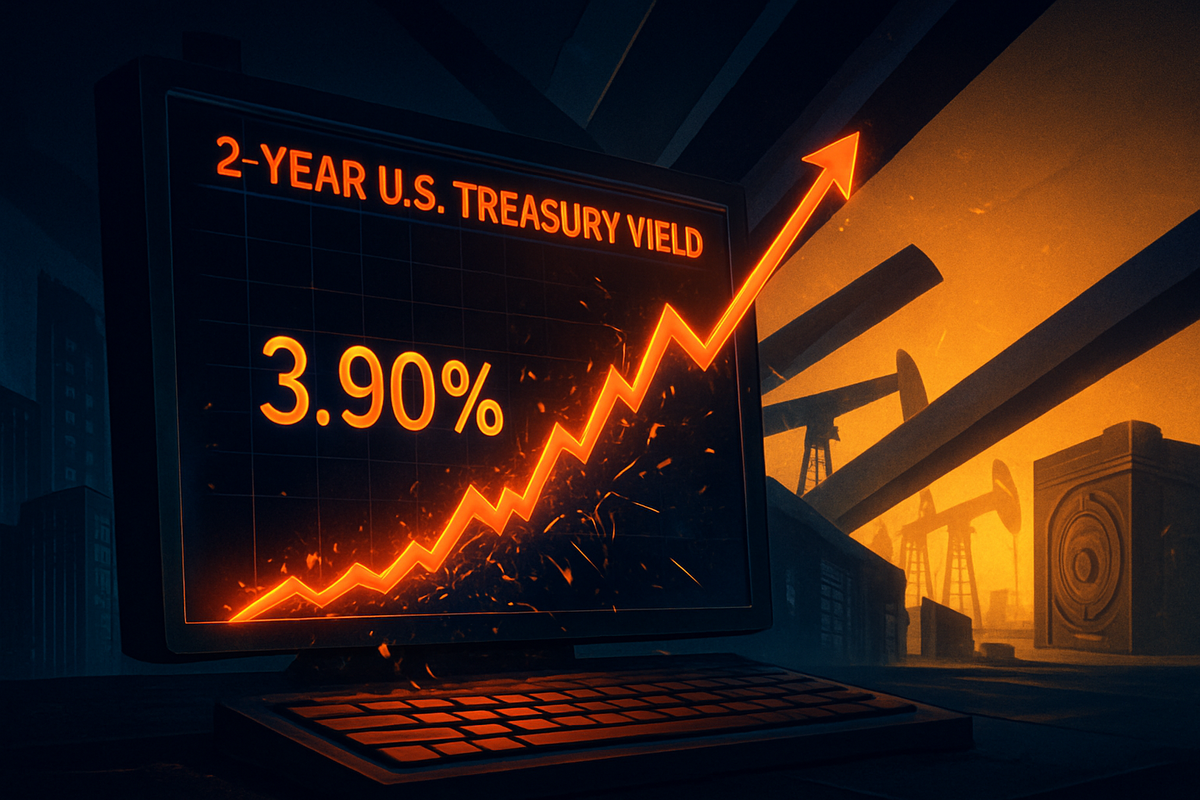
The era of easy-money anticipation has met a violent end on Wall Street this week. On March 20, 2026, the yield on the 2-year U.S. Treasury note surged to a multi-month high of 3.90%, effectively dismantling investor hopes for a series of Federal Reserve interest rate cuts throughout the remainder of the year. This aggressive repricing of the "short end" of the curve follows a week of hotter-than-expected inflation data and a hawkish stance from the central bank, signaling that the "higher-for-longer" regime is not a temporary posture, but a structural reality.
The immediate implications are being felt across the equity markets, where the "valuation gravity" of nearly 4% risk-free returns is pulling the air out of high-multiple growth stocks. The Nasdaq Composite fell over 2% in mid-day trading as the 10-year Treasury yield also broke toward 4.39%, creating a pincer movement that has forced fund managers to aggressively rotate out of speculative tech and into tangible assets like energy and large-cap financials.
The Perfect Storm: Inflation, Energy, and a Hawkish Fed
The surge to 3.90% on the 2-year yield was catalyzed by a convergence of geopolitical and economic shocks that caught markets off-guard. The primary driver was the sudden escalation of conflict in the Middle East, which led to strikes on critical energy infrastructure and pushed Brent crude prices toward $120 per barrel. This "energy-driven inflation" immediately translated into a spike in the February Core PCE (Personal Consumption Expenditures) index, which rose to 3.1%—significantly above the Federal Reserve’s 2% target.
Leading up to this moment, the market had been pricing in at least three rate cuts for 2026, betting on a "soft landing" scenario. However, the Federal Open Market Committee (FOMC) meeting on March 18, 2026, delivered a sobering reality check. Fed Chair Jerome Powell and the board held the benchmark rate steady at 3.50%–3.75% and revised their "dot plot" to suggest that only one cut—at most—remains on the table for the year. This hawkish recalibration was further fueled by a disastrous $16 billion 20-year bond auction in late February that "tailed" significantly, indicating that institutional demand for U.S. debt at lower yields has vanished.
The internal division within the Fed has also become public, with some hawkish members reportedly suggesting that if energy prices do not stabilize, the next move might be a rate increase rather than a cut. This uncertainty has spiked the MOVE Index, a measure of bond market volatility, to its highest level since the regional banking crisis of 2023, leaving investors scrambling to hedge against a "no landing" economic scenario.
Winners and Losers: From 'Bits to Atoms'
The violent shift in yields has created a stark divergence in the equity markets, marking a transition from the digital growth obsession of the early 2020s to a "tangible economy" focus. The primary losers are the mega-cap technology firms that have led the market for years. NVIDIA (NASDAQ: NVDA) has seen its valuation come under intense pressure; after a meteoric rise fueled by artificial intelligence, the stock is now grappling with "AI ROI Fatigue." As the discount rate rises, investors are less willing to pay premium multiples for NVDA’s future earnings, leading to a contraction in its forward P/E to the 24x–29x range. Similarly, Apple (NASDAQ: AAPL) and Microsoft (NASDAQ: MSFT) have struggled, with AAPL facing the dual headwind of higher borrowing costs for consumers and a valuation that analysts now call "unsustainable" in a 4% yield environment.
Conversely, the "Winners" of this regime change are those that benefit from inflationary pressures and rising rates. ExxonMobil (NYSE: XOM) has emerged as the premier inflation hedge, with its stock rallying 25% year-to-date as it captures windfall profits from $110+ oil. The energy giant is projected to generate over $50 billion in cash flow for the 2025-2026 period, making it a magnet for capital fleeing the tech sector.
Large-cap financials are also seeing a resurgence. JPMorgan Chase (NYSE: JPM) and Bank of America (NYSE: BAC) are leveraging the "higher-for-longer" environment to expand their Net Interest Margins (NIM). JPM, in particular, has been dubbed a "Financial Fortress," with projections of over $100 billion in Net Interest Income for 2026. While higher yields typically pressure the broader economy, these institutions are currently capturing "volatility alpha" and benefiting from a steepening yield curve that favors traditional lending models.
A Structural Shift in Market Dynamics
This event marks a significant departure from the "Great Moderation" that defined the pre-2020 era. The current yield surge fits into a broader trend of "Bits to Atoms," where the physical limits of the economy—energy production, grid capacity, and raw materials—are once again dictating market performance. The "Power Wall" has become a central theme in 2026, as data center expansion for AI faces physical constraints from an aging power grid, further shifting investor focus from chip designers to energy providers and utility firms.
Historically, when 2-year yields sustain levels near 4% while inflation remains "sticky" above 3%, it signals a regime of structural volatility. Comparisons are being made to the late 1970s and early 1980s, though the modern economy is far more leveraged. The ripple effects are already being seen in the commercial real estate sector, where companies like American Tower (NYSE: AMT) and Prologis (NYSE: PLD) are facing higher refinancing costs, potentially leading to a wave of credit downgrades later this year.
Furthermore, the "One Big Beautiful Act" (OBBBA)—the massive fiscal package passed in late 2025—is now being viewed through a more critical lens. While it initially fueled consumer spending, it is now being blamed for keeping the economy "too hot," essentially forcing the Fed's hand to keep rates elevated. This fiscal-monetary tension is a new paradigm for 2026 investors to navigate.
The Road Ahead: September or Never?
Looking forward, the market is now fixated on the September 2026 FOMC meeting as the last possible window for a rate cut this year. However, several hurdles remain. Short-term, the market must digest a flurry of labor data; if initial jobless claims remain near the current 213,000 level, the Fed will likely maintain that the labor market is "too tight" to justify easing.
Strategic pivots are already underway. Many growth-oriented hedge funds are shifting toward "Value-Plus" strategies, looking for companies that offer both moderate growth and high dividend yields—a rare combination in the current environment. A potential market opportunity is emerging in "Energy Infrastructure" and "Grid Modernization" plays, which are seen as essential to overcoming the "Power Wall" that is currently throttling the AI revolution.
If the 2-year yield breaks above 4.00% in the coming weeks, we may see a "Value Tantrum" where even the strongest tech names face double-digit drawdowns. Conversely, a stabilization of oil prices could provide the necessary relief for the Fed to soften its tone. For now, the "No Landing" scenario—where the economy continues to grow despite high rates—is the dominant narrative, but it remains a precarious balance for the market to maintain.
Conclusion: A New Baseline for Investors
The surge in Treasury yields to 3.90% represents more than just a bad week for bonds; it represents a fundamental repricing of risk for the year 2026. The key takeaway is that the "Fed Pivot" is no longer a viable investment strategy. Investors who spent the last 18 months waiting for a return to 2% rates are being forced to accept a new baseline where capital has a significant cost and "AI hype" must be backed by tangible "AI margins."
Moving forward, the market will likely remain in a state of "valuation discovery." The dominance of mega-cap tech is being challenged by the resurgence of the "Atoms" economy—energy, materials, and financials. Investors should keep a close watch on the monthly PCE data and geopolitical developments in the Middle East, as these will be the primary drivers of yield volatility through the summer. The transition may be painful for growth-heavy portfolios, but it is a necessary recalibration for a global economy that is finally learning to live without the crutch of zero-interest rates.
This content is intended for informational purposes only and is not financial advice