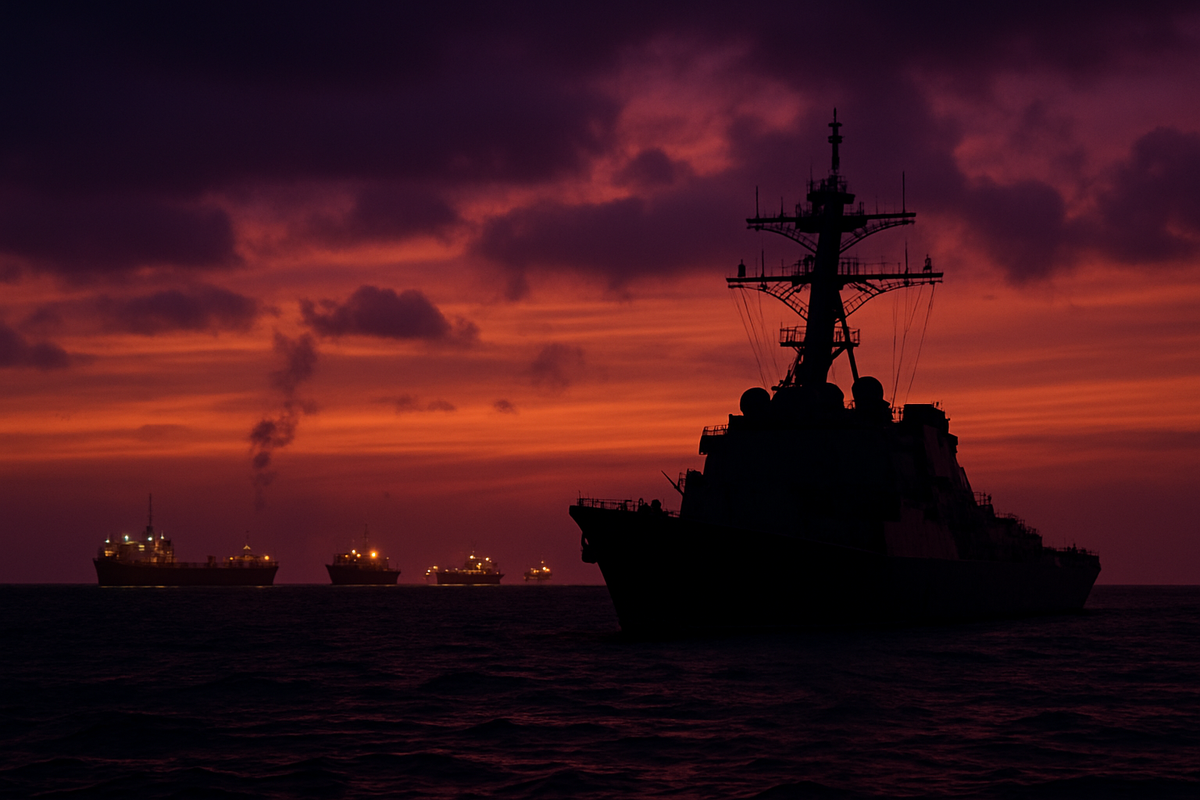
As of late March 2026, the global economy stands on the precipice of a systemic energy shock following the functional closure of the Strait of Hormuz. Following a series of high-intensity military exchanges between the United States, Israel, and Iran, the world’s most critical maritime chokepoint has seen tanker traffic plummet by over 90%. What began as a "shadow war" in 2024 and 2025 has escalated into a direct conflict, leaving approximately 21 million barrels of oil and 20% of the world’s liquefied natural gas (LNG) stranded behind a naval blockade.
The immediate implications are staggering: Brent crude prices have surged toward the $100 per barrel mark, while insurance premiums for any vessel attempting to navigate the Persian Gulf have quintupled in a matter of weeks. For major Asian economies—specifically China, India, and Japan—which rely on the Strait for over 80% of their energy imports, the blockade represents an existential threat to industrial stability. In the West, the shock is being felt through a localized spike in fuel prices and a massive capital rotation into defense and domestic energy sectors as investors scramble to hedge against a prolonged regional war.
Escalation in the Gulf: A Timeline of Conflict
The current crisis is the culmination of a multi-year breakdown in Middle Eastern diplomacy. While 2024 was defined by "gray zone" tactics—such as the brief seizure of the MSC Aries and Houthi-led disruptions in the Red Sea—the situation fundamentally shifted in June 2025 during the "Twelve-Day War." This brief but violent conflict involved Israeli and U.S. airstrikes (Operation Rising Lion) on Iranian nuclear enrichment facilities in Fordow and Natanz. Though a tenuous ceasefire held through the winter of 2025, the maritime environment remained highly volatile, with the United Nations confirming 17 separate incidents of damage to merchant ships in early 2026 alone.
The definitive break occurred on February 28, 2026, when the U.S. and Israel launched Operation Epic Fury, a massive strike campaign following intelligence reports of imminent IRGC mobilization. The operation resulted in the death of Iran’s Supreme Leader, Ali Khamenei, prompting the Islamic Revolutionary Guard Corps (IRGC) to declare the Strait of Hormuz a "closed combat zone." By March 11, the commercial vessel Mayuree Naree was struck by projectiles and abandoned, effectively halting all non-military commercial traffic. As of March 30, 2026, U.S. naval forces are currently engaged in intensive minesweeping operations and carrier-led strikes on IRGC bases in Bandar Abbas to forcibly reopen the waterway.
Key stakeholders, including the UN and the International Energy Agency (IEA), have called for an immediate cessation of hostilities, but the regional power vacuum created by the leadership change in Tehran has made diplomatic outreach nearly impossible. Major shipping conglomerates, led by A.P. Møller – Mærsk A/S (OTC: AMKBY), have officially suspended all transits, rerouting global logistics chains and adding weeks to delivery times for goods moving between Europe and Asia.
Winners and Losers: Market Segmentation in a War Economy
The closure has created a stark divide in the equities market, with defense contractors and domestic U.S. energy producers emerging as the primary beneficiaries. RTX Corporation (NYSE: RTX) has seen its shares reach all-time highs, climbing over 6% in March as demand for its Patriot and AMRAAM missile defense systems skyrocketed. Similarly, Lockheed Martin (NYSE: LMT) and Northrop Grumman (NYSE: NOC) have reported record-breaking backlogs, currently totaling over $280 billion combined, as the Pentagon ramps up procurement for high-end naval and air superiority platforms.
In the energy sector, the "decoupling" of U.S. shale from Middle Eastern risk has turned domestic drillers into safe havens. EOG Resources (NYSE: EOG) and ExxonMobil (NYSE: XOM)—the latter now benefiting from its massive 2024 acquisition of Pioneer Natural Resources assets—are generating unprecedented free cash flow. With Brent crude near $100, these companies are shielded from the physical blockade while reaping the rewards of higher global pricing. Conversely, European majors like Shell (LSE: SHEL) and TotalEnergies (NYSE: TTE) face significant headwinds due to their deep involvement in Qatari LNG projects, which are currently unable to reach global markets.
The most severe losses are being felt in the transportation and aviation sectors. Delta Air Lines (NYSE: DAL) and United Airlines (NYSE: UAL) have been hammered by a near-doubling of jet fuel prices in March 2026. Delta recently reported that its fuel expenses are rising by $40 million for every one-cent increase in fuel costs, leading to a massive contraction in profit margins and the implementation of emergency "war-risk" surcharges on international tickets. Shipping firms like Frontline PLC (NYSE: FRO) and DHT Holdings (NYSE: DHT) are also seeing extreme volatility; while their "war-risk" revenue has spiked, the total volume of oil they can physically move has plummeted, threatening their long-term dividend stability.
Geopolitical Shifts and the Future of Energy Security
This event fits into a broader trend of "weaponized interdependence," where critical trade chokepoints are used as primary levers of geopolitical influence. Historically, the threat of closing the Strait was viewed as a "nuclear option" that Iran would never truly exercise for fear of total economic collapse. However, the events of 2025 and early 2026 suggest a shift toward a "scorched earth" strategy by regional actors who feel they have little left to lose. This mirrors the 1973 oil embargo in its scale but is compounded by the modern global reliance on just-in-time manufacturing and high-frequency energy trading.
The policy implications are likely to be permanent. Regulatory bodies in the U.S. and EU are already drafting emergency legislation to accelerate the transition to non-hydrocarbon energy sources, not just for environmental reasons, but as a matter of national security. Furthermore, the crisis has exposed the fragility of the "Blue Economy," prompting a massive reinvestment in naval capabilities by nations that had previously de-emphasized maritime defense. The historical precedent of the "Tanker War" in the 1980s is being studied closely, but the current conflict’s use of hypersonic missiles and autonomous drone swarms makes the 2026 landscape far more lethal for commercial shipping.
The Path Forward: Scenarios and Strategic Pivots
In the short term, the market's focus will remain on the U.S. Navy's ability to clear the Strait of mines and IRGC fast-attack craft. If the waterway remains functionally closed through the summer of 2026, we could see a global recession as energy costs trickle down into every sector of the consumer economy. A "successful" reopening of the Strait would likely involve a massive, permanent international naval presence, turning the Persian Gulf into the most heavily militarized zone in human history.
Strategic pivots are already underway. Multi-national corporations are shifting supply chains away from the "Hormuz-dependent" route, favoring land-based corridors through Central Asia or the costly Cape of Good Hope detour. For investors, the "energy transition" is no longer a 20-year horizon—it is a current-year necessity. Companies that can provide localized energy solutions, such as modular nuclear reactors or large-scale battery storage, are likely to see a surge in venture capital and government subsidies as nations seek "energy island" status.
Market Outlook and Final Thoughts
The closure of the Strait of Hormuz in March 2026 is a watershed moment for global finance. It has proven that geopolitical risk can no longer be "priced in" as a mere footnote; it is now a central driver of valuation across every asset class. The key takeaway for investors is the definitive end of the era of "cheap energy security." Whether the Strait reopens tomorrow or in six months, the psychological and structural damage to global trade routes is done.
Moving forward, the market will be characterized by extreme volatility in commodities and a continued premium on U.S.-based industrial and defense stocks. Investors should closely monitor the "Breakout" capacity of U.S. shale and the speed of naval de-mining operations in the Gulf. The lasting impact will be a world that is more fragmented, more expensive, and more focused on securing the physical lanes of trade that were once taken for granted.
This content is intended for informational purposes only and is not financial advice.